Monday, 21 Septenber 2026 — Struggle / La Lucha
President Donald Trump says the U.S. war on Iran will end “immediately after” the Nov. 3 midterm elections. His own officials describe another possibility.
U.S. officials told Axios on Sept. 17 that Trump could resume major combat operations after the midterms if Iran has not accepted a deal. Trump and War Secretary Pete Hegseth have ordered U.S. forces in West Asia held at their current levels through the end of the year, ready for renewed war.
At the same time, the Trump administration is preparing a $2.8 billion transfer to Israel containing 40,000 one-ton bombs and 20,000 penetrator warheads.
The war is in an armed pause forced by Iranian retaliation and the depletion of U.S. interceptor stocks. Trump is arranging his next decision around the election calendar. The U.S. government opened this war on Feb. 28 to overthrow Iran’s government and take back its oil. It has done neither.
Forty thousand one-ton bombs
The Washington Post first reported the proposed transfer on Sept. 15. It has been submitted informally to Congress but is not yet final.
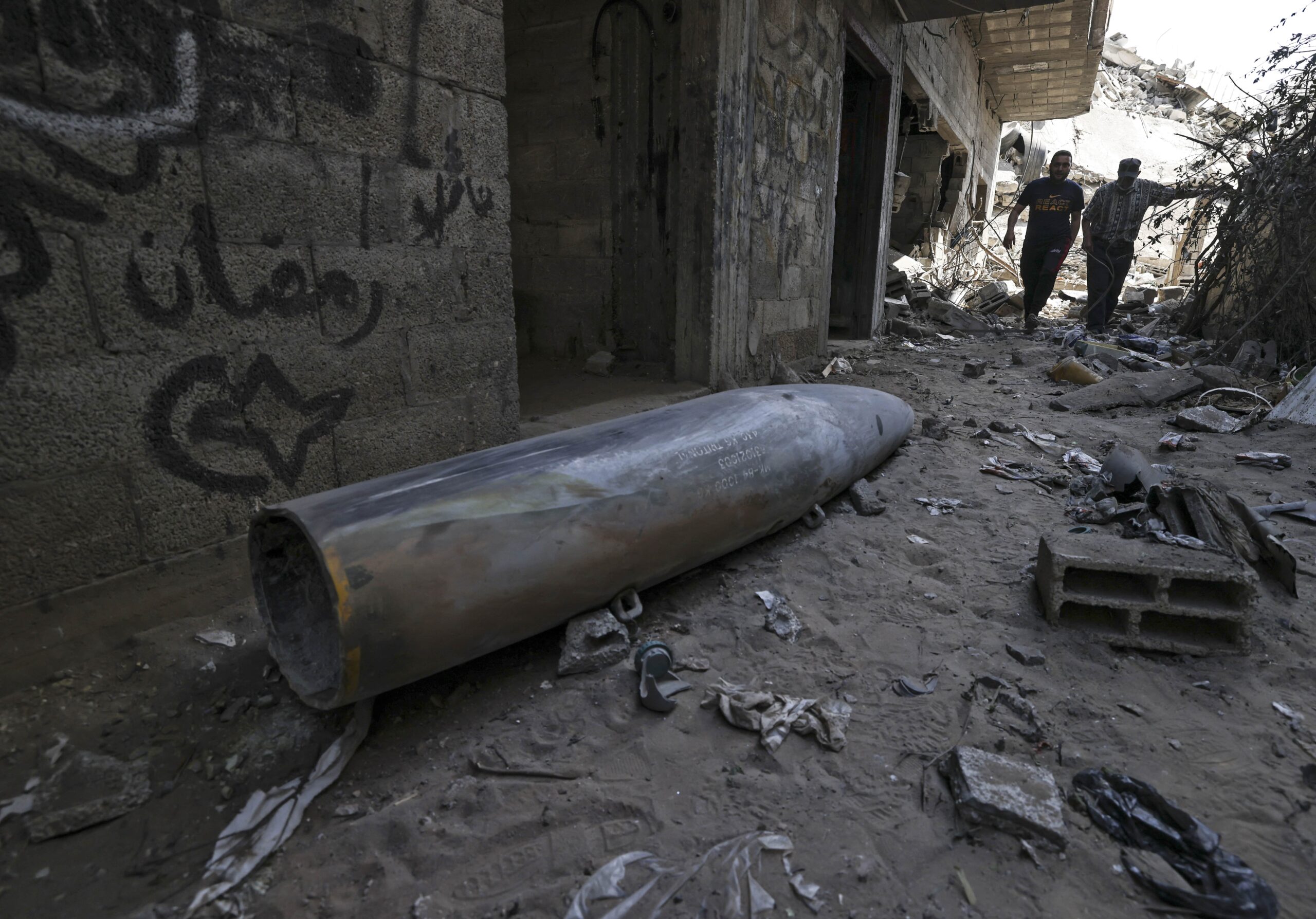
The package includes 20,000 MK-84 bombs and 20,000 BLU-117s. Each weighs 2,000 pounds. The BLU-117 is a version of the MK-84 with thermal protection for storage aboard ships.
The package also includes 20,000 I-2000 penetrator warheads. They are designed to break through soil, rock or concrete before exploding. Their targets include hardened underground sites like those the Pentagon has bombed in Iran since Trump launched the war on Feb. 28 and the bunkers Israel attacks in Lebanon.
The proposed transfer follows a $2.04 billion package approved under emergency authority in February 2025, which contained more than 35,000 of the same one-ton bombs and 4,000 penetrator warheads. If the new transfer goes through, the two Trump packages will have given Israel more than 75,000 one-ton bombs in less than two years.
An MK-84 blast throws metal fragments hundreds of yards and can tear through concrete and leave a huge crater. Israel has dropped hundreds of these bombs on Gaza. It has dropped them on the areas where it had ordered Palestinians to go for safety.
An armed holding pattern
Trump held off on another round of major attacks in early August after Saudi Arabia and Qatar warned that Iran would retaliate against Saudi oil and gas facilities.
The U.S. government has continued its naval blockade of Iranian ports, suspended negotiations and imposed new sanctions. The Pentagon has kept its forces assembled for a return to full-scale combat.
Iranian retaliation has forced the Pentagon to burn through the interceptors protecting U.S. bases and Israel. It has used up nearly four-fifths of its THAAD interceptors and half of its Patriot interceptors. Every new round of U.S. bombing would draw further Iranian attacks and drain those stocks further. Mark Cancian of the Center for Strategic and International Studies said this depletion was a major reason Trump held off on another round of major attacks. Rebuilding the stockpiles will take years.
Forces kept in place, stocks that take years to rebuild, a war that has not achieved its aims. An army in that position could be pulled out. The price of that is set in Tehran. Iran’s terms for reopening the Strait of Hormuz are that the U.S. leave the region, release the Iranian money it has seized and lift the sanctions it has piled on for 46 years. Meeting them would mean giving up what successive U.S. governments have fought for since the 1979 revolution took Iran’s oil out of imperialist hands. Refusing them leaves the Strait closed. The Gulf monarchies that host the U.S. bases are watching which way it goes.
What Trump suspended was the next round of major attacks. The bombing has continued. On Sept. 1, U.S. forces struck about 100 targets in Iran. They also hit the engine rooms of two Iranian oil tankers, the first strikes under a policy Trump approved: U.S. forces answer any Iranian action by destroying the tankers that carry Iran’s oil. On Sept. 5, after Iranian forces fired ballistic missiles at a U.S. aircraft carrier and a destroyer, U.S. forces disabled two more tankers and sank a third. On Sept. 8, after an Iranian attempt to strike another U.S. warship, they destroyed five more tankers. The naval blockade of Iran’s ports now extends to the ships carrying its oil.
Officials told Axios that the military cannot be held this way much longer without a decision. On Sept. 20, Trump said he was considering destroying Iran, letting its economy rot or making a deal. “If and when do I blow the entire nation up? They better behave,” he told Fox News. He was talking about a country of 90 million people.
Iran’s military command said it had information that another U.S. attack was being prepared. The State Department issued a security alert for U.S. citizens across West Asia warning of possible escalation, flight cancellations and airspace closures.
Iran’s top security official, Mohsen Rezaei, says Iran has sent terms for resuming negotiations through Qatar and Pakistan: end the fighting on all fronts, release Iran’s frozen assets and lift the U.S. naval blockade. He said Iran is waiting for Trump’s response.
On Sept. 22, Trump is scheduled to meet the heads of six U.S.-backed Gulf monarchies at the United Nations in New York: Saudi Arabia, the United Arab Emirates, Qatar, Bahrain, Kuwait and Oman. They hold their thrones under U.S. protection, and U.S. bases sit on their territory. Any resumed assault would need those bases and their airspace. Iran has already demonstrated that the bases and the oil installations around them can be hit in return.
The new weapons package would replenish Israel for further attacks on Iran, Lebanon and Gaza. It would keep the bombing capacity in place whether Trump resumes full-scale U.S. attacks or continues the holding pattern.
Bombs beneath the talk of ‘strain’
The Washington Post and The New York Times reported the bomb package alongside accounts of Trump’s frustration with Israeli Prime Minister Benjamin Netanyahu and what the Post called “unprecedented strain” between the two governments.
Nothing in those accounts describes a change in what the two governments do together. The Trump administration launched the war on Iran. U.S. aircraft carriers, bases and the blockade fleet sustain it, and the Pentagon is holding its forces in place for another round. Israel serves as the forward military base that the U.S. government arms for the same war.
What the strain stories accomplish is to put distance between Trump and the bombs. They appeared in the same week as the 40,000-bomb package, and they let Trump be reported as frustrated with Netanyahu while he arms him.
Government money for U.S. arms makers
The Post and the Times call the proposed transfer a sale. Israel would pay for it with Foreign Military Financing — money Congress appropriates for Israel to purchase U.S. weapons.
Nearly nine-tenths of the $3.8 billion in annual U.S. military aid to Israel comes through this financing. The money passes through Israel on paper and goes to U.S. arms manufacturers such as General Dynamics, which produces the MK-84 bomb body.
Israel receives the bombs. U.S. weapons corporations receive government money.
Congressional review has not stopped the weapons. In April, the Senate rejected resolutions to block about $450 million in bombs and bulldozers for Israel. Secretary of State Marco Rubio can declare an emergency and send the weapons without any review, as he did for the $2.04 billion bomb package approved in 2025. The Biden administration declared the same emergency twice during the Gaza war.
War prices before the vote
The election calendar hangs over the military holding pattern because the war has already reached the fuel, food and transportation on which daily life depends.
The average U.S. diesel price reached a record $6.29 a gallon during the week of Sept. 14, two-thirds higher than a year earlier and well above the previous record, set in June 2022. In California, the statewide average passed $8.
The increase comes from the war on Iran and Ukrainian attacks on Russian refineries. Iran holds the door to the Strait of Hormuz, and a fifth of the world’s oil moves through it.
Diesel runs the trucks, trains, ships, combines and tractors. A South Dakota corn, soybean and cattle farmer told Reuters that fueling one combine could cost him $1,500 a day, twice what he paid last year.
The cost of trucking produce out of California has risen by 40% to 120% on some routes. Independent truckers buy fuel before they are paid for hauling the load. A freight analyst at DAT warned that many face bankruptcy.
Most food moves by truck. Higher diesel prices enter the cost at every step between the field and the grocery store.
Refining margins on diesel have reached record levels. Tanker owners now collect more than $1 million a day to charter some ships through the Strait of Hormuz, five times the prewar rate.
Truckers, farmers and shoppers pay more. Refiners and shipping interests collect the proceeds.
U.S. refiners have continued exporting diesel to Europe. Senate Majority Leader John Thune says he is “open to considering” an export ban.
Meanwhile, the Strategic Petroleum Reserve has fallen to 285 million barrels, its lowest level since November 1982.
The U.S. Treasury borrows to pay for the war, and the banks and bondholders lending the money are charging it more. The war and the price of oil are why.
On Sept. 15, the same day the 40,000 bombs for Israel became public, the government agreed to pay more than 5 cents a year for every dollar it borrowed for 20 years — nearly three times what it paid five years ago. Over those 20 years, every $1 billion in bonds will cost the government more than another $1 billion in interest. It pays the lenders more than it borrowed. That morning, Treasury Secretary Scott Bessent had told Congress that recent sales of government debt were the “most successful” in 20 years.
The rise in interest rates does not stop with government debt. New mortgages cost more. Credit-card balances become harder to carry. Companies already loaded with debt must pay more to refinance it, pushing the weakest toward bankruptcy and putting jobs and wages at risk.
The Pentagon spends government money on war. Arms manufacturers take the contracts. Refiners, tanker owners and the banks lending the money collect the profits. Working people face higher prices, higher interest charges and threatened layoffs.
After the ballots are counted
The White House is drafting plans for West Asia after the present stage of the war. They center on containing Iran and pushing more Arab governments into formal relations with Israel.
Israel votes on Oct. 27 and the U.S. midterms are Nov. 3.
When the ballots are counted, the U.S. war machine will still be in place. But it was Iranian resistance, not ballots, that forced the pause in major attacks.
Trump opened this war on Feb. 28 to overthrow Iran’s government and take back its oil. Seven months later, Iran’s government stands, Iran’s oil is Iran’s, and Iran holds the door to the Strait of Hormuz.
The Pentagon has fired off four-fifths of its THAAD interceptors and half of its Patriot interceptors, and the arms industry cannot replace them fast enough to protect U.S. bases from the retaliation another full-scale assault would bring. Trump is holding U.S. forces in place through December and preparing to send Israel 40,000 bombs for the wider war he threatens.
Join the Struggle-La Lucha Telegram channel

 The New Dark Age
Leave a comment