Thursday, 12 November 2026 — Weaponised Information
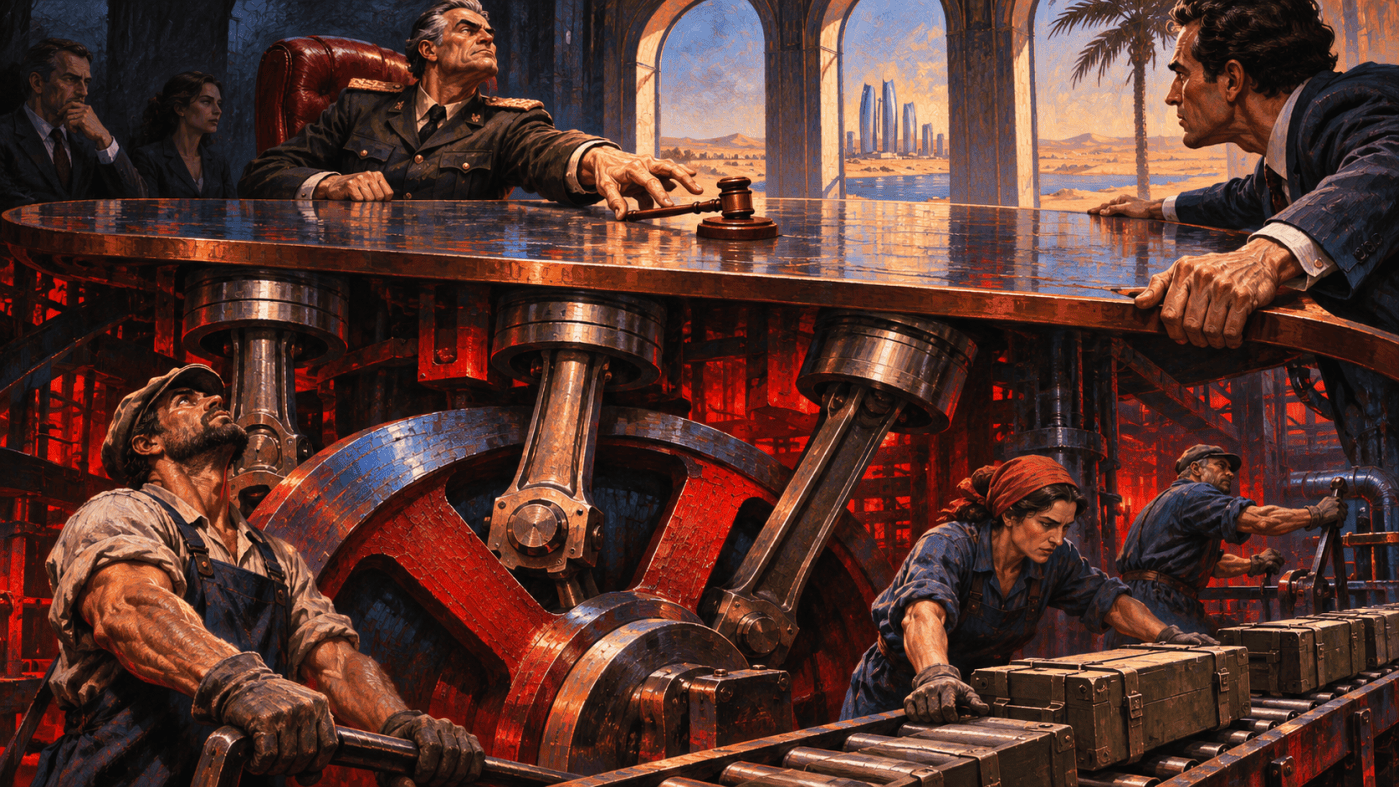
When Russia forced the terms of European security onto the table at Abu Dhabi, two Atlanticist columnists had a hell of an answer: put NATO’s commander in charge of the peace talks. Washington built that alliance’s power while capitalist restoration weakened Russia, and now it wants European treasuries to carry more of the cost while NATO keeps its hand on the weapons pipeline. Russian resistance opened room to bargain over that power, and the terms of any deal will show who can actually restrain it. For the workers who make the weapons, move the freight, and pay the bills, the fight over peace starts with who gets to decide what all that labor is for.
Prince Kapone | Weaponized Information | November 12, 2026
The Alliance Calls Its Own Power “Security”
Mark Toth and Jonathan Sweet tell you whose peace they want in the last two sentences of their November 12 column, Trump’s Yalta: Witkoff and Kushner Get Played Yet Again in Abu Dhabi. General Alexus Grynkewich should take over from the two U.S. envoys. “His job is to defend NATO and not to sell it out to Putin.” There’s the job description. Put the commander of the alliance in charge of talks about the exercise of its military power, then judge the talks by how much of that power he keeps off the table. The column calls that defending Europe. The general already has an institution to defend, and the authors have helpfully told him which one.
Watch what happens to the words European security on the way to that conclusion. Toth and Sweet tell us that discussing Europe’s security architecture is “code for NATO.” They’ve made an entire continent’s security synonymous with one military alliance. From there, giving Russia a say in the discussion becomes a threat to the alliance’s future. The authors themselves say all 32 NATO members would get a vote. By the end, they’re railing against Russian “say-so, let alone a veto.” The veto is the specter. The thing they’re already furious about is that Moscow got to raise the question. Once you’ve decided who owns European security, even hearing from somebody outside the club starts to look like giving away the damn property.
Yalta gives that complaint a picture. The headline puts the reader in a room where great powers are already carving up somebody else’s future. Inside the column, Toth and Sweet quote Putin’s charge that Ukraine was being prepared as a “springboard against Russia,” call his argument “entirely nonsense,” and steer the reader toward Kyivan Rus and his supposed ambition to reconstitute the Warsaw Pact. The charge about the military use of territory gets answered with a story about one man’s appetite for an old map. That’s how a military alliance built through decisions by governments, backed by public money, and run through a chain of command gets to sit there like part of the fucking landscape. All the ambition belongs to the man who objects to it.
The casualty figures serve the same argument. The column moves from its claim that Russia’s army is “getting wiped out” straight into a cumulative figure and a single day’s toll. The precision gives the verdict the look of a calculation. Its political use is plain. If Moscow has no strength to bargain with, any ground it gains in the discussion must’ve been handed over by gullible envoys. The dead and wounded get pressed into service as witnesses to something the figures can’t tell us about what happened at the table.
That’s what Russophobia buys the defenders of Atlantic command. They get to treat their own military power as the standing definition of security, explain resistance to it through the character of a Russian leader, and call in a general when diplomacy puts that power up for discussion. Their whole argument depends on a right they take for granted. How did Washington acquire the authority that Toth and Sweet treat as its birthright?
How Washington Acquired the Power It Calls the Rules
Washington extended that power while Russia was living through the wreckage of capitalist restoration. Yeltsin’s government privatized public assets and put wealth built by generations of Soviet workers into capitalist hands. The United States kept its military alliance and expanded it eastward. Russia’s state later recovered leverage over strategic assets, including oil. As Tony Wood documents in Russia Without Putin, that recovery went alongside business tax cuts and a labor code that weakened workers’ rights. The state could bring oil assets back under its influence while employers gained power over labor. The same workers who’d lost their claim on public property were expected to applaud the recovery of state power as if it were their own.
The 2002 NATO–Russia Council gave Moscow a role in joint decisions on agreed matters and preserved each side’s freedom to act independently. NATO kept expanding. At Bucharest in 2008, it declared that Ukraine and Georgia would become members. That commitment entered a country with political struggles of its own. Andrew Wilson documented how rival accounts of Donbas history were already being used in the early post-Soviet years to press competing claims about the region’s place in Ukraine and its ties to Russia. As military integration deepened, the question of alignment acquired consequences you could count in weapons, training, and commitments about who might fight alongside whom.
Moscow’s 2009 draft security treaty sought wider obligations among states. Its 2021 draft agreement put specific restraints on paper. It called for an end to NATO enlargement and proposed that Russia and the states already in NATO in May 1997 limit deployments in other European states to that date’s baseline, with exceptions requiring every party’s consent. In the disputed April 2022 Istanbul draft, Moscow proposed requiring all guarantors to agree before assistance could be provided under the guarantee if Ukraine came under attack. Had that provision been adopted, Russia could’ve blocked assistance under that treaty. That’s what a consent rule looks like when somebody’s actually put the damn thing on paper.
At the November 10–11 Abu Dhabi talks, Russia and Ukraine reached a prisoner-exchange agreement in principle. An earlier truce at Oleshky had already shown what a limited agreement could deliver. Ukraine’s human rights commissioner reported that aid reached the town and civilians were evacuated. At Abu Dhabi, Vladimir Medinsky put a wider European security framework at the center of Russia’s account of the talks. Jared Kushner publicly outlined reciprocal de-escalation measures. He separately described the U.S. request for Moscow to put forward proposals and take steps to lower tensions. Kyiv’s position put Ukraine’s security guarantees at the center of what would follow a deal.
European officials took part in separate consultations. Ukrainian negotiator Davyd Arakhamia counted bringing Europeans into the process among the round’s results. Kushner called for Europe to have a seat. Kremlin spokesman Dmitry Peskov said the format for possible Russia–Europe talks was still unsettled. Grynkewich attended the opening. The public record establishes who raised these questions and who was in the room. It contains no agreed clause that gives Moscow authority over a NATO decision.
The column’s two casualty figures come from Ukraine’s General Staff. Its November 11 release estimated 2,580 Russian personnel losses the previous day and about 1.61 million since February 24, 2022. On the Russian side, Dmitry Medvedev reported about 200,000 Defense Ministry contract signings in the first half of 2026. Estimated personnel losses and reported contract signings cover different periods and measure different things. You can’t use them to calculate how Russia’s deployable strength changed or explain why Moscow came to the table.
Washington’s strategy papers give us something firmer. The 2025 National Security Strategy calls for an end to hostilities in Ukraine, strategic stability with Russia, and greater European responsibility for defense. The 2026 National Defense Strategy sets out greater allied burden-sharing alongside U.S. priorities in the homeland and Indo-Pacific. Follow the money through NATO’s Prioritised Ukraine Requirements List. Ukraine identifies its operational needs. Grynkewich validates packages in coordination with Ukraine and the United States. Allies fund the packages, and NATO coordinates delivery. The Netherlands paid for the first one in full.
European governments also exercise authority through the EU. Its Council authorized €4.7 billion in reimbursements covering part of the cost of military aid member states had already delivered. Before the talks opened, the Council extended the EU training mandate and authorized a coordination presence in Ukraine. The mandate places training on EU member-state territory and provides for cooperation with NATO’s training command. Washington could convene a round with European governments outside the trilateral room. Any settlement that asks them to spend money, train forces, or guarantee military commitments still depends on what they authorize. When Washington tells Europe to carry more of the load, who gets to decide where it’s carried?
Empire Can Bargain and Still Keep Its Hands on the Levers
Washington wants Europe to carry more of the load because military command costs money and somebody’s got to appropriate it. When allied treasuries pay for U.S.-sourced arms, they turn public revenue into demand for the output of the U.S. arms industry. NATO command helps turn that expenditure into military power by coordinating where the equipment goes. The people who make and move it do the work. Governments and military commands decide what that work will serve. That’s a class relation as much as an alliance arrangement. A treasury can pay the bill while a command headquartered elsewhere helps direct what the money puts in motion.
The United States built up that power during a period when capitalist restoration had weakened Russia’s ability to contest it. Every eastward extension of NATO put more decisions about European military power inside institutions Washington helped direct. Russia’s recovery of state authority over strategic assets gave it more capacity to resist that expansion. So the alliance’s advance helped produce the resistance its defenders now invoke to justify its reach. The sequence matters. Washington enlarged the military order while Moscow was weak. Once Russia could impose costs on the exercise of that power, the United States had to reckon with demands it had once been freer to brush aside. Abu Dhabi put the terms of that power into the bargaining itself.
The U.S. administration’s published strategy gives de-escalation and allied rearmament room to coexist. It can seek a settlement that reduces the immediate costs of the European confrontation while keeping the arms supply and command relationships that make renewed pressure possible. Toth and Sweet’s prescription would put the officer who helps run those relationships in charge of the talks. That’s the institutional difference the column buries under its story about two envoys getting fooled. The administration’s course leaves room to bargain over how Atlantic power gets exercised. The column wants Atlantic command to police the bargaining from the start. The general’s supposed advantage is that he comes to the table with the interests of his command already settled. Some damn qualification for deciding how far that command should reach.
That’s the European side of Fortress America. Washington’s drive to secure its hemispheric base goes hand in hand with a division of military labor across the American Pole. If European allies take on more financing, training, and military support, the United States has more room to concentrate its resources where its strategy says it wants them, including the Indo-Pacific. That’s where the New Cold War enters this argument. The power to sustain pressure in one theater depends partly on who can take up the work in another. But European governments have to authorize the money and make the commitments Washington wants them to carry. The more the arrangement depends on what they can deliver, the more they can bargain over what they’ll agree to deliver. The empire would like the capacity without the politics. Good fucking luck.
So judge a settlement by what it lets people do. If it limits deployments, which forces does it cover, and who can enforce the limit? If it creates a guarantee, who can authorize assistance, and whose refusal can stop it? Governments can accept a restraint in one agreement and retain considerable power through the budgets, supply arrangements, and commands that agreement leaves available. Russia’s achievement at Abu Dhabi was to make the wider military order a subject of bargaining. A change in who can deploy forces, authorize assistance, or block a decision would be a further gain, and it would have to be won in the terms themselves.
There’s a class question on the Russian side of that opening. The state’s recovery of authority over strategic property gave the country greater means to resist subordination. The same reconstruction of state power preserved private appropriation and strengthened employers against labor. A Russian worker can fight the imperial pressure brought against the country and fight the boss who takes the surplus that worker produces. Both struggles concern who has the power to decide what the country’s productive capacity is for. In Ukraine, that question will be fought over in reconstruction as well as diplomacy. Who’ll own what gets rebuilt? Who’ll direct the funds, set the terms of employment, and decide which communities get the resources to live again? A government can sign a guarantee. The people who’ll rebuild the country need their own organized power over what follows.
That’s the political opening multipolarity gives us. When Washington has to bargain over decisions it once had greater freedom to make, there’s more room to defend national sovereignty. The struggle over who uses that room runs through workplaces, public budgets, and control of property. Sovereignty can give a government more freedom to direct investment. Working people have to fight for the power to direct it themselves. In the Atlantic countries, that fight begins where our own governments put public money and other people’s labor at the service of military command. Every appropriation has an authority behind it. Every arms order has workers behind it. Those are places to organize against the power that claims the right to set everybody else’s terms of peace.
The People Who Pay for the War Have a Claim on the Peace
In the United States, there’s a budget fight workers can enter now. Congress’s stopgap funding runs through December 11, and the House Appropriations Committee has reported its FY 2027 Pentagon bill. CODEPINK is already organizing through its Cut the Pentagon campaign. Bring that fight into a union meeting. Move a resolution against expanding Pentagon appropriations and send a delegation to your House member and senators before they vote on the next funding package. Demand that they publish the military spending they’re backing and oppose increases. If they tell you the money’s for security, ask them to put the purpose, the amount, and who gets to spend it in writing. They can spare ten damn minutes for the people whose work pays for it.
Bring the workers who build, maintain, and move the equipment into that fight from the start. They’ve got rent due even when an order dries up. An arms contractor can point to the payroll every time it wants another public contract. Give the people on that payroll some power over what the plant makes. At the bargaining table, demand that employers guarantee jobs, wages, and benefits during conversion and give elected shop-floor representatives a say in the plan. In Congress, demand money for civilian orders that can keep those shops working. A machinist needs to know what’ll be on the line when the military order ends. Congress can put rail equipment or electrical machinery on the order book if it’s willing to put public money behind it.
The people living through the war have demands of their own. The Russian and Ukrainian authorities responsible for prisoners should carry out the exchange and give families reliable information about relatives still held. Both governments should keep aid moving and protect civilians who need to leave. Here, we can press Congress to demand disclosure of proposed U.S. military guarantees and insist that the administration bargain for reciprocal, verifiable restraints on deployments. Defend Russia’s sovereignty against imperial coercion and uphold the right of Ukrainian workers and communities to decide who controls the money, land, and labor that’ll rebuild their towns. A peace agreement opens that fight over reconstruction. The people doing the rebuilding need the power to carry it through.
After the funding vote, bring the record back to the hall. Keep the delegates in place, bring more shops into the fight, and put the conversion demands on the bargaining agenda. The people who make the equipment and move the freight already make the machinery run. The power to decide what it runs for is worth organizing to take.


Leave a Reply