9 November 2012 — Fairness and Accuracy in Reporting
Different standards for different elections–and parties
When it comes to explaining election results, there’s no precise way to determine whether voters gave the winner a “mandate”–defined by Oxford as “the authority to carry out a policy, regarded as given by the electorate to a party or candidate that wins an election.” That makes it interesting to see how media use the expression–and which presidents they think earned one.
In 2004, George W. Bush won 50.7 percent of the popular vote over Democrat John Kerry, and had a 286-251 edge in electoral votes. As FAIR noted (Media Advisory, 11/5/04), many outlets proclaimed that to be a “mandate.” “Clear Mandate Will Boost Bush’s Authority, Reach,” read a USA Today headline (11/4/04); NPR‘s Renee Montaigne said (11/3/04), “By any definition, I think you could call this a mandate.”
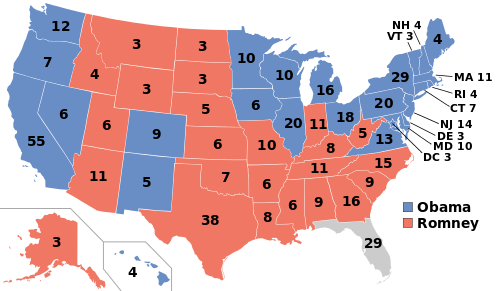
So this week Barack Obama won re-election; before the Florida results were final, he had a 303-206 electoral vote advantage and 50.5 percent of the popular vote. What do you call that? For a lot of people in the media, definitely not a mandate.
On CBS Evening News (11/7/12), Bob Schieffer declared, “In the hard world of American politics, the president did not get a mandate yesterday.” On the NPR website (11/7/12), a headline was “For Obama, Vindication, but Not a Mandate.” The Washington Post‘s Dan Balz (11/7/12) called it “an uncertain mandate, although Obama will attempt to claim one.” While USA Today declared Bush’s 2004 victory a mandate, the front-page of the paper the day after the election bore the headline “A Nation Moving Further Apart.”
Glenn Thrush of Politico (11/7/12) wrote that Obama‘s “hard-won victory seemed too narrow and too rooted in the Democratic base to grant him anything close to a mandate–much less the popular support needed to break the deadlock of Washington partisanship as he promised during the campaign.” The racial subtext of the “Democratic base” echoed the pre-election analysis of Politico‘s Jim VandeHei and Mike Allen (11/5/12), who wrote:
A broad mandate this is not.
For a proper mandate, CNN pundit David Gergen (11/6/12) declared that Obama needed to win “by a much more convincing national margin,” adding:
Fox News conservative Charles Krauthammer (11/6/12) told viewers: “I think the real story here is that Obama won, but he has got no mandate. He won by going very small, very negative, and we are left as a country exactly where we started but a little bit worse off.” Krauthammer’s reaction to Bush’s narrow victory in 2004 was different (Fox News, 11/3/04):
When you have a popular vote majority, which is unusual in our time, over 50 percent, 51.5 percent–we haven’t had that since ’88–and you expand your representation in the House and the Senate, in an election where the president ran on the record an on the stuff he says he’s going to do in the future, you’ve got a mandate.
If Obama does have a mandate, what might it be to do? CNN pundit Gloria Borger (11/7/12) put it this way: “So what kind of a mandate does he have? His mandate is to fix things. And I think that’s about as far as it really goes.”
And Time magazine’s Joe Klein (11/7/12) declared that “the election was a mandate for moderation,” adding:
So the “will of the people” is for politicians to enact policies that are deeply unpopular? For a lot of pundits, that seemed to be the message, one that could be wrapped up in rhetoric about the need to end Beltway divisiveness. As Washington Post columnist Kathleen Parker (11/7/12) put it, “If this election provided any mandate at all, it is that we set aside our special interests and work together before it’s too late.”
On NPR (11/7/12), Cokie Roberts lamented the divide in the country, and defined the task for Obama this way:
That is a curious notion about how politics work: that the politician who wins an election should quickly move to satisfy voters who did not support his agenda. But for many in corporate media, that is what centrism is all about–when the politician is a Democrat.

 The New Dark Age
Leave a comment