Thursday, 28 May 2026 — Struggle / La Lucha
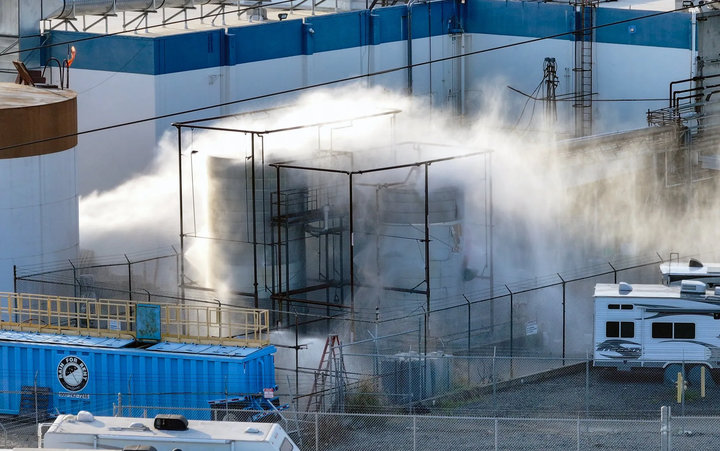
For nearly a week, 50,000 residents of Garden Grove, California — a working-class immigrant city in Orange County — were driven from their homes by a chemical emergency at an aerospace plant manufacturing components for F-35 fighter jets and other military aircraft.
On the night of May 26, the last evacuation orders were finally lifted. No one has been held accountable. The plant has not been shut down. The Pentagon contracts continue.
The incident at GKN Aerospace Transparency Systems in Garden Grove began May 21 when a storage tank containing methyl methacrylate (MMA) — a volatile, highly flammable chemical used to manufacture cockpit canopies for military aircraft — began overheating uncontrollably. MMA undergoes a self-accelerating polymerization reaction: the hotter it gets, the faster it reacts; the faster it reacts, the hotter it gets.
Unchecked, the result is a BLEVE — a Boiling Liquid Expanding Vapor Explosion. Had the tank exploded, the danger would not have stayed inside the plant fence. It would have reached homes, schools and small businesses across a densely packed evacuation zone. Orange County District Attorney Todd Spitzer called the situation “irresponsible” and “horrific.”
A catastrophic explosion was averted only by a fortunate accident: officials said a crack in the tank appeared to relieve pressure that had been building for days. Officials later said monitoring showed no release of contamination or fumes. But that did not make the crisis imaginary. For days, residents were driven from their homes because the tank could rupture, spill thousands of gallons of MMA or explode. There were no guaranteed hotel rooms for the people forced out.
The company behind the tank
GKN is not a household name. But its parts go into front-line U.S. and allied warplanes, including the F-35. The Garden Grove facility manufactures stretched acrylic canopies for the F-16, F-15, F/A-18 and F-35 — the F-35s used to bomb Gaza.
GKN is owned by Melrose Industries, a Britain-based holding company. Melrose’s slogan is “buy, improve, sell.” In practice, that means buying industrial companies, cutting jobs and costs, raising profits and selling at a gain. Melrose took over GKN in 2018 in a hostile takeover that GKN’s management opposed. Layoffs followed across GKN’s operations around the world. When Palestinian human rights groups went to court in Britain to stop the export of F-35 parts to Israel, GKN’s role in the F-35 supply chain became one of the reasons Britain gave for keeping that supply chain open.
A record of violations
The May 21 emergency did not come out of nowhere. GKN had been cited before. In 2018, California’s Department of Industrial Relations cited the Garden Grove facility for failing to inspect active machinery and for improper cooling of volatile chemical tanks — the same kind of safety failures at issue when an MMA tank began overheating.
In 2020, South Coast Air Quality Management District inspectors found more problems. GKN was operating equipment that released more chemical emissions than its permits allowed. It was using chemicals outside those permits and failing to keep required records. The case dragged on for nearly five years. In early 2025, GKN agreed to pay $909,935.95. The company admitted no wrongdoing but did not dispute the listed violations.
That five-year gap is itself an indictment of how regulatory enforcement works when the regulated company is a defense contractor with government contracts worth far more than any fine it will ever pay.
The cause of the May 21 overheating remains under investigation. What is already clear is that when the tank began to fail, GKN had no effective means to bring the danger under control. Newsom declared a state of emergency. Spitzer ordered the company to preserve records and urged workers to come forward. Residents filed a class-action lawsuit two days after the crisis began.
The community that was put at risk
Garden Grove is a working-class immigrant city of about 172,000 people. Nearly 45% of its residents are foreign-born. It is majority Asian and Latine, with the largest Vietnamese community in the United States. More than 55,000 Vietnamese residents live there, many in and around Little Saigon — inside the evacuation zone.
When the emergency notices went out, they went out in English only. In a city where many families speak Vietnamese, Spanish or another language at home, that failure put people in greater danger.
The GKN plant sits on a 15.5-acre site surrounded by homes, schools and small businesses. It handles large quantities of volatile chemicals in the middle of a dense working-class community. That is not just a zoning detail. It is how hazardous industry is allowed to operate: close to immigrant communities, renters and workers with the least power to force it out. The neighborhood has lived beside it for more than 30 years.
When the evacuation orders came, FEMA did not provide shelter. Residents described sleeping in their cars. Schools closed for days. Graduation ceremonies were canceled. Memorial Day weekend was spent in shelters, special-rate hotel rooms, relatives’ homes or parking lots.
Militarism’s hidden invoice
Congress is currently weighing the Trump administration’s request for a massive Pentagon increase — a proposed expansion to $1.5 trillion to refill the arsenals drained by war on Iran, U.S.-armed assaults on Gaza and Lebanon, and preparations for confrontation with China. The political debate around that request focuses almost entirely on what the money will buy: warplanes, missiles, munitions, readiness. It does not ask what it will cost the people who live next door to the facilities that make those things.
The war machine demands output: more parts, more contracts, more profit. Safety systems, maintenance crews and protection for nearby residents get treated as expenses to cut. Garden Grove residents paid the real bill.
What accountability would actually look like
A criminal case can deal with one tank, one facility and one chain of decisions. It cannot answer the larger question: why was a plant handling explosive chemicals allowed to operate for decades in the middle of a working-class neighborhood? Why did years of violations end in a penalty of less than $1 million, small enough for a Pentagon supplier to absorb and move on? And why is expanded military production treated as an unquestioned necessity while nearby communities are left to carry the danger?
Real accountability begins with the people who were put in the blast zone. Garden Grove residents — and every community living beside a defense plant — have the right to know what chemicals are stored there, in what quantities, under what safety protocols and in every language spoken by the people at risk.
Worker-safety enforcement has been cut to the bone. The AFL-CIO reported in 2026 that federal OSHA had the lowest number of inspectors in the agency’s history — enough to inspect each workplace only once every 191 years. In California, even Cal/OSHA’s maximum penalty for a serious violation is only $25,000. That is not a deterrent to a defense supplier tied into Pentagon contracts.
The tank has been stabilized. The evacuees have returned home. The DA is investigating. And on the other side of the world, aircraft whose canopies were made in that Garden Grove facility are still destroying lives and communities in Gaza.
Join the Struggle-La Lucha Telegram channel


Leave a comment