Friday, 21 August 2026 — Glenn Diesen
Prof. Glenn Diesen
Narrative control has seemingly rendered our societies incapable of distinguishing between ‘explanation’ and ‘justification’. There is overwhelming evidence that Russia has considered NATO expansionism to be the main security threat since the end of the Cold War, and that Russia has considered NATO’s incursion into Ukraine to be an existential threat. Yet, our political-media establishment smears and censors any explanation as “justification”. By doing so, they also criminalise any path toward a political settlement to end the war.
Germany invaded my country, Norway, during World War II to a large extent as a pre-emptive move. Britain considered invading Norway to control its Atlantic coastline, to disrupt the iron supplies that were vital to Germany, and to have a northern flank against the Germans. Norway was neutral, yet its neutrality could not be enforced as the British Navy operated in Norwegian waters without its permission. Am I ‘justifying’, “legitimizing”, or “excusing” Nazi Germany’s invasion of Norway by stating these historical facts to explain how states compete for security? To understand how our societies are abandoning strategic thinking, freedom of speech, diplomacy and peace, it is imperative to understand how our political-media establishment suppresses reality to protect war narratives.
The Western war narrative is structured around the absurd claim that the Russian invasion of Ukraine was “unprovoked”. This narrative is protected by smears and intimidation against anyone who discusses the role of NATO expansionism. The former US ambassador to Russia, who later became the Director of the CIA, wrote in 2008 that any effort to pull Ukraine into the NATO orbit could trigger a civil war in Ukraine and that “Russia would have to decide whether to intervene; a decision Russia does not want to have to face”. This is a far cry from the claim of an “unprovoked” Russian invasion to restore the Soviet Union. At the end of the first day of the Russian invasion, Zelensky confirmed that they had been contacted by Moscow to discuss putting an end to the war, which would be based on restoring Ukraine’s neutrality. Three days later, Moscow and Kyiv agreed to start peace talks that were linked to restoring Ukraine’s neutrality. This is absent from our media, as it does not fit the narrative of an “unprovoked” invasion.
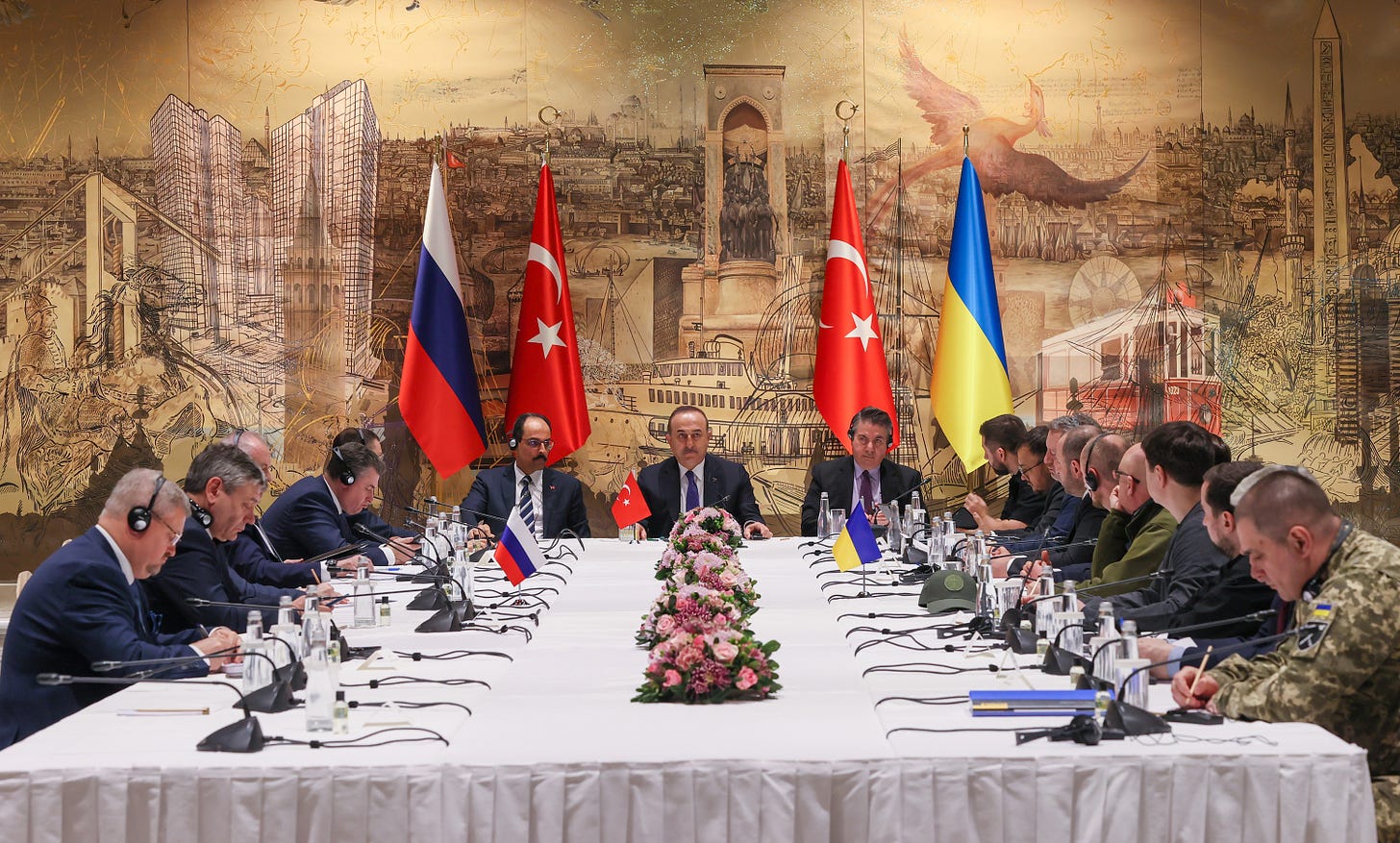
After the Istanbul talks failed, we were informed by the Turkish and Israeli mediators that Russia and Ukraine were close to a deal based on restoring Ukraine’s neutrality before the US and UK decided to torpedo the agreement as they saw an opportunity to use Ukrainians to fight and weaken Russia. As Zelensky recognised in an interview with The Economist in March 2022: “Everyone has varied interests. There are those in the West who don’t mind a long war because it would mean exhausting Russia, even if this means the demise of Ukraine and comes at the cost of Ukrainian lives”. However, the only acceptable discourse in the West must seemingly be based on the premise that NATO is simply an altruistic actor that responded to Ukraine’s desire to join NATO, even though every poll between 1991 and 2014 demonstrated that only a tiny minority of Ukrainians wanted NATO membership.
The discourse is dumbed down to the extent that claiming the Russian invasion was unprovoked is the litmus test for being “pro-Ukraine,” while any dissent is labelled “pro-Russia”. Why? The situation for Ukraine has consistently worsened since 2014, and continuing along this path could destroy Ukraine as a nation. In contrast, if we recognize that Russia will not accept NATO in Ukraine any more than the US would accept the Russian military in Mexico, then a deal could be made that would manage the security competition, remove Ukraine from the front lines of a divided Europe, and create a stable and prosperous Ukraine. Yet, even discussing the possibility of reducing the security competition is criminalized as “justifying”, “legitimizing”, and “excusing” the Russian invasion.
The West has subsequently trapped itself in narratives that make peace impossible to pursue in a war it cannot win.


Leave a Reply