Monday, 24 August 2026 — The Dissenter
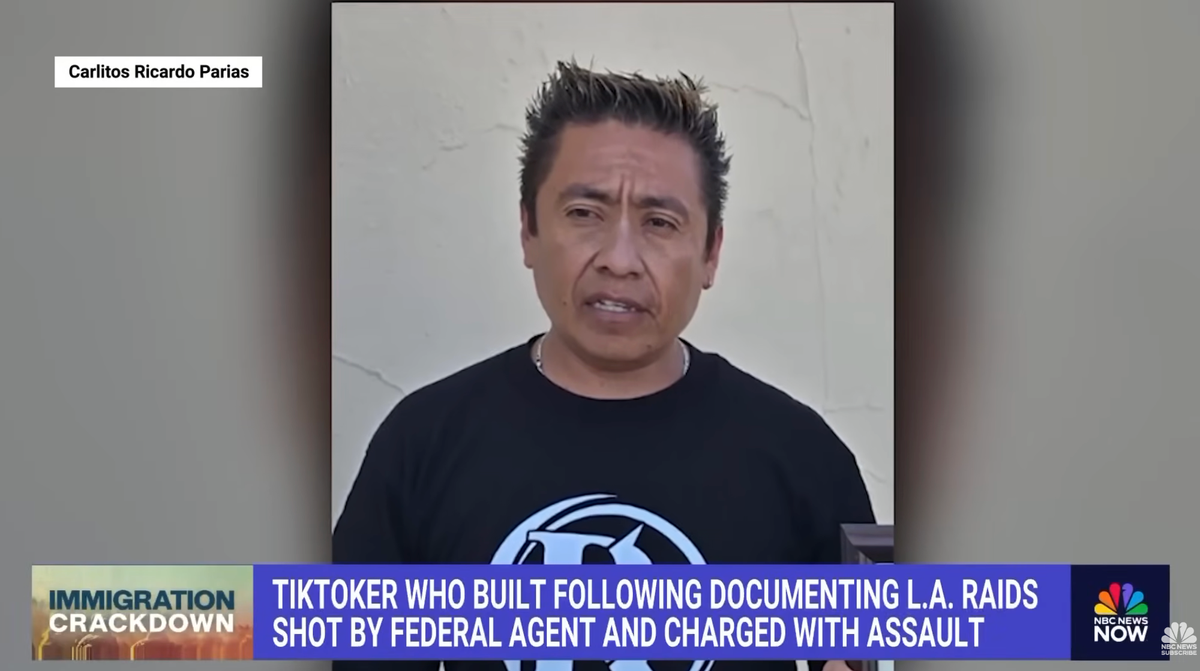
Parias is a father of two children in southern Los Angeles. He is known for documenting ICE operations and goes by Richard LA on TikTok.
As the order to dismiss the case recounted, on October 21, 2025, ICE agents “used their vehicles to box in” Parias’s car. While attempting to break the car’s windows, the “wheels spun and emitted clouds of smoke.” One agent reached in through the broken window and “brandished” a gun as he tried to open the car door.
The agent exchanged words with Parias before shooting him in the arm. Later that day, the government accused him of assaulting a federal officer.
A U.S. court twice ordered Parias’ release from detention, yet when the case against him was dismissed, ICE took him into custody. He was transferred to the Adelanto ICE Processing Center near the end of November, and Parias has endured confinement with a worsening gunshot injury for more than 300 days.
Adam Rose, the deputy advocacy director for the Freedom of the Press Foundation and a board member of the Los Angeles Press Club, recently reported on the “horrifying conditions” in which Parias has been detained.
“Perhaps no journalist has endured such a sustained sequence of violence, prosecution, and imprisonment at the hands of the U.S. government,” Rose declared.
Several American journalists have spent months in jail to protect their sources: New York Times reporter Judith Miller (85 days in 2005), writer Vanessa Leggett (168 days ending 2002), and freelancer Josh Wolf (226 days ending in 2007). Last year, Emmy-winning journalist Mario Guevara spent more than 100 days in immigration detention before being deported, prompting national outrage.
But as Rose emphasized, Parias’ time in detention far surpasses the record set by Wolf nearly 20 years ago.
Parias, who immigrated from Mexico, has continued to engage in journalism while held in the Adelanto detention center. His family provided a video to the news media that featured Parias sharing that a fellow detainee had seen worms in a cup of water, which came from “a 10-gallon jug of drinking water.”
“I want to shed light on everything that is happening in this place,” Parias declared. His commitment to exposing conditions will almost certainly result in retaliation and further abuse.
The case has received scant attention compared to Guevara’s case, which saw a coalition of civil liberties, journalism, and press freedom groups demand his release. Still, Guevara was deported to El Salvador—the home country that he fled more than 25 years ago.
On July 23, Congresswoman Sydney Kamlager-Dove spoke up for her constituent in a speech on the House floor.
“Carlitos is a father. A husband. A volunteer in our community who was even recognized by City Council for his service,” Kamlager-Dove said. “Since being transferred to the Adelanto ICE facility in December, ICE has denied him proper care for the injury they caused.
“I visited Carlitos in late May. His hand was purple. His fingers were atrophied. He’s experiencing headaches and nerve pain. I’m worried that he may have a bone infection and that his arm could be amputated,” she added.
Perhaps, that is what officials at ICE, the Department of Homeland Security (DHS), and the White House would like to see: a journalist who routinely documented ICE raids lose his arm.
After Judge Fernando M. Olguin dismissed the case, DHS Assistant Secretary Tricia McLaughlin lashed out. “ICE law enforcement officers, assisted by U.S. Marshals, pulled the illegal alien from Mexico over in a standard law enforcement procedure. The illegal alien weaponized his vehicle and began ramming the law enforcement vehicle in an attempt to flee. Fearing for the safety of the public and law enforcement, our officers followed their training and fired defensive shots.”
“These are the consequences of conduct and rhetoric by sanctuary politicians and activists who urge illegal aliens to resist arrest,” McLaughlin declared. She added, “We are once again calling on sanctuary politicians, agitators, and the media to turn the temperature down and stop calling for violence and resistance against ICE law enforcement.”
Federal immigration agents have killed at least four people in vehicle stops. At least 10 or more people have been killed by ICE during Trump’s second term.
In January, journalist Radley Balko, who has chronicled police violence for two decades, grappled with this savagery. “[N]early all of the administration’s responses to deaths in custody, shootings or other accusations of abuses have used maximalist language to venerate immigration officers, dehumanize their victims and villainize anyone who doesn’t support the Trump administration.”
“There are no disinterested parties. No innocent bystanders. People are either criminal immigrants or radical leftists who deserve what happens to them, or they are heroic, patriotic federal cops incapable of mistakes. There is no humanity for the civilians and no humility for the officers.”
This is one of the most precarious moments for non-citizen journalists, who regardless of what Trump lawyers argue have First Amendment rights, too.
Unfortunately, as Margaret Hellerstein, an immigration attorney representing Parias, told NPR, Parias is not eligible for bond while in ICE custody because Trump had Republicans change the law.
All that Parias can do is file a habeas petition and request that a U.S. court review his detention. However, that may take multiple years to play out.
Petitioning a U.S. court to intervene did not stop the Trump administration from deporting Guevara to El Salvador. Parias may be sent to Mexico with an amputated arm before a court takes any meaningful action. Or worse, he could die as a result of ICE detention conditions, including the lack of access to adequate medical care.


Leave a Reply