Thursday, 3 September 2026 — The Tricontinental
While capitalism confines the Global South to raw extraction and cheap exports, democratic planning can break dependence, claim technological control, and turn resources into collective economic power.
 Juan O’Gorman (Mexico), Mexico City, 1949.
Dear friends,
Greetings from the desk of Tricontinental: Institute for Social Research.
For forty years, the countries of the Global South were told that economic planning was an error. The state was to retreat, tariffs were to fall, public firms were to be privatised, and investment was to be entrusted to those who move money across borders at the speed of a keystroke. Development would arrive through comparative advantage: each country should sell what it already had and buy what others had learned to make. The result is visible from Harare to Jakarta. Countries rich in minerals, fertile land, and young workers remain trapped at the least rewarding end of global value chains, exporting raw materials while importing the higher-value goods made from them. Ghana, for example, exports cocoa and imports chocolate, while Venezuela exports crude oil and imports refined fuel. Wealth drains out of the Global South, while debt, informality, and the discipline of austerity deepen.
A progressive industrial policy for the Global South must begin with a refusal of this deal. The ‘economy’ is not a neutral or natural fact but a historical product of colonial intervention, neocolonial restructuring, property regimes, and patterns of access to technology and capital. Growth rates are important, but even more important is the question of what is produced, how it is produced, who controls the process of production, and how the benefits are distributed. The goal of development should not be growth per se but the flourishing of human life.
 Charles Sheeler (United States), Water, 1945.
The institutions that once made industrial policy taboo for the Global South – the International Monetary Fund (IMF), the World Bank, and the Organisation for Economic Co-operation and Development (OECD) – have now begun to revise their prescriptions. The OECD, for instance, now acknowledges that market forces alone cannot resolve weak productivity, fragile supply chains, and green and digital transitions; few firms would risk their capital for long-term investment unless compelled to do so. The World Bank goes further, arguing that only state-led investment can drive industrialisation, including through the creation of industrial parks, transport infrastructure, energy grids, and the provision of long-term financing. The IMF is more guarded – it recognises the importance of subsidies and trade protection for infant industries but warns against the protection of non-competitive sectors. Each of these institutions now suggests, without saying outright, the need for planning. We add that such planning should be democratic and for the public good. We must build popular power and state capacity to discipline capital and penalise it when it refuses to meet social goals.
There is a revealing asymmetry in the old arguments about industrial policy. When wealthy states subsidise semiconductors, electric vehicles, defence industries, or green technologies, it is framed as ‘innovation’ or ‘national security’. When poor countries try to process their own minerals or protect infant industries, they are warned about ‘distortion’, ‘inefficiency’, ‘corruption’, and ‘fiscal risk’. The fact is that the world market is already planned by powerful states, transnational firms, patent regimes, financial institutions, and military priorities. The real question is who plans, for whose benefit, and at what level of the value chain.
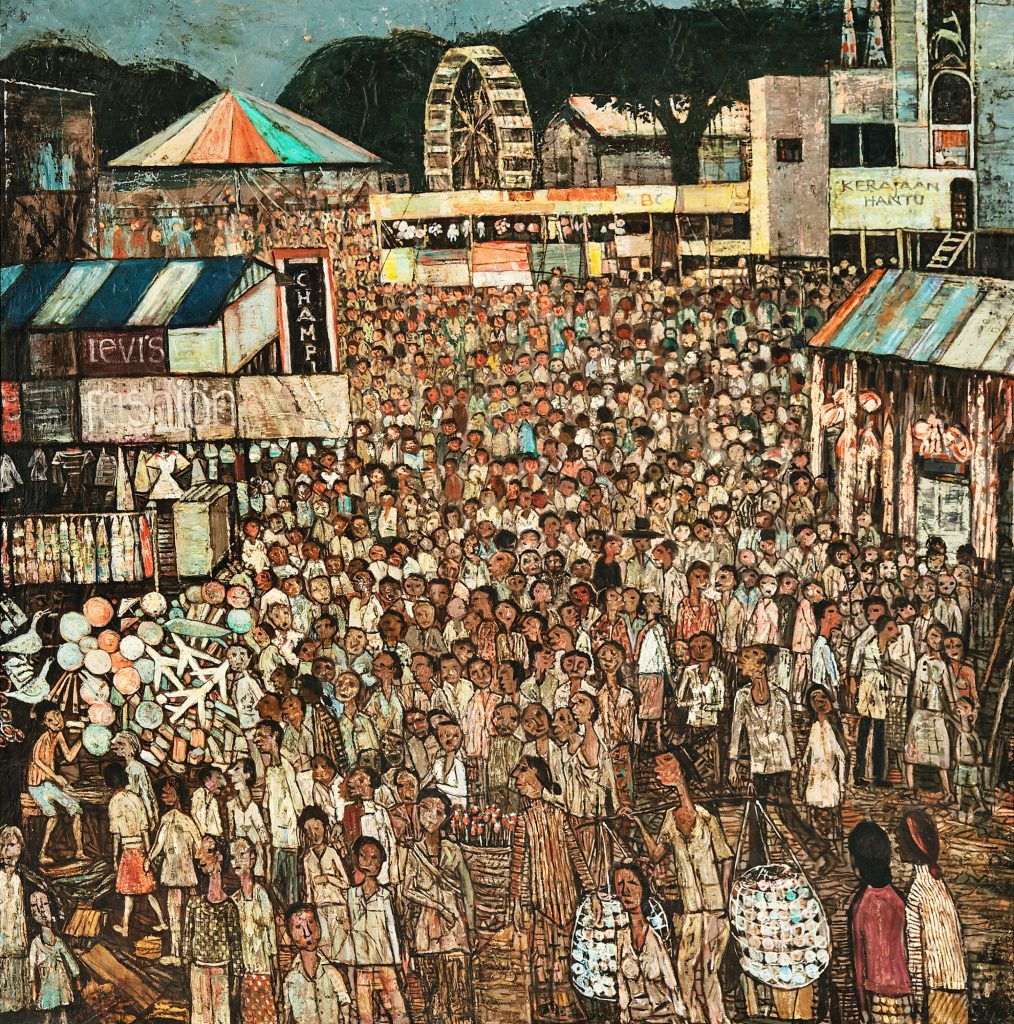 Haji Widayat (Indonesia), Perayaan Sekaten di Yogya (Sekaten Festival in Yogya), 1983.
The UN Conference on Trade and Development (UNCTAD) emphasises the necessity for state coordination so that trade policy, energy policy, education and research policy, environmental policy, and foreign investment rules move in the same direction. Without coordination, a government may announce local processing while its central bank starves industry of long-term credit, its power system fails factories, and its trade regime rewards imports. UNCTAD’s arguments are useful, but they ignore the elephant in the room – capitalists seek profit, not the public good.
An industrial policy that does not discipline capital and channel it toward the well-being of society will necessarily fail. Publicenterprises are necessary to make the long-term investments in socially
necessary areas where the private sector shows no interest. Rather than use public funds for private speculation, it is far better to harness public funds for public institutions that can create managed markets, incubate new technologies, and develop lines of production that are socially beneficial. Ultimately, an industrial policy cannot be sustained unless countries restore some trade barriers and capital controls. Without these measures, governments will face severe foreign exchange shortages and heavy fiscal costs. Over time, these pressures will weaken public finances and undermine industrial development.
Part of the destruction of industrial policy in the Global South took place with the 1994 Agreement on Trade-Related Aspects of Intellectual Property Rights (TRIPS), which narrowed the policy space countries once used to imitate, adapt, and build on existing technologies. TRIPS made it harder for countries to build new technologies on their own terms. It is time for states in the Global South to reconsider the full recognition of intellectual property rights. Compulsory licensing already allows for the production of life-saving medicines when public needs are urgent. Similar tools should be extended to other critical sectors for industrial development. This would improve access to
essential technology, strengthen domestic production, and reduce dependence on multinational corporations.
 Gresham Tapiwa Nyaude (Zimbabwe), May Flights of Fance, 2019.
Zimbabwe’s lithium policy is an important example of the economic imagination needed for contemporary industrial policy. In December 2022, Zimbabwe’s Statutory Instrument 213 prohibited the export of lithium-bearing ores and unrefined lithium without ministerial permission. The policy overturned the colonial common sense that an African country’s role is to dig and ship. The country used control over a strategic resource to pressure mining firms to invest in processing and create more value-addition, skills, and tax revenue at home. This is precisely the kind of measure that mainstream economics cautions against. But such bold instruments may be necessary when the existing system makes extraction appear ‘efficient’ and industrialisation ‘inefficient’. Zimbabwe’s ban changed the calculation facing mining capital: access to the ore increasingly required investment in domestic processing. This helped push firms toward processing lithium ore into concentrate and, more recently, toward plans for lithium-sulphate facilities – bringing Zimbabwe one step closer to battery inputs.
Zimbabwe’s policy should be defended without romanticisation. Processing ore into concentrate is not the same as controlling the battery value chain. Foreign firms still dominate production. Technology, finance, and market access remain under the control of multinational corporations. Local communities have raised concerns over working conditions, land and water rights, and poor regulation. An export ban by itself cannot produce engineers, reliable electricity, publicly owned research, or domestic manufacturers. Zimbabwe’s next step must therefore be deeper and more
public: a mine-to-manufacturing plan linking geological knowledge, state equity, development bank credit, vocational education, chemical processing, component production, recycling, and regional demand. Such a plan would need to grant mining communities and workers institutional power and ensure that public revenues build universal goods rather than private wealth.
Zimbabwe’s success should not be measured by processing plants but by whether lithium policy helps build new public schools, hospitals, water and transport infrastructure, energy grids, and other public goods.
 Alexander ‘Skunder’ Boghossian (Ethiopia), Crossroads, 1992–1997.
The United Nations’ Fourth Industrial Development Decade for Africa (2026–2035) recognises the urgency of our conjuncture. Nearly twelve million young Africans enter the labour force each year, while the African Continental Free Trade Area offers the scale needed to build regional value chains. The UN correctly calls for Africa to move from raw-material exports to the production of value-added goods. But declarations and ‘bankable projects’ are not enough. As Grieve Chelwa and I argue in our book, How the International Monetary Fund Strangles Africa (2026), Africa needs public development banks, continental infrastructure planning, coordinated mineral policy, local-content rules, infant industry protection, and relief from foreign debts that drain the very fiscal capacity industrialisation requires.
The opponents of industrial policy offer no neutral alternative. To leave investment to multinational corporations is to accept a plan written elsewhere: mines without industry, farms without food processing, cities without dignified work, and a green transition in which technologies are designed in the North using minerals extracted in the South. Industrial policy is not a guarantee of emancipation, but it can be a terrain of class struggle over who controls investment, production, and economic surplus. The peoples of the Global South have the right to use their own resources to build the future.
The current conjuncture has opened space for debate about industrial policy, in part because the long stagnation that followed the 2008 financial crisis has made old prescriptions increasingly untenable. After decades in which planning was discredited and state capacity was weakened, the countries of the Global South must have the audacity to imagine something better than the deal handed down to them. There is an old Shona proverb from Zimbabwe that might be useful to remember: Chawawana batisisa mudzimu haupi kaviri – what you have found, hold on to it tightly, for the ancestors do not give twice.
Warmly,
Vijay


Leave a Reply