Saturday, 28 November 2026 — Weaponised Information
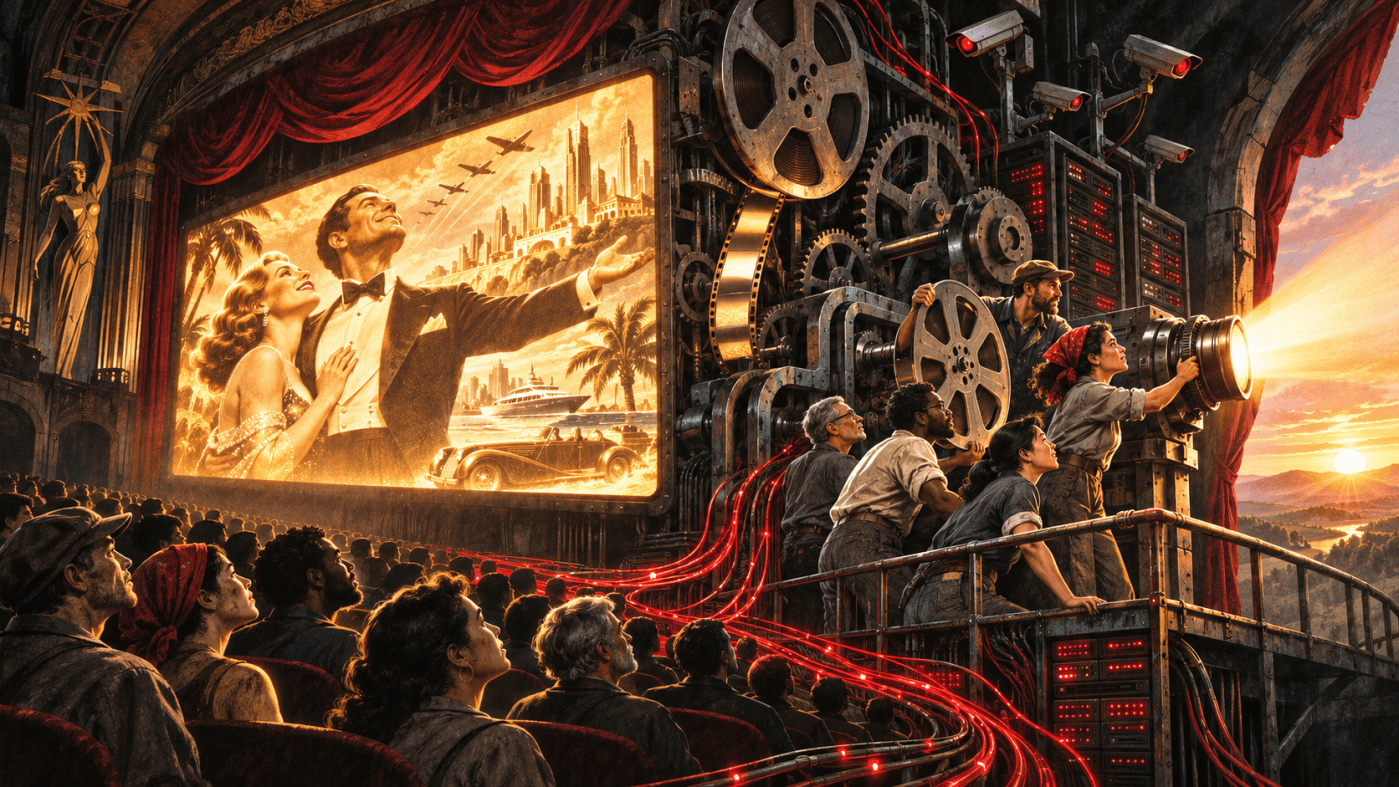
From the colonial fantasies of Hollywood westerns to the algorithmic machinery of digital capitalism, Michael Parenti’s Make-Believe Media: The Politics of Entertainment exposes an entertainment industry that manufactures consent while manufacturing profits. Behind the glamour of the silver screen lies a history of labor repression, imperialist propaganda, white supremacy and the commercial colonization of everyday life. Under technofascist consolidation, the old dream factory has acquired the technological capacity to monitor the very people it entertains. Our struggle for emancipation must therefore extend beyond the battle over what appears on the screen to the revolutionary struggle over who owns the damn screen in the first place.
By Prince Kapone | Weaponized Information | Weaponized Intellects Book Review | November 27, 2026
I. The Factory of Make-Believe
After ten hours of making somebody else rich, a worker comes home, kicks off their boots, cracks open a beer and settles down in front of the television. For a few precious hours, the boss can go to hell. But the world awaiting that worker on the screen belongs, in large measure, to the same class of people who own the world they’ve just escaped. Michael Parenti opens his 1992 book, Make-Believe Media: The Politics of Entertainment, with a deceptively simple observation: “The entertainment media are the make-believe media; they make us believe” (p. 1). There’s an entire political economy tucked inside that little play on words. Human beings have always invented stories, imagined other worlds and found pleasure in the adventures of fictional characters. Under capitalism, however, an immense commercial industry has appropriated much of that creative activity and acquired the power to furnish millions of people with pictures of the world they inhabit.
Parenti begins by contrasting the manufactured fantasies of Hollywood with the storytelling, games, folklore and imaginative activities through which people have historically produced their own culture. We shouldn’t mistake this observation for nostalgia about some idyllic past. Feudal societies had their religious superstitions, slave societies their racial mythologies, and patriarchal households their own methods of teaching obedience. Culture has never floated above the conflicts of the society that produces it. What distinguishes capitalist entertainment is the industrial scale on which capital has organized human imagination as a commercial enterprise. Thousands of people contribute their labor, creativity and technical knowledge to the production of a film. Yet the finished product confronts society as the property of somebody else, carrying a vision of human life shaped under conditions that most of its creators and consumers have little power to determine.
The Hollywood director Cecil B. DeMille once suggested that anybody who wanted to send a message ought to use Western Union. He was particularly comfortable with the political messages Hollywood sent because they expressed convictions he already shared. Parenti gets to the heart of this ideological sleight of hand: “Beliefs are less likely to be preached than assumed” (p. 3). A film needn’t deliver a sermon on the virtues of private property if its entire dramatic universe treats the capitalist’s right to own factories and command workers as unquestionable. The plot might even condemn a particularly unscrupulous businessman, allowing the audience to applaud his downfall while leaving the social relations that produced him untouched. The bastard gets what he deserves, the credits roll, and capitalism walks out of the theater with a clean bill of health. The political judgment resides in the way the filmmakers have defined the problem and constructed its resolution.
This is why Parenti’s conception of political entertainment takes us considerably further than the conventional understanding of propaganda. Human beings encounter only a fraction of the social world through immediate personal experience. We depend upon others to tell us what happens beyond the boundaries of our workplaces, neighborhoods and countries. Parenti illustrates the political consequences of this dependence through the testimony of Black actress Ellen Holly, who describes employers and casting directors judging actual Black people against images manufactured by the entertainment industry (pp. 4–5). A fictional character can acquire a very real presence in a personnel office, determining how an employer interprets the qualifications, intelligence or conduct of the person sitting across the desk. The image becomes materially consequential through somebody’s power to hire, reject and distribute opportunities. For the person denied a livelihood, there’s nothing make-believe about it.
Things become more complicated when Parenti examines what audiences themselves bring to the screen. People interpret stories through their accumulated experiences and beliefs, but previous encounters with commercial entertainment may have helped shape those very beliefs. Under such circumstances, Parenti writes, our minds sometimes become “active accomplices in our own indoctrination” (p. 6). The operative word here is active. Ideological domination can enlist the intellectual faculties of the people subjected to it. We make connections, draw conclusions and recognize familiar patterns, often without investigating where we acquired those patterns in the first place. The ideological content of an entertainment product therefore doesn’t reside entirely within the product itself. It becomes socially effective through its encounter with people who’ve already been formed by particular historical circumstances. Capital didn’t invent the human capacity to interpret the world; it’s acquired enormous power over the materials with which we undertake that interpretation.
But commercial entertainment also reorganizes the circumstances under which we encounter one another. “The most pervasive effect of television—aside from its actual content—may be its very existence,” Parenti observes (p. 11). His concern here reaches beyond the political messages contained in particular programs. Television occupies a considerable portion of the time through which people might otherwise develop relationships, exchange experiences and participate in communal life. Consider the difference between neighbors gathering to discuss the problems confronting their community and those same neighbors sitting separately in their homes watching fictional characters resolve fictional problems. Neither activity guarantees revolutionary consciousness. Yet the former creates opportunities for people to discover common interests and develop shared capacities for action. The latter can consume hours of their lives without bringing them any closer to one another. For a ruling class that depends upon the political fragmentation of working people, that difference carries significance.
Parenti nevertheless refuses to surrender human agency to the entertainment industry. “The viewing audience is something more than just a passive victim” (p. 12), he insists, pointing to organized popular pressure as a force capable of compelling changes in commercial representation. This qualification belongs at the center of his argument. Working people bring to their encounters with culture experiences that capitalist entertainment can’t entirely absorb or explain away. A worker who’s stood on a picket line possesses knowledge of class struggle that no television executive can simply erase. The experience of exploitation can expose the bullshit of its ideological justification, particularly when people develop that experience into collective political understanding. The very society that produces the cultural instruments of domination also produces the people capable of challenging them.
What gives Parenti’s intervention its revolutionary potential, then, is the contradiction he uncovers between our collective capacity to make sense of the world and capital’s command over so much of the cultural life through which we exercise that capacity. To understand the political character of this command, however, we’ve got to establish what kind of society the entertainment industry reproduces. Hollywood didn’t invent the empire whose adventures it dramatizes, the racial order whose characters it manufactures, or the property relations its stories take for granted. Those relations have a history written in stolen land, appropriated labor and the resistance of peoples who refused to accept their assigned place in the world. And that history presents the make-believe merchants with a particularly troublesome body of material.
II. The Empire That Edits Its Own History
The American western generally begins after the theft has already commenced. The covered wagons are making their way across somebody else’s homeland, the settlers are busy establishing their claims to somebody else’s land, and the Indigenous people who object to the proceedings suddenly appear over the horizon as the aggressors. Parenti begins his examination of colonial representation by restoring precisely what this dramatic arrangement conceals: “For centuries the land, labor, and resources of peoples in Asia, Africa, and Latin America have been forcibly expropriated by European and North American colonizers” (p. 13). That’s where any serious investigation of imperial ideology must begin. Before the European colonizer manufactured elaborate theories about the inferiority of the peoples he conquered, there were kingdoms to plunder, lands to appropriate, markets to monopolize and human beings whose labor could be extracted through naked force. White supremacy supplied the ideological justification for these undertakings and helped reproduce the material relations they established. Hollywood inherited this bloody history and turned it into Saturday afternoon entertainment.
Parenti is careful to preserve the historical sequence. The racist images manufactured by the entertainment industry “cannot be seen as the cause of the atrocities” (p. 13). Capitalist civilization had already accumulated several centuries of colonial barbarism before anybody figured out how to project moving pictures onto a screen. But the western performs a particularly ingenious ideological operation upon that history. By placing the audience inside the circle of covered wagons, the filmmakers establish the settlers’ security as the dramatic problem and Indigenous resistance as its disruption. Everything that preceded the attack disappears from the immediate field of vision. The audience experiences the defense of stolen property as self-defense, while the people fighting to recover their homeland become an obstacle to human progress. And what a peculiar definition of civilization Hollywood gives us: the fellow who arrives with a rifle, stakes a claim to another people’s land and shoots anybody who objects gets to ride into the sunset as the hero.
This ideological arrangement also has room for the friendly native. Parenti examines the relationship between the Lone Ranger and Tonto as a relatively affectionate representation of colonial subordination (p. 17). Tonto possesses enough intelligence and courage to rescue his white companion whenever the situation demands it, but apparently not enough political consciousness to ask what the hell they’re doing helping settlers consolidate their occupation of Indigenous territory. His usefulness depends upon the restriction of his agency to the interests of the colonizer. The two characters therefore dramatize something more substantial than a racial hierarchy of personal intelligence. They offer an acceptable political role for the colonized person: opposition to the imperial project makes him an enemy, while service to that project earns him recognition as a friend. Hollywood can celebrate his humanity provided he doesn’t exercise it in pursuit of his people’s liberation.
Even films that condemn colonial brutality can reproduce important elements of imperial ideology. Parenti recognizes the cinematic achievements of Richard Attenborough’s Gandhi (1982), including its willingness to depict British soldiers massacring peaceful demonstrators and beating nonviolent resisters. Nevertheless, he identifies an extraordinary omission: “But Gandhi fails to explain what the British are doing in India” (p. 21). The audience witnesses the violence without confronting the economic relations that make it necessary to British imperial rule. The destruction of indigenous productive capacities, the extraction of wealth and the subordination of India’s economy to British capital scarcely enter the picture. Colonialism consequently assumes the appearance of an enormous moral misunderstanding, correctable once the British recognize the injustice of their behavior. Apparently, an entire empire had traveled halfway around the world, occupied a subcontinent and maintained its dominion for generations without having any particularly compelling financial reason to stay there.
Compare this with the Italian-French production Burn! (1969), which Parenti commends for exposing the economic interests behind Caribbean colonialism and examining the different advantages capital could derive from enslaved and formally free labor (pp. 22–23). Here, the transition from one system of exploitation to another becomes intelligible through the changing requirements of accumulation. The difficulties of revolutionary independence likewise emerge from a historical world in which imperialism has already deformed the conquered society’s economic development. Parenti objects to the film’s portrayal of Black revolutionaries as insufficiently prepared to exercise political power, recognizing that the legacy of underdevelopment and the pressures of counterrevolution provide a more substantial explanation of their difficulties. The comparison exposes the difference between depicting an empire’s crimes and explaining imperialism as a system. Without the latter, even a sympathetic portrait of liberation can leave the colonial interpretation of the colonized people’s capacities remarkably intact.
Chapter 4, “Make-believe History,” develops this problem beyond the immediate representation of the colonial encounter. Parenti identifies the great taboo of commercial historical drama as “the importance of class power and class struggle” (p. 58). His treatment of the costume epic is especially revealing. The inhabitants of ancient Rome appear chiefly as emperors, generals, aristocrats and occasionally the slaves who fetch their wine. The extravagance of the imperial court supplies the spectacle, while the exploitation that financed that extravagance rarely becomes the dramatic subject. In the medieval adventure, the struggle over the throne substitutes for the struggle over land, rent and the labor of the peasantry. The audience must choose between a benevolent monarch and a wicked one, although both live off the surplus extracted from the people whose liberation ought to concern us. Commercial historical drama offers the ruling classes of bygone societies a public relations department they could hardly have imagined in their own lifetimes.
The political consequences of manufacturing an alternative history become especially apparent in the representation of Black people within the United States. D. W. Griffith’s The Birth of a Nation (1915) reconstructed the struggle over emancipation and Reconstruction as a white civilization imperiled by Black political advancement. The actual Ku Klux Klan had emerged from the defeat of the slaveholding Confederacy and conducted a campaign of counterrevolutionary terror against freedpeople and their allies. Griffith’s film recast the perpetrators of that terror as national saviors. Economist Desmond Ang’s 2023 historical study found increases in lynchings and racial disturbances around the arrival of the film in counties where it was screened, alongside evidence that its circulation contributed to the growth of the revived Klan. The important mediation here was political organization. The film entered a society already structured by white supremacy and furnished an existing reactionary movement with mythology, symbols and opportunities for recruitment. The imperial fantasy had acquired flesh and blood through the organizations capable of acting upon it.
Yet the Black liberation struggle eventually made many of the industry’s older racial caricatures politically untenable. Parenti documents the campaigns of Black journalists, performers and civil rights organizations that forced concessions from commercial entertainment (p. 128). By the 1950s and 1960s, Black people were organizing sit-ins, boycotts, demonstrations and mass struggles against the institutional foundations of racial domination. Hollywood, meanwhile, discovered Sidney Poitier. Of the exemplary characters Poitier played during this period, Parenti observes that “he asserted himself only within limited parameters” (p. 132). Poitier’s characters represented an important departure from the degrading buffoonery that had previously dominated Black representation. But the political conditions under which Hollywood could recognize Black dignity remained exceedingly restrictive. The industry’s ideal Black protagonist possessed seemingly inexhaustible reserves of patience and moral rectitude, precisely when actual Black people were demonstrating that their liberation would require considerably more than exemplary personal conduct.
The commercial rehabilitation of Black identity subsequently acquired an increasingly pronounced class character. Parenti recognizes the achievements of The Cosby Show in depicting an intelligent, affectionate Black family without reducing its members to the grotesque racial caricatures of earlier television. His objection concerns what the Huxtables’ prosperity implies about the possibilities of Black emancipation: “this small economic minority within a larger ethnic minority points the way to ending discrimination” (p. 141). Here we encounter the political limits of liberal inclusion. A Black physician and a Black lawyer can enjoy a comfortable existence within capitalist society, but their professional advancement doesn’t explain how millions of Black workers are supposed to escape exploitation, impoverishment and the accumulated consequences of national oppression. Capital can accommodate considerable diversity among the people occupying privileged positions without surrendering the property relations that make those positions privileged. The existence of a Black landlord won’t cancel a Black tenant’s rent.
Parenti strips the sentimental coating from this same contradiction in his discussion of Driving Miss Daisy (1989). The film invites us to celebrate the friendship that develops between an affluent white Southern woman and Hoke, her Black chauffeur, following decades in which he serves her with extraordinary patience. “Their friendship prevails, but it is hardly one of equals” (p. 145). The distinction matters because Hoke’s apparent reconciliation with Miss Daisy doesn’t abolish the conditions that brought him into her service. Her dependence upon his labor and companionship becomes the basis of an emotional resolution, while his economic dependence upon employment remains outside the film’s conception of the problem. Liberal humanitarianism finds something profoundly comforting in this arrangement. The affluent can discover the humanity of their servants without having to relinquish the social advantages that enable them to employ servants in the first place.
Parenti’s treatment of Italian Americans in Chapter 9 reveals another, historically distinct dimension of commercial ethnic representation. The descendants of European immigrants experienced exploitation, discrimination and considerable pressure to abandon their cultural identities, although their incorporation into the U.S. settler order cannot simply be equated with the dispossession of Indigenous nations or the enslavement and national oppression of African peoples. In Parenti’s account, Hollywood transforms the Italian immigrant from a grateful beneficiary of American society into the colorful gangster or the vulgar working-class character whose principal aspiration is to escape his neighborhood. The romanticization of the Mafia is particularly revealing because it obscures the violence organized crime inflicted upon Italian workers themselves, including its participation in union-busting and extortion (p. 160). A community’s desire to see itself recognized becomes an opportunity to sell it an attractive caricature of precisely the forces that preyed upon it.
At the conclusion of that chapter, Parenti brings the question of ethnic representation back to the material conditions of working-class existence: “What has been stolen from many of them is their labor, their health, their communities” (p. 162). The theft of historical identity matters because people need to understand what has been done to them, who’s benefited from it and what their predecessors accomplished through struggle. A people deprived of that knowledge must rediscover through painful experience lessons that generations before them paid dearly to acquire. But there’s another historical experience that Hollywood has good reason to keep out of circulation. The workers whose collective struggles disappear from American entertainment aren’t confined to the plantations, mines, railroads and manufacturing towns that furnish its dramatic scenery. They can also be found inside the studios themselves, building the sets, operating the cameras, writing the scripts and fighting the bosses who claim ownership over the stories America tells about itself.
III. The Workers Behind the Screen
In March 1945, Hollywood’s set decorators went on strike over the renewal of their union contract. Nearly ten thousand workers belonging to nine unions joined the struggle. By October, the dispute had spilled into the streets outside Warner Bros., where police, studio guards and members of a rival union confronted striking workers. Behind the glamorous industry that sold American audiences their dreams stood an industrial proletariat fighting over wages, working conditions and control over the labor process. The people who built the sets, painted the scenery and made the machinery of cinematic illusion operational had discovered something that the studio executives understood perfectly well: without their labor, Hollywood couldn’t produce a damn thing.
Records of the 1945 studio strike reveal the material foundations of the political warfare that subsequently engulfed Hollywood. The Conference of Studio Unions, led by Herb Sorrell, challenged both the employers and the entrenched leadership of the International Alliance of Theatrical Stage Employees. Despite a favorable National Labor Relations Board ruling, renewed conflict in 1946 brought further attacks against the militant unions. Rival union officials supplied labor to sustain production while the leadership of the Screen Actors Guild, which included Ronald Reagan, helped isolate the strikers. The defeat of the Conference of Studio Unions consolidated a more accommodating form of trade unionism within the entertainment industry. The bosses had secured a victory on the shop floor before their congressional allies set about cleansing the screen.
Parenti identifies one objective of the House Un-American Activities Committee’s Hollywood investigations with admirable economy: “Fourth: curb labor militancy in Hollywood” (p. 41). The congressional witch-hunts of 1947 and 1951 can’t be understood apart from this preceding struggle over industrial power. Anticommunism furnished the employers with an ideological weapon against workers whose organizational strength threatened managerial authority. Congressional investigations, blacklisting and compulsory declarations of political loyalty made a person’s ability to earn a living conditional upon their political conduct. What a marvelous bourgeois conception of freedom: a worker’s conscience belonged to them, provided they exercised it in accordance with the requirements of their employer and the national security state.
Some of the anticommunist pictures that followed the congressional investigations performed poorly at the box office. Parenti observes that “[i]n this instance, ideology took precedence over box-office considerations” (p. 42). There’s an important distinction here between the immediate profitability of an individual commodity and the wider political interests of the capitalist class. A studio could lose money producing a lousy anticommunist film while gaining considerably from an industrial environment in which workers feared organizing, writers avoided politically troublesome subjects and employers enjoyed greater authority over production. The balance sheet of a particular motion picture couldn’t register all the benefits that accrued to capital through the political disciplining of labor. Hollywood’s bosses understood class solidarity considerably better than many of the workers who’d been taught to despise the very idea.
The ideological flexibility of Hollywood’s anticommunism further exposes its political character. During the Second World War, American studios produced sympathetic representations of the Soviet Union as Washington depended upon Soviet military power in the struggle against Nazi Germany. An internal Office of War Information review welcomed the 1943 film Mission to Moscow as a contribution to the government’s wartime information program and encouraged its widespread distribution. Within a few years, films of this kind became objects of congressional suspicion. During the subsequent period of détente, sympathetic Soviet characters became permissible once again. By the time capitalist restoration was advancing in the Soviet Union, Parenti remarked that former communist adversaries underwent yet another moral rehabilitation: “they are no longer considered evil because they are no longer anticapitalist” (p. 53). The Russian people hadn’t undergone some mysterious transformation of their national character. The political and economic relations through which the U.S. ruling class understood its interests had changed. Hollywood dutifully adjusted its moral compass.
The consequences of this ideological offensive extend well beyond the disappearance of sympathetic communists from American cinema. “In the war between labor and capital,” Parenti writes, “there are thousands of untold stories and unsung heroes” (p. 69). Generations of workers confronted employers, company thugs, police departments and hostile courts to secure shorter working hours, safer workplaces and the right to organize. Yet millions of people who inherit the fruits of these struggles have scarcely any knowledge of the people who fought them. When the entertainment industry removes organized labor from popular historical consciousness, the concessions that workers extracted from capital begin to resemble gifts bestowed upon society by enlightened employers or benevolent governments. The ruling class gets credit for the very things it fought like hell to prevent.
Hollywood can, of course, accommodate stories about working people. The difficulty arises when those people discover their collective power. Consider Elia Kazan’s celebrated 1954 film On the Waterfront. The exploitation of dockworkers provides the setting, but the corrupt union leadership becomes the principal source of their oppression. The employers largely escape scrutiny, despite the historical connections between waterfront employers and labor racketeering. Terry Malloy’s decision to testify against the union leadership supplies the moral resolution. What Parenti identifies in this narrative is the elevation of “individual motives rather than collective goals, individual heroics rather than organized mass action” (p. 79). Union corruption is a real problem that workers have every reason to combat, especially when union officials sell their members’ interests to the bosses. But Kazan’s film denies the rank and file the political capacity to reclaim their own organization. The audience applauds the courage of an individual worker while the workers’ collective dependence upon capitalist employment survives untouched.
Released that same year, Salt of the Earth emerged from an altogether different relationship between cinematic production and the working class. Drawing upon the 1951–1952 Empire Zinc strike in New Mexico, the film follows Mexican American miners fighting discriminatory wages and dangerous working conditions. Their struggle encompasses a history considerably older than their employment in the mine. One of the miners recalls that the land on which the company operates once belonged to his grandfather. Within this seemingly incidental recollection lies the historical connection between colonial dispossession and capitalist proletarianization. The people whose land passed into the hands of others must now negotiate with a company over the conditions under which they’ll sacrifice their bodies extracting its wealth. Racial discrimination within the workplace helps reproduce the unequal relations established through that earlier dispossession.
When a court injunction prevents the striking miners from maintaining their picket line, the women of the community assume responsibility for the pickets. Their intervention transforms the struggle against the company and the relations within the workers’ own households. The men, compelled to undertake domestic work, discover how much labor their wives have been performing without recognition. The women, through political organization and direct confrontation with the company’s coercive apparatus, establish themselves as indispensable participants in the strike. Parenti recognizes the film’s exceptional achievement: “Salt of the Earth is one of those rare films that offers the solution of collective action” (p. 89). The collective itself develops through struggle. The miners can’t effectively resist the company while denying the political agency of the women whose labor sustains their households and whose organization sustains their picket line. Their unity requires the transformation of relations among the oppressed themselves.
The circumstances under which the filmmakers produced this picture explain much about its political intelligence. Blacklisted artists collaborated with the International Union of Mine, Mill and Smelter Workers, which had been expelled from the Congress of Industrial Organizations during its anticommunist purges. Actual miners and their families participated in the production. Juan Chacón, president of the striking union local, played Ramón Quintero. Working people helped produce a cultural representation of their own historical experience. The industry’s reaction, documented in the film’s production history, was ferocious. Congressional denunciations, union leadership obstruction, difficulties securing laboratory services and resistance from exhibitors impeded the film’s circulation. Immigration authorities arrested the Mexican actress Rosaura Revueltas and returned her to Mexico, where filmmakers completed parts of her contribution. An industry supposedly devoted to entertaining the public went to extraordinary lengths to prevent the public from seeing a motion picture.
Seven decades later, the workers behind America’s entertainment industry again demonstrated their collective power. The Hollywood strikes of 2023 brought the production of films and television programs to a standstill as writers and performers confronted the studios over compensation, streaming revenues and the commercial application of artificial intelligence. The 2023 writers’ agreement secured restrictions on employers’ use of artificial intelligence in literary production, while the 118-day performers’ strike secured contractual protections concerning digital replicas, consent and compensation. Capital’s technological ambitions encountered the organized resistance of the very people whose work supplied the industry’s commercial assets. The strikes confirmed a fundamental material reality that survives every technological transformation of entertainment: capital must command labor to accumulate wealth, and organized labor retains the capacity to interrupt that command.
What Hollywood finds so dangerous in a film like Salt of the Earth is therefore something that continually reproduces itself within Hollywood’s own factories of entertainment. Workers possess interests independent of their employers, acquire knowledge through collective struggle and can develop institutions through which they exercise their own power. Their emancipation begins with recognizing that capacity. A cultural industry organized under capitalist ownership has every reason to obstruct such recognition and to cultivate allegiance to other sources of social authority. Having deprived the working class of its historical agency, the industry furnishes society with a different cast of indispensable men: the benevolent proprietor, the indispensable executive, the heroic policeman and the righteous defender of established order. Capital manufactures its own heroes out of the relations through which it rules.
IV. The Good Hands of the Ruling Class
“Class is the colossal reality right before our eyes that we Americans are trained not to see,” Parenti writes in the opening pages of Chapter Six (p. 91). His emphasis here falls upon class as a relation of power rather than a statistical arrangement of people according to their incomes. The distinction is essential. A millionaire and a machinist occupy different positions in capitalist society because one can purchase and command the labor of others while the other must sell their capacity to work. Hollywood can show us the enormous differences in their living standards without giving us the slightest understanding of the relationship between them. Indeed, some of its most successful productions have made a fortune displaying the magnificence of wealth while concealing the social relations through which that wealth accumulates.
“For decades,” Parenti observes, “the make-believe media have represented the socioeconomic power of our society as being in good hands” (p. 101). Frank Capra’s It’s a Wonderful Life provides a particularly instructive example. George Bailey protects the ordinary inhabitants of Bedford Falls from the predatory designs of the monopolist banker, Mr. Potter. The film recognizes a genuine contradiction between the housing needs of working people and the interests of concentrated financial capital. But its resolution depends upon the survival of a charitable alternative within private enterprise, sustained by the extraordinary virtue of an exceptional individual. The community rallies to save the building and loan association, yet the institutional conditions that allow Potter to accumulate his enormous power remain intact. American capitalism can apparently redeem itself if only its capitalists develop a sufficient abundance of Christmas spirit.
Oliver Stone’s Wall Street (1987) carries this ideological operation into the age of corporate raiders and financial speculation. Gordon Gekko delivers a remarkably candid description of capitalist ownership: “I create nothing. I own” (p. 105). Five words lay bare a social relation that generations of bourgeois economists have spent their careers dressing up in elaborate mathematical costumes. Yet the film retreats from the implications of its own revelation. Against Gekko stands Lou, the principled stockbroker who insists that the money investors make creates jobs and advances scientific research. Parenti identifies the mystification: the film credits those who appropriate and invest wealth with creating the wealth generated by those who actually perform the work. Gekko’s downfall vindicates the supposedly legitimate operations of Wall Street. The financial system leaves the courtroom with its reputation rehabilitated, having sacrificed one of its more disagreeable practitioners to the altar of bourgeois morality.
The relationship between wealth and virtue takes an interesting turn in the television culture of the Reagan years. Prime-time spectacles like Dallas and Dynasty invited working people into the luxurious surroundings of oil magnates whose ruthlessness supplied much of the dramatic attraction. Parenti notes that these tycoons “are too busy skimming the cream” to undertake productive labor (p. 100). Their servants clean the mansions, their employees operate the businesses and somebody, presumably, extracts the goddamn oil. Yet the people who produce this wealth possess scarcely any dramatic existence independent of their employers. The degradation of human relationships into property relations becomes a source of entertainment, and even the viciousness of the proprietors acquires a certain glamour. The audience is invited to experience the pleasures of ruling-class power without acquiring an understanding of the costs imposed upon those who live beneath it.
What the corporate drama accomplishes through the figure of the proprietor, the medical drama accomplishes through the figure of the benevolent professional. Parenti’s treatment of television doctors gets beneath the sentimental celebration of individual devotion to expose the privatization of an elementary human need. Even relatively sophisticated productions such as St. Elsewhere, he argues, “leave unexamined the political economy of modern medicine” (p. 112). A physician may be compassionate, extraordinarily competent and personally committed to saving lives. But none of those qualities explains why a hospital becomes an investment opportunity, why a patient must demonstrate an ability to pay or why the people who clean operating rooms and care for the sick must fight their employers for decent wages. The television doctor promises through personal virtue what the capitalist organization of medicine systematically prevents through the distribution of purchasing power. Everybody can receive the doctor’s compassion through the television set; considerably fewer can afford an appointment.
With the police drama, the entertainment industry moves from cultivating confidence in the institutions that administer capitalist society to cultivating approval of the armed institutions that defend it. In Chapter Seven, Parenti dismantles the ideological inversion at the heart of the celebrated law-and-order genre. “The message communicated is that crime can be best met by state-sponsored illegality and brutality” (p. 115). In films like Dirty Harry (1971), constitutional protections become impediments to justice, while the policeman who disregards them becomes the heroic defender of an endangered population. The script has already established the villain’s guilt, so the audience experiences the violence inflicted upon him as a deserved punishment. What disappears is precisely the reason such legal protections matter: the capacity of the state to exercise its coercive power against people whose guilt hasn’t been established, whose political activities threaten established authority or whose poverty leaves them virtually defenseless against its machinery.
Parenti makes the class content of policing explicit when he observes that conventional crime dramas scarcely acknowledge how police protect “owners from workers and landlords from tenants” (p. 123). Nor can the colonial character of American policing be understood through the familiar television spectacle of individual officers overcoming their racial prejudices. Inside the settler republic, the policing of Black and Indigenous populations has developed historically through the enforcement of racialized property relations, territorial dispossession, labor control and the repression of political resistance. Hollywood’s urban-frontier drama carries something of the old cavalry picture into the modern metropolis. The threatened settlement becomes the police precinct; the racialized population surrounding it becomes the source of danger. The violence of the established order recedes into the background, leaving the violence of those subjected to it available for spectacular condemnation.
Nearly three decades after Parenti published his book, the 2020 study Normalizing Injustice, conducted by Color Of Change and the USC Annenberg Norman Lear Center, examined 353 episodes across 26 scripted crime series. Researchers found that these productions routinely justified abusive law-enforcement practices while minimizing the realities of institutional racism and the necessity of holding police accountable. The development of more sophisticated characters and racially diverse casts hadn’t dissolved the political function Parenti identified. There’s nothing inherently emancipatory about giving a Black actor the role of a federal agent whose principal dramatic function is to legitimize the power of the federal government. The complexion of the person holding the badge can change while the institutional authority represented by that badge remains largely beyond criticism.
Parenti understands that counterexamples matter. He praises Sidney Lumet’s Serpico (1973) for showing how widespread police corruption and official cover-ups frustrate an honest officer’s efforts. Such a film acquires political value because it allows the audience to encounter the institutional pressures that shape individual conduct. That’s precisely what the conventional heroic narrative suppresses. Under capitalism, the good intentions of individual executives, bankers, physicians and police officers can coexist with the reproduction of oppressive social relations. Their personal decency affords no guarantee of our collective freedom. Yet the entertainment industry repeatedly invites us to invest our hopes in the character of those who exercise power over us. And when working people have been taught to look upward for protection, salvation and even pleasure, the magnificent possessions of their rulers become objects of aspiration. The owners of society can now sell us little pieces of their lifestyle while retaining the property that makes that lifestyle possible.
V. Manufacturing the Consumer
Long before a child receives their first paycheck, the capitalist class has already begun laying claim to it. In Chapter Ten, appropriately entitled “Child Abuse,” Parenti examines the commercialization of childhood as a formative process in the reproduction of capitalist society. Television advertisements, he writes, “help implant the consumeristic mentality at an early age” (p. 172). The immediate objective is to get children to persuade their parents to purchase particular commodities. The longer-term objective is to cultivate a disposition toward consumption that will survive childhood itself. The corporations that manufacture the toys, the sugary cereals and the cartoon characters are simultaneously engaged in manufacturing the future purchasers of their products. Capital invests in the commercial education of children years before those children enter the labor market.
Parenti recounts the experience of Joni Colburn, a single mother and student nurse struggling to raise her six-year-old son on a weekly income of one hundred dollars. She’d spent fifty dollars on advertised toys for his birthday, only to discover that he scarcely played with them. The significance of this encounter reaches beyond the waste of money. The advertisers have inserted themselves into the relationship between mother and child, exploiting the child’s desire for pleasure and the mother’s desire to provide it. A corporation has millions of dollars at its disposal to manufacture expectations that a working-class parent must somehow satisfy out of a hundred-dollar paycheck. And when she can’t afford to fulfill those expectations, the disappointment settles upon her shoulders rather than those of the executives who produced them. An elementary expression of human affection becomes another opportunity for the accumulation of capital.
The Reagan-era transformation of children’s television brought this process to a new level. The distinction between entertainment and advertising, Parenti observes, became increasingly difficult to maintain as cartoons “devolved into program-length commercials of sorts” (p. 174). Characters from He-Man and G.I. Joe acquired personalities, enemies, adventures and entire fictional universes through which manufacturers could market their merchandise. A piece of molded plastic became the material embodiment of a fantasy that children could ostensibly purchase and possess. The toy’s exchange-value depended increasingly upon the narrative surrounding it. And what a convenient convergence of commercial and ideological interests that the adventures associated with these toys so frequently celebrated militarism, technological supremacy and the violent destruction of designated enemies. Corporate America could sell the children an arsenal of miniature weapons and cultivate the political sensibilities of a population expected to finance the real ones.
This commercial appropriation of childhood encompasses something deeper than the messages children encounter on their television sets. The relentless succession of images, Parenti argues, risks “conditioning the mind to an endless flicker of changing pictures” (p. 164). His concern is with the kinds of intellectual capacities that children develop through their activities. A child constructing something, exploring a neighborhood, inventing a game with friends or listening to a grandparent exercises faculties quite different from those involved in following a succession of commercially manufactured spectacles. We needn’t accept an absolute opposition between audiovisual media and intellectual development to recognize the force of his argument. The question is what children are encouraged to do with their time, who determines the conditions under which they spend it and what interests those arrangements serve. A child’s curiosity has enormous human value. To a commercial broadcaster, it has value insofar as it can be captured, retained and converted into revenue.
Digital technology has intensified the commercial penetration of this world. A September 2023 Federal Trade Commission report documented the incorporation of advertisements into online games, influencer videos and immersive digital environments, where children often struggle to distinguish entertainment from commercial persuasion. The report also recognized the exploitation of children’s emotional attachments to influencers and virtual personalities, alongside the collection of personal information used to target them commercially. The old television advertisement interrupted the child’s program; contemporary digital advertising can inhabit the very activity through which the child develops an attachment to the program. Even the federal agency charged with regulating commercial practices acknowledges that working parents lack the time and resources to supervise every such encounter. Capital claims more of the child’s waking life while simultaneously claiming the parent’s waking hours through wage labor. And then some well-paid expert comes along to lecture the working class about responsible parenting.
Parenti’s analysis comes into sharper focus when read alongside Dallas Smythe’s political economy of communications. In Dependency Road (1981, pp. 22–24), Smythe examines the commercial media’s production and sale of audiences to advertisers. Sut Jhally subsequently refines this argument in The Codes of Advertising (1987, pp. 72–75), distinguishing the audience’s viewing time, which media companies can sell, from the purchasing behavior that advertisers hope to induce but can’t guarantee. This distinction illuminates the material content of Parenti’s critique. The television company finances entertainment to attract and retain an audience whose attention it can commercially exploit. The advertiser purchases access to that attention in the expectation that it can influence the circulation of commodities. Under these arrangements, even an evening spent recovering from a ten-hour shift becomes a potential source of revenue for somebody else’s business. The worker has clocked out, but capital hasn’t finished making money off them.
Against this political economy, the bourgeois doctrine of consumer sovereignty begins to look like a particularly elaborate piece of bullshit. In Chapter Twelve, Parenti identifies the fundamental inversion concealed within the claim that the entertainment industry merely satisfies popular demand: “The first necessary condition for all consumption is accessibility to the product” (p. 199). A motion picture denied adequate distribution can’t compete for audiences on equal terms with one playing in theaters across the country and backed by a multimillion-dollar publicity campaign. The commercial success of the latter subsequently becomes evidence of its supposedly natural popular appeal. The studios manufacture the conditions of consumption and then point triumphantly to the results as proof that their original decisions reflected the sovereign will of the people. The doctrine offers a wonderfully convenient arrangement under which the capitalist exercises the power and the consumer assumes responsibility for its consequences.
Consider Parenti’s account of Oliver Stone’s Salvador (1986), a gripping political drama about the U.S.-supported counterrevolutionary terror inflicted upon the Salvadoran people. Every major Hollywood studio rejected the film, which eventually secured financing from British and Mexican investors and obtained limited distribution. Its dramatic qualities conformed to much of what industry executives insisted audiences wanted. Its politics were another matter entirely. “The public is not the first audience a producer has in mind,” Parenti explains (p. 202). The people who finance, commission, distribute and advertise a production exercise their judgment before most members of the public ever encounter it. Cultural commodities must first survive the scrutiny of capital before audiences can express their preferences regarding them. The freedom of the American consumer begins where the prior decisions of the American capitalist permit it to begin.
Yet Parenti refuses to reduce the working class to a collection of helpless receptacles for bourgeois ideology. “The public is not infinitely malleable,” he reminds us (p. 200). The enormous publicity expenditures behind reactionary motion pictures couldn’t invariably guarantee commercial success, just as the political seriousness of productions such as Roots couldn’t prevent them from attracting enormous audiences. These apparent anomalies reveal the limits of capitalist command over consciousness. People acquire knowledge, interests and aspirations through their own lives, through the struggles of their communities and through experiences that the entertainment industry neither originates nor entirely controls. Their actual conditions of existence continually generate the possibility of intellectual rebellion against the representations offered to them. The tension between lived experience and its commercial distortion remains a fertile ground for revolutionary political education.
Drawing upon Marx’s understanding of the reciprocal relationship between production and consumption, Parenti arrives at the heart of his argument: “This preconditioned consumption is then treated as evidence that the public is getting what it wants” (p. 207). Bourgeois freedom permits us to select among the commodities that capital deems commercially and politically suitable for circulation. Genuine cultural freedom would require the capacity to participate in determining what society produces, which histories it preserves, what intellectual possibilities it cultivates and how its collective creative labor is employed. Those capacities can’t be purchased in a toy store, acquired through a subscription or exercised by switching channels. They depend upon command over the material means through which culture comes into existence. Beneath the spectacle of seemingly limitless consumer choice stands the decidedly undemocratic machinery of capitalist cultural production, with its owners, financiers, distribution networks and instruments of exclusion.
VI. From Cultural Preemption to the Digital Leviathan
“The make-believe media not only distort reality, they preempt it,” Parenti writes in Chapter Eleven (p. 181). Here we encounter perhaps the most consequential theoretical insight in the entire book. The ruling class needn’t suppress every undesirable political idea if it can occupy the social space in which people might otherwise encounter, develop and exchange those ideas. A revolutionary book can remain perfectly legal while scarcely anybody knows of its existence. A politically explosive film can sit undisturbed in an archive while millions of dollars finance the circulation of cinematic garbage. Bourgeois society can congratulate itself on having preserved freedom of expression while the material means of exercising that freedom remain concentrated in the hands of a small class of proprietors. The censor needn’t always arrive with a warrant. Sometimes he arrives with a programming schedule and a contract from an advertising agency.
Parenti locates the material foundation of this phenomenon in the twin functions of the corporations that dominate cultural production: “capital accumulation” and “ideological legitimation” (p. 181). The relationship between these functions becomes particularly apparent when the same financial interests extend their ownership across different branches of the economy. A corporation financing television productions may also manufacture weapons, own financial assets or administer industrial enterprises whose profitability depends upon the political arrangements that its programming helps legitimate. Parenti reproduces the editorial restrictions that Procter & Gamble imposed upon sponsored television programs, including prohibitions against portraying business as ruthless or casting members of the armed forces as villains (p. 186). The advertiser exercised political authority over cultural production through its control of commercial financing. Here was American freedom of expression in its most unadulterated capitalist form: writers could exercise their imagination within the boundaries established by a company that sold laundry detergent.
These boundaries also found expression in the seemingly independent judgments of professional cultural critics. Parenti observes that “by focusing on form, the cultural gatekeepers can fault a movie without being too explicit about its politics—or their own” (p. 194). A film exposing imperialist atrocities can be condemned for its allegedly inadequate characterization, while a politically reactionary spectacle receives praise for its technical brilliance. The critic needn’t consciously participate in a coordinated censorship operation. A lifetime of professional formation within bourgeois institutions can furnish the critic with standards of artistic judgment that systematically privilege certain kinds of representation over others. Parenti recognizes that what appears as independent cultural judgment can perform an ideological function precisely because it enjoys a degree of independence from direct commercial instruction. Capitalist society produces its own arbiters of intellectual respectability, some of whom possess the remarkable ability to examine a work of art from every conceivable standpoint except the standpoint of the people whose exploitation it depicts.
When Parenti published Make-Believe Media, cable television and videocassettes were already disrupting the dominance of the established networks. He recognized that multiplying the channels of cultural distribution wouldn’t necessarily disperse the ownership of those channels. The enormous expansion of digital communications has vindicated that insight while fundamentally transforming the mechanisms through which concentrated capital exercises its power. In May 2025, Nielsen recorded streaming’s share of U.S. television viewing at 44.8 percent, surpassing the combined share of conventional broadcast and cable television for the first time. The significance of this transformation stretches well beyond the displacement of one entertainment technology by another. The medium through which people receive cultural commodities has increasingly become an infrastructure capable of recording their interactions, processing their behavior and reorganizing what they subsequently encounter.
The implications of this development become clearer when we extend Parenti’s analysis through Robert W. McChesney’s Digital Disconnect (2013). The internet possessed extraordinary potential to undermine established information monopolies and distribute communicative capacities throughout society. Its development under capitalist property relations, however, allowed powerful corporations to appropriate much of that potential through monopolization and commercialization. The material contradiction has become sharper than it was during the age of network television. A worker can produce a documentary on a modest computer and make it accessible to people thousands of miles away, yet the infrastructure through which that documentary must compete for public attention largely belongs to private corporations. The means of cultural creation have become more widely distributed without a corresponding democratization of the means of cultural circulation. Billions of people can speak through these systems; a comparatively tiny number of corporations exercise enormous power over the conditions under which their voices can be heard.
Moreover, the digital monopolies possess something that the television networks of Parenti’s time could only approximate through relatively crude audience research. They can continuously accumulate information about the people who use their services. The Federal Trade Commission’s September 2024 investigation, A Look Behind the Screens, documented extensive collection, retention and commercialization of personal information by major social media and video-streaming companies, including data acquired from brokers and information concerning people who weren’t even registered users of the services. The commission also documented the incorporation of personal information into automated systems that help determine advertising and content delivery. Where the network broadcaster once assembled a mass audience for a particular program, platform capital can differentiate that audience into commercially valuable categories and continually adjust its interventions. Our habits, associations and interests become informational raw materials for machinery over which we exercise virtually no collective authority.
The concentration of ownership extends into the commercial infrastructure that finances digital publishing itself. In April 2025, a federal court judgment found that Google had unlawfully acquired and maintained monopoly power in two markets for open-web display advertising technology: publisher ad servers and advertising exchanges. The company had also unlawfully tied together its products operating in those markets. Publishers and advertisers may appear to participate in an enormously decentralized digital economy, yet their transactions can depend upon privately controlled infrastructure linking the two. The corporation that owns the machinery through which advertising revenues flow acquires power over enterprises that formally remain independent of it. A newspaper may own its articles, employ its own writers and determine its editorial positions while remaining commercially dependent upon systems controlled by a much larger capitalist enterprise. The freedom of the press has acquired another landlord.
Parenti’s observation that “the mass media are really class media” (p. 184) must also be carried into the international division of communicative power. Herbert I. Schiller’s Communication and Cultural Domination (1976) established that cultural imperialism entails the incorporation of societies into a world system whose dominant institutions transmit and reproduce the values and practices of the imperial center. Digital communication expands this relationship beyond the international circulation of American movies and television programs. Where U.S. corporations control advertising exchanges, cloud services, social platforms and distribution systems used by other societies, they can extract revenue from those societies’ own cultural activities while acquiring informational resources generated by their populations. Indigenous languages, national histories and locally produced revolutionary literature can circulate through the same commercial infrastructure that monetizes their consumption. Cultural dependence can persist even where the cultural content itself originates outside the imperial center. Communicative sovereignty consequently requires more than the production of national cultural commodities; it requires the material capacity to circulate them independently.
There’s a further historical development that Parenti’s framework helps us identify but couldn’t yet fully explain. The informational resources accumulated in the pursuit of commercial profit possess considerable value to the coercive institutions of the capitalist state. In May 2024, the Office of the Director of National Intelligence published its commercial information framework, explicitly acknowledging intelligence agencies’ acquisition and processing of information collected by commercial enterprises. The document recognizes that such information can disclose extraordinarily intimate details of people’s lives. An infrastructure constructed to identify commercially valuable behavior thereby supplies the national security apparatus with additional means of acquiring knowledge about populations. The advertising industry and the intelligence establishment needn’t operate under a single centralized command for their activities to become materially interconnected. A market in privately accumulated information can establish that connection through the ordinary mechanisms of capitalist exchange.
The political implications aren’t hypothetical. In its December 2024 complaint against Mobilewalla, the Federal Trade Commission alleged that the data broker accumulated vast quantities of location information through advertising exchanges and other sources. The company used such information to produce a report analyzing participants in the 2020 protests following the murder of George Floyd, including their racial backgrounds and whether they lived in the cities where they protested. Consider the enormous political significance of this development. The infrastructure that helps capital sell merchandise can also help private enterprises reconstruct the composition of a protest movement. A popular uprising against police violence becomes an object of commercially organized surveillance. The same technological capacities that promise to bring people closer together can furnish powerful institutions with more elaborate means of scrutinizing their collective activities. Here we encounter one of the material foundations of what Weaponized Information calls technofascist consolidation: the developing integration of monopoly capital’s digital infrastructure with the informational and coercive capacities of the capitalist state.
We must distinguish this expanding capacity for domination from any fantasy of its guaranteed success. Parenti himself rejects the notion that “the media are the sole manipulators of mass consciousness” (p. 177). Contemporary evidence reinforces the importance of that determination. A 2023 experimental study of Facebook and Instagram found that replacing algorithmically ordered feeds with chronological ones substantially altered participants’ exposure to content and their use of the platforms, without producing significant changes in several measured political attitudes during the three-month study period. A subsequent account deactivation experiment likewise found little effect upon several political attitudes or electoral outcomes during its six-week intervention. The distinction is politically decisive. Ownership of the machinery that organizes people’s exposure to information confers immense power, but it doesn’t confer ownership of their minds. The landlord may own the building without determining every conversation that takes place inside it. Human consciousness develops through contradictions that no algorithm can abolish.
Parenti describes the established media’s capacity to incorporate oppositional ideas while containing their revolutionary implications as a process through which “the media reinforce the hegemonic ideology while giving the appearance of challenging it” (p. 208). Under digital capitalism, even opposition to the prevailing order can become commercially valuable content, generating advertising revenue, behavioral information and prolonged engagement with privately owned platforms. Yet those same technologies can circulate forbidden histories, connect dispersed communities and furnish working people with unprecedented means of intellectual cooperation. That’s the contradiction we must seize upon. Humanity possesses cultural productive capacities of a magnitude Parenti could scarcely have imagined, while monopoly capital has accumulated extraordinary power over their employment. The revolutionary task can’t consist simply of abandoning the technology or demanding that its proprietors exercise their authority more benevolently. We’ve got to confront the property relations through which the collective intelligence of humanity becomes the private wealth and political power of its rulers.
VII. Seizing the Means of Cultural Life
“There is no going back to a pretechnological age,” Parenti insists as he draws Make-Believe Media to a close (p. 211). Thankfully, he neither succumbs to romanticism about a world before television nor mistakes technological development itself for the enemy. Humanity’s capacity to communicate across great distances, preserve the experiences of successive generations and create forms of artistic expression previously unimaginable constitutes an extraordinary historical achievement. The tragedy is that these capacities have developed under social relations that allow a relatively small class of people to appropriate them for private accumulation and political domination. We’ve got no quarrel with the camera, the printing press, the computer or the satellite. We have a quarrel with the goddamn property relations that determine what humanity gets to do with them.
Parenti proposes several avenues of resistance: supporting progressive films, reclaiming time for reading and community activity, organizing public pressure through unions and political movements, expanding noncommercial television and establishing publicly financed filmmaking institutions. His insistence that “‘talking back to our television sets’ is something we have to do through organized action” (p. 211) distinguishes his approach from the fashionable politics of ethical consumption. The isolated consumer can withhold a few dollars from a corporation; an organized working class can contest the social arrangements through which that corporation exercises power. Publicly funded media, independent cultural institutions and collective educational activities can become material footholds from which such a struggle develops. But we’ve got to carry Parenti’s proposals beyond the democratization of access to existing institutions and toward the democratization of the power that governs them.
The experience of oppressed nationalities within the United States demonstrates the importance of this distinction. Since 1976, Vision Maker Media has supported Indigenous storytelling through filmmaking, distribution, training and the preservation of cultural knowledge. Its significance lies in enabling Native people to participate in determining which experiences are recorded, how they’re represented and what knowledge survives for future generations. For peoples whose dispossession involved the systematic suppression of their histories, languages and institutions, these capacities have a particular political importance. Similarly, the preservation of the L.A. Rebellion filmmakers’ work has required painstaking institutional labor to recover, restore, catalogue and circulate films that emerged from an insurgent generation of Black artists. Charles Burnett’s Killer of Sheep belongs to a cinematic inheritance that working people ought to possess rather than encounter as an obscure footnote in the history of Hollywood. Cultural sovereignty encompasses responsibility for the past as well as authority over what gets produced tomorrow.
Revolutionary Cuba confronted this problem at an altogether different level. In March 1959, the revolutionary government established the Cuban Institute of Cinematographic Art and Industry (ICAIC). Its founding Law No. 169 addressed the organization of film production and distribution, the administration of studios and laboratories, the establishment of credit facilities, the development of film clubs and the preservation of cinematic works. The revolution understood that a national cinema required an industrial foundation. Cuban filmmakers needed laboratories, equipment, financing and distribution networks, while the Cuban people needed access to the fruits of that creative labor. Cultural liberation demanded the construction of institutions capable of performing functions previously subordinated to private commercial interests. The revolution had to develop the material conditions under which a people could tell its own stories.
What this meant in practice can be seen in the Cuban mobile cinema program, which began in 1961. Trucks equipped with projectors carried films into factories, schools, farms and remote communities. By 1968, the program recorded more than 7.5 million attendances at its free screenings. Imagine the significance of a collective cinematic experience for campesinos who’d previously lived beyond the commercial reach of movie theaters. Capital had effectively classified these communities as culturally expendable because serving them offered insufficient prospects for profit. The revolution recognized their participation in cultural life as an objective worthy of committing social resources to. Here was an entirely different principle for determining where the machinery of artistic production and exhibition ought to go: send it where the people need it.
The outstanding Cuban filmmaker Julio García Espinosa pushed this revolutionary conception even further in his 1969 essay, Por un cine imperfecto. He interrogated the historical separation between the specialized artist and the great majority of people relegated to the status of spectators. The privileges of the former rested upon access to education, technology and time that society denied the latter. What possibilities might emerge if working people possessed those resources themselves? The question cuts considerably deeper than whether the movies produced under socialism ought to contain socialist messages. It concerns the division of labor that restricts artistic creation to a relatively small portion of humanity. The revolutionary transformation of culture requires the progressive abolition of the material conditions that make the development of creative capacities a privilege.
Across Latin America, Fernando Solanas and Octavio Getino demonstrated another dimension of this struggle through their conception of Third Cinema. In their 1969 manifesto, they described screenings of La hora de los hornos as occasions for collective discussion and political formation. The film became part of a living encounter among people who could interrogate its conclusions, introduce their own experiences and develop their understanding together. Its political significance extended beyond whatever the filmmakers had deposited in the completed work. The people assembled around the projector became participants in producing knowledge. Here, the relationship between artist and audience begins to shed the character that capitalist cultural production imposes upon it. The social experience toward which the film directs our attention becomes the common property of those engaged in its interpretation and transformation.
The Senegalese revolutionary filmmaker Ousmane Sembène understood that such ambitions also required a continental political economy. The principles developed by African filmmakers at the 1982 Niamey conference connected cinematic production to exhibition, distribution, technical infrastructure, professional training and Pan-African cooperation. In a 1992 interview, Sembène returned to the difficulties African filmmakers faced in reaching their own populations. Nearly three decades later, a UNESCO industry assessment reported that Africa possessed only one cinema screen for roughly every 787,000 inhabitants. The continent’s considerable creative vitality confronted a historically impoverished infrastructure of cultural circulation. National liberation must therefore extend into the construction of productive capacities through which formerly colonized peoples can sustain cultural development on their own terms. And those capacities must remain answerable to the workers and communities whose collective labor sustains them.
Public ownership offers the possibility of reorganizing cultural production around social needs, but the realization of that possibility depends upon the character of political power and the participation of the people themselves. That’s why we need institutions through which working people can exercise authority over cultural resources, protect artistic experimentation, contest bureaucratic decisions and preserve the autonomy of oppressed nationalities. We need libraries, collectively supported publications, workers’ media, independent archives, community broadcasting, film cooperatives and publicly owned technological infrastructure. We also need shorter working hours and the material security that allows people to develop their intellectual and artistic capacities. There’s little emancipatory content in giving a worker access to the accumulated knowledge of humanity while extracting so much labor from them that they’ve scarcely enough energy to read a few pages before falling asleep.
“The struggle against corporate cultural hegemony is an important part of the struggle for political democracy itself,” Parenti concludes (p. 213). This is where his book leaves us, and where revolutionaries must pick up the work. The cultural struggle belongs within the wider struggle for popular sovereignty, colonial liberation and the abolition of capitalist class rule. Its purpose encompasses the full development of human beings capable of understanding their world, creating beauty within it and collectively determining its future. The revolutionary measure of a film, a book, a school or a communication network rests in part upon the capacities it helps place in the hands of the people. Those capacities have been produced through centuries of collective human ingenuity and labor. They belong to humanity. We’ve spent long enough watching somebody else’s version of our lives. It’s time we acquired the means to tell our own stories, preserve our own histories and make a world worth dreaming about.


Leave a Reply