Saturday, 9 May 2026 — The Grayzone
By Kit Klarenberg
A scandal has erupted over covert NATO conferences with the Western entertainment industry. Leaked documents reviewed by The Grayzone show how NATO has sought to infiltrate film and TV for decades, with UK intel operatives taking the lead.
On May 3, The Guardian revealed that NATO has held a series of secret meetings with film directors, screenwriters and TV producers in cities from Paris to Los Angeles. The disclosure suggests NATO is seeking to employ the entertainment industry in its propaganda operations as a European war looms.
To date, NATO’s “conversations” with scriptwriters have reportedly “inspired, at least in part” three separate unstated projects, which are already in development. At a forthcoming London summit, NATO operatives are set to meet with screenwriters tied to the Writers’ Guild of Great Britain (WGGB). In email correspondence, the union told its members the event will focus on the “evolving security situation in Europe and beyond.”
Organizers claim NATO was “built on the belief that cooperation and compromise, the nurturing of friendships and alliances, is the way forward.” The alliance is actively seeking to influence film and TV projects extolling this mantra, stating, “even if something so simple as that message finds its way into a future story,” as a result of the meeting, “that will be enough.”
But collusion between NATO and the entertainment industry has a well-established history. Over recent decades, NATO has covertly sought to employ film and television creatives as psychological operations specialists, while influencing popular culture. A core driver of this push has been Chris Donnelly, a veteran British Ministry of Defence and military intelligence operative, who led alliance expansion into Central and Eastern Europe during the 1990s.
Donnelly later developed the Integrity Initiative to cultivate support for conflict with Russia through covert networks of influential pro-war pundits and operatives. Hidden behind a seemingly legitimate think tank called the Institute for Statecraft, the Integrity Initiative only became known to the public after independent outlets like The Grayzone reported on leaked emails from Donnelly revealing its existence.
In leaked documents discussing NATO expansion, Donnelly stated, “What I needed in the 1990s and did not have” was a major international public relations firm to “scale up successful activities to have real impact,” and achieve “essential behavioural change” in audiences. To address the problem, he proposed “advertising campaigns on TV promoting change, a TV soap opera looking at the problem of corruption” and other innocent-seeming cultural products aimed at enhancing NATO control.
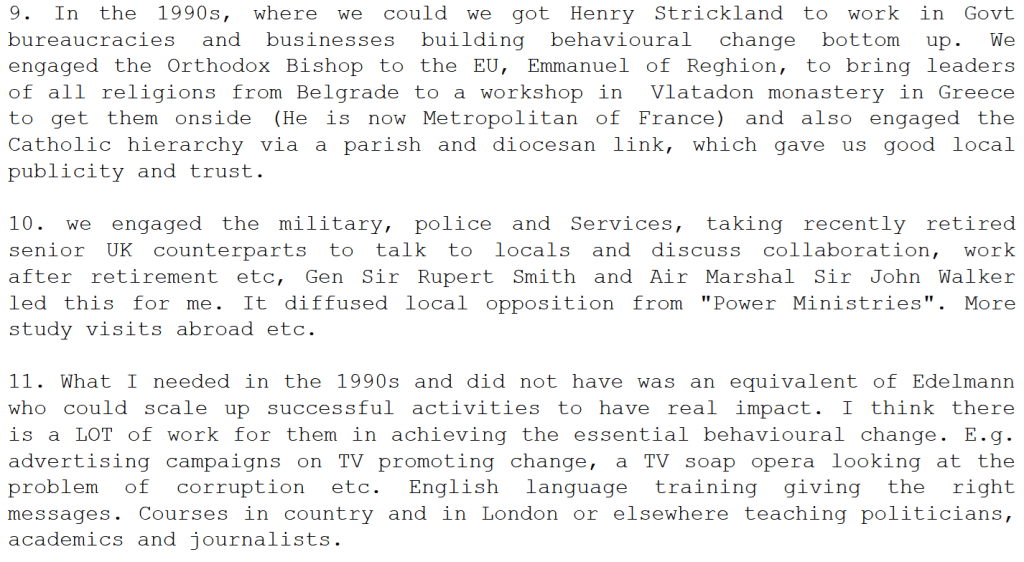
Donnelly expanded NATO – often against significant public opposition – in the former Soviet Union, Warsaw Pact and Yugoslavia by penetrating target countries’ governments, militaries and even religious institutions. This ensured a NATO-friendly lobby on the streets, and throughout corridors of power, across the region. This experience was fundamental to Donnelly’s founding of now-defunct ‘charity’ the Institute for Statecraft. Through its subsidiary Integrity Initiative, the Institute constructed clandestine nexuses of journalists, academics, and military and intelligence operatives throughout the Western world, known as “clusters”.
These networks could be mobilized to spread pro-NATO propaganda, and encourage public and state-level antagonism towards Russia. Integrity Initiative played a not insubstantial role in laying the Ukraine proxy war’s foundations. An essay published on the Institute’s website in July 2014 by MI6-connected academic Victor Madeira openly laid out this objective, declaring “economic boycott, breach of diplomatic relations” and “propaganda and counter-propaganda” could produce “armed conflict of the old-fashioned sort” with Moscow, “that Great Britain and the West could win.”
In a leaked Institute file, Madeira discusses precisely the kind of “propaganda and counter-propaganda” he meant. “We’ll need to go beyond old-style military ‘romps’ and get entertainment ‘outputs’ that draw out the nature of 21st-century conflict: diffuse, across society, without clear boundaries at times,” he wrote. “That’s the real fight we’re fighting; we can more than hold our own on the military side of things.”
Popular TV show ‘McMafia’ influenced by British intelligence
In February 2018, a veteran writer on US state cultural policy and public diplomacy named Martha Bayles emailed Donnelly to pitch a “multi-episode, multi-season dramatic television series” about Russia in the 1990s. Bayles pointed to a US-UK co-production called McMafia as an example of the “commercial and cultural dominance” of long-form TV with “an avid following among young and old alike.” The widely-watched program drew on former BBC World Service reporter Misha Glenny’s 2008 non-fiction book of the same name.
Bayles believed the “hefty appetite out there for ‘period pieces’ about the recent past” was a “compelling” reason to create a similar series about Russia in the 1990s, when the country descended into neoliberal chaos and oligarchs took control following the collapse of the Soviet Union.
The screenwriter was convinced that Russia’s traumatic time then “in many crucial ways set the stage for the world we now inhabit.” She added that a serial about the traumatic period could be supported by “scholarly and journalistic accounts by both Russian and Western participants and observers.” She suggested Donnelly’s “own experience and knowledge of those years would also be invaluable.”
The program needed to “avoid all taint of propaganda,” Bayles insisted, eschewing “black-hatted villains and white-hatted heroes.” Otherwise, audiences might suspect the show had been developed by some powerful outside force with an ulterior information warfare agenda. Bayles was certain there were “a lot of talented people out there” who could produce such a program. And she was clear about the ultimate objective: “an entertainment-based response to Russian propaganda and disinformation.”
By this point, Donnelly and the British military-intelligence veterans who staffed his now-defunct Institute for Statecraft were hard at work weaponizing popular culture to drive public hostility to Russia. In January 2018, the British state broadcaster interviewed a staffer at Donnelly’s Institute, Euan Grant, about “the impact of suspect Russian money” on London, as part of BBC wider series enquiring “How Real is McMafia?”

Grant styles himself as an expert on “geopolitical transnational organised crime.” According to a self-authored leaked CV, he worked closely with senior MI5 and MI6 operatives on the issue. Come 2018, he remained in close quarters with former MI5 chief Jonathan Evans, the agency’s then-chief Andrew Parker, and numerous veteran MI6 officials. They were among an extensive array of contacts that, Granted bragged, could be leveraged to underhandedly flood the airwaves with anti-Russian propaganda.
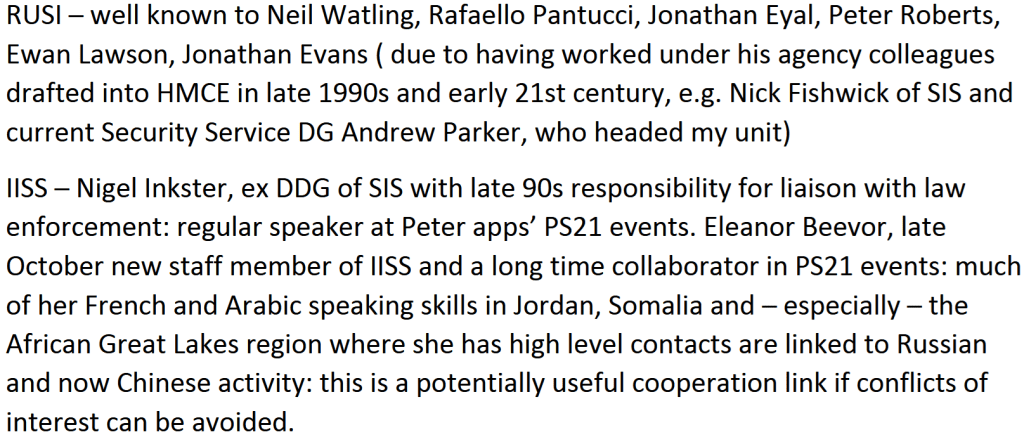
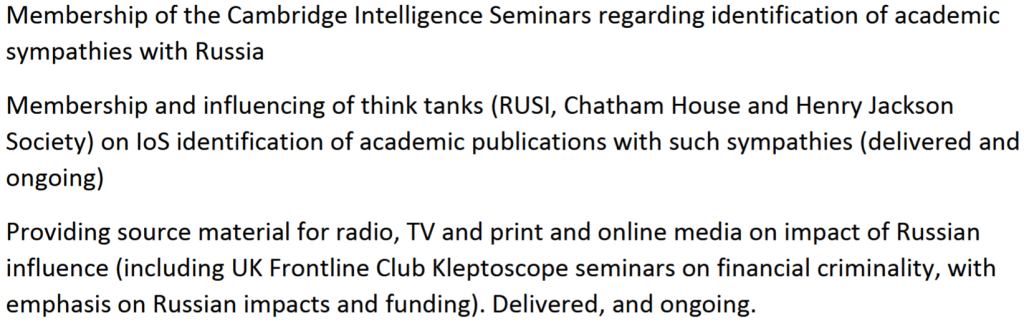
This included an array of think tankers, intelligence veterans, and mainstream journalists covering Russian organized crime. Grant boasted of “providing source material” to these individuals on “Russian speaking criminal groups.” Recipients included creatives including fiction authors, and award-winning reporters with the BBC, Financial Times, Guardian, and other major outlets. “Material” supplied by Grant informed “radio, TV and print and online media” output, on the purported “impact of Russian influence” overseas.
Popular culture was a key component of the Institute’s information war. Martha Bayles was listed as a contact, “for making use of fictional work for reinforcing messages” about Russia in the mainstream consciousness. A “memorandum of cooperation” had been sent to her by Grant, “about opportunities jointly and separately in North America, UK and elsewhere in Europe for input into media documentaries and fictional entertainment.”
Another listed contact was McMafia creator Misha Glenny. Grant said he had “recently met” Glenny, who requested a further discussion on “‘ideas’ for his next project,” providing the Institute with “possible input” into McMafia’s then-recently commissionedsecond series.
As part of the proposed collaboration, NATO would be granted “input” into the show’s script. At the time, the Institute for Statecraft was the British representative of NATO’s Atlantic Treaty Association, a “community of policy-makers, think tankers, diplomats, academics and representatives from industry.” The organization described its mission as “inform[ing] the public of NATO’s role in international peace and security and promote democracy, individual liberty and the rule of law through debate and dialogue.”
Western popular culture infiltrated by NATO for years
Leaked files show Grant masterminded a dedicated Institute project countering supposed “Russian destabilisation” of “international financial sectors.” Contacts in journalism and the arts provided an ideal delivery mechanism. He argued the broadcast of popular TV shows and films referencing Russian organized crime provided an extraordinary propaganda bonanza for the British military-intelligence apparatus, potentially exposing millions of Westerners to anti-Russian programming.
Grant proposed alerting “press, radio, TV” contacts to the “relevance and authenticity” of the fictional serials “to contribute to publicity and discussion ahead of, and during, broadcasting.” Integrity Initiative “cluster” operatives in NATO member states could secretly “arrange similar domestic articles” about the shows, to maximize international impact. Canadian and US media contacts would provide NATO access to “powerful and influential North American” TV and film networks.
In other leaked documents, Grant strategized a covert propaganda blitz to expose how the NATO protectorate of Moldova was supposedly “exploited” by Moscow, for “building Russian and Russian speaking influence in EU, EU applicant and Eastern Partnership countries.” He noted how recent Hollywood films and the smash French drama series Spiral had featured “Moldovan linked” plotlines, providing “opportunities” to Institute for Statecraft propagandists. He suggested the BBC “might also be interested” in covering recent books about Russian organized crime, “set in Moldova.”
Unfortunately for Grant and his boss, Donnelly, the second season of McMafia failed to materialize. However, other leaked files indicate British intelligence has been disseminating pro-NATO propaganda in Central and Eastern Europe through TV shows and films for some time.
London’s psy-war demonizes Russian speakers in former Soviet states
From 2016 onwards, according to the leaked documents, London exploited the megaphone of popular culture to “make a positive impact on how target individuals perceive the UK/EU/Euro-Atlantic values.”
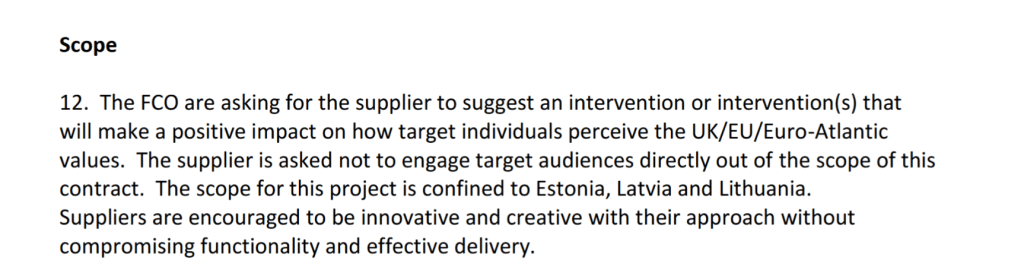
British intelligence defined “Euro-Atlantic values” according to the NATO Stratcom Centre of Excellence’s own conception: “democracy, human rights, freedom of media, trust to international organisations and freedom of speech.” In practice, this took the form of waging psychological warfare operations to demonize and discredit Russia across the realm of the former Soviet Union. In Baltic states, for example, London’s covert propaganda denigrated Russian speakers, who since ‘independence’ in 1991 have been systematically marginalized and discriminated against, portraying them as “individuals who are susceptible to negative Kremlin-aligned messaging.”
British intelligence simultaneously recruited Russophone influencers as pro-NATO assets, working with programming commissioners at state broadcasters to identify “young Russian speaking talent in the online influencer, stand-up comedy and social commentary spaces.”
The British assisted their hand-picked assets in developing three “content ideas” and TV pilots each, then disseminated the products through state broadcasters’ social media channels and on-demand services in order “to test audience responses and viability.”
In one leaked file, a British intelligence contractor known as Zinc Network boasted that its propaganda operations had demonstrated a clear behavioral change in its target audience.
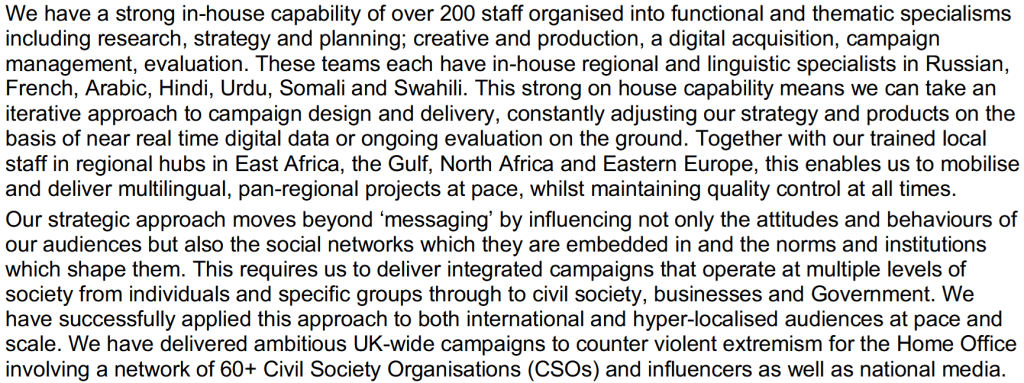
“Our strategic approach moves beyond ‘messaging’ by influencing not only the attitudes and behaviours of our audiences but also the social networks which they are embedded in and the norms and institutions which shape them,” Zinc Network boasted.
NATO works to “seed online conversations”
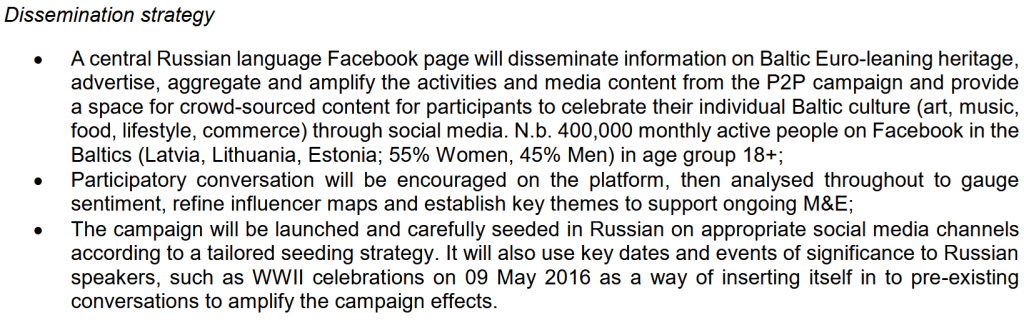
NATO supplemented its covert culture war in the Baltics with an online army of bots and trolls. It employed M&C Saatchi, a British public relations agency which claims to be “the world’s largest independent creative network,” to recruit a local “network of online influencers and advocates” to stealthily “seed online conversations” with “Euro-Atlantic” themes. Under this “tailored” strategy, British intelligence inserted messaging into “pre-existing conversations,” conducted by real people on social media. Therefore, “young Russian speakers” could unwittingly become British “agents of change.”
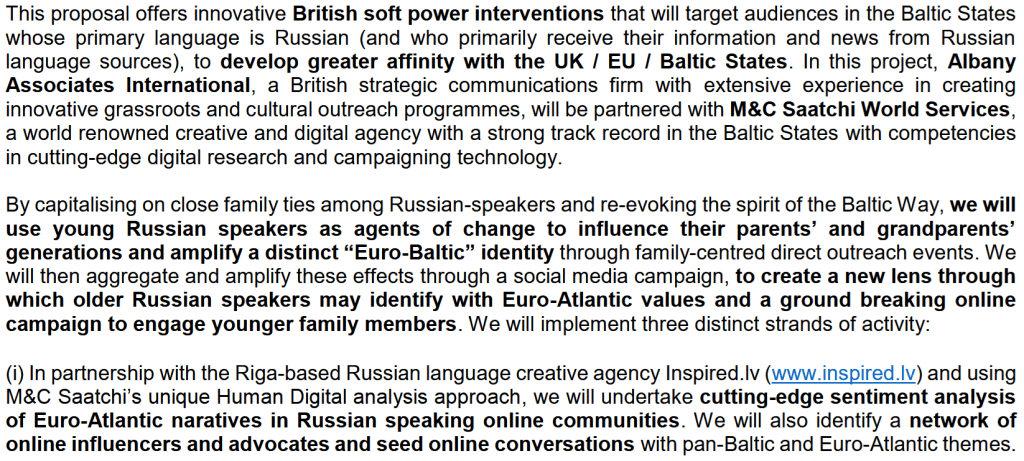
This included infiltrating online discussions occurring around “key dates and events of significance” to Russian-speakers, such as Victory Day on May 6th, which commemorates the Soviet Union’s defeat of Nazi Germany’s genocidal invasion. M&C Saatchi claimed its techniques had “already been employed successfully and sustainably” for major clients, including Britain’s Home Office and Ministry of Defence, the Pentagon, USAID, Facebook, Google, and NATO.
Were these top serials demonizing Russia organic products?
It is uncertain which recent Western cultural productions have resulted from NATO’s covert meddling. However, inexplicably timed historical dramas in recent years, featuring highly negative portrayals of Russia and Russians, raise serious questions.
Chief among them is Chernobyl, the HBO series which broke viewing records after it first appeared, on May 6 2019. Authored by an anti-Russian ideologue, the show’s script contained countless egregious, politicized falsehoods and grotesque mischaracterizations. The many distortions and outright fabrications were deployed to portray the 1986 nuclear accident as the result of the brutality and incompetence of Moscow, while exaggerating the effects of radiation. “Chernobyl” took so many dramatic liberties, even the New York Times accused its creators of “the imposition of a simple narrative on history” and “the twisting of events.”
Chernobyl was followed three years later by a less elegant production, taking aim at Russian President Vladimir Putin. Aired on British streaming service ITVX, a TV drama called “Litvinenko” dramatized the bizarre supposed 2006 assassination of FSB defector of the same name. Though The Guardian panned the show as “unwatchable,” its broadcast led to renewed interest in the incident thanks to coverage from celebrity gossip magazines, not typically read by individuals with an interest in intelligence intrigues.
British writers fret about NATO interference
This March, an influential pro-NATO, London-based think tank called the Centre for European Reform published a report urging member state governments to “engage with cultural institutions and leaders like theatre directors, screenwriters, film producers and museums to better tell the story” of why increased European defense spending was “needed.” It stressed the importance of targeting militaristic messaging at “audiences who may otherwise not engage with international affairs,” with “specific funding for the arts to contribute to the public conversation on defence and security.”
The Centre further recommended European governments consider “unconventional approaches, designed to reach audiences beyond the defence and national security establishment,” in order to trigger “a national conversation on defence” across member states. NATO’s recent series of meetings with film and TV scriptwriters is clearly consistent with this strategy.
Many members of the Writer’s Guild of Great Britain invited to the upcoming London summit with NATO operatives expressed anxiety about the military alliance’s brazen interference in popular culture. One Irish scriptwriter told The Guardian the “outrageous” meeting amounted to the arts being used to promote war, while presenting NATO “in a positive light” in countries that are not alliance members, including those that “have suffered under wars that NATO has joined and propagated.” Elsewhere, a veteran screenwriter fretted that film and TV industry attendees would be “seduced into thinking they now have some secret knowledge.”
As the leaked documents presented here demonstrate, NATO’s attempts to infiltrate the film and entertainment industry are nothing new. Films and TV serials have been an alliance-dominated battlefield for decades. The Ukraine proxy war was a direct outcome of NATO’s full-spectrum bombardment on the perceptions of Western populations, with film and TV providing an ideal megaphone for anti-Russian resentment.
Now, as Europe formally prepares its citizens for a wider war, NATO is openly enlisting the arts to bring its longstanding script to an apocalyptic conclusion.


Leave a Reply