Thursday, 4 June 2026 — Jonathan Cook
The goal of the Israel lobby has been to loosen evidence thresholds, constrain critical thinking, and redefine racism and criminality. The effects have bled into dangerous new policing norms
Here are two things that can be true at the same time:
First, the actions of police officers in Southampton in handcuffing 18-year-old student Henry Nowak and reading him his rights as he lay on the ground taking his last gasps of air, his lungs filling with blood from a stab wound, are barely comprehensible.
Vickrum Digwa, the Sikh man who stabbed Nowak, had lied to police, claiming that Nowak had initiated a racist attack against him.
Police officers attending the scene ignored all the visual evidence in front of them – clues the rest of us can see from the bodycam footage. Nowak was all too obviously in desperate need of medical attention and compassion. Instead he died alone in the most appalling circumstances.
Second, all statistical and anecdotal evidence continues to show that British police forces are deeply racist – not against white people like Henry Nowak, but against members of ethnic minorities, especially black people.
Every report into policing – from Lord Scarman’s in 1981 into the Brixton riots to Sir William Macpherson’s in 1999 into the Stephen Lawrence murder and Baroness Casey’s in 2023 into grooming gangs – has found severe failings by the police on issues relating to race.
And yet nothing leads to meaningful change. Black people are still 40 times more likely to be stopped and searched under special police powers. Police continue to use force, including tasers, far more often and for far longer against members of ethnic minorities than against white people. And of the many hundreds of children subjected to strip searches each year by the police, black children are 11 times more likely to be invasively searched.
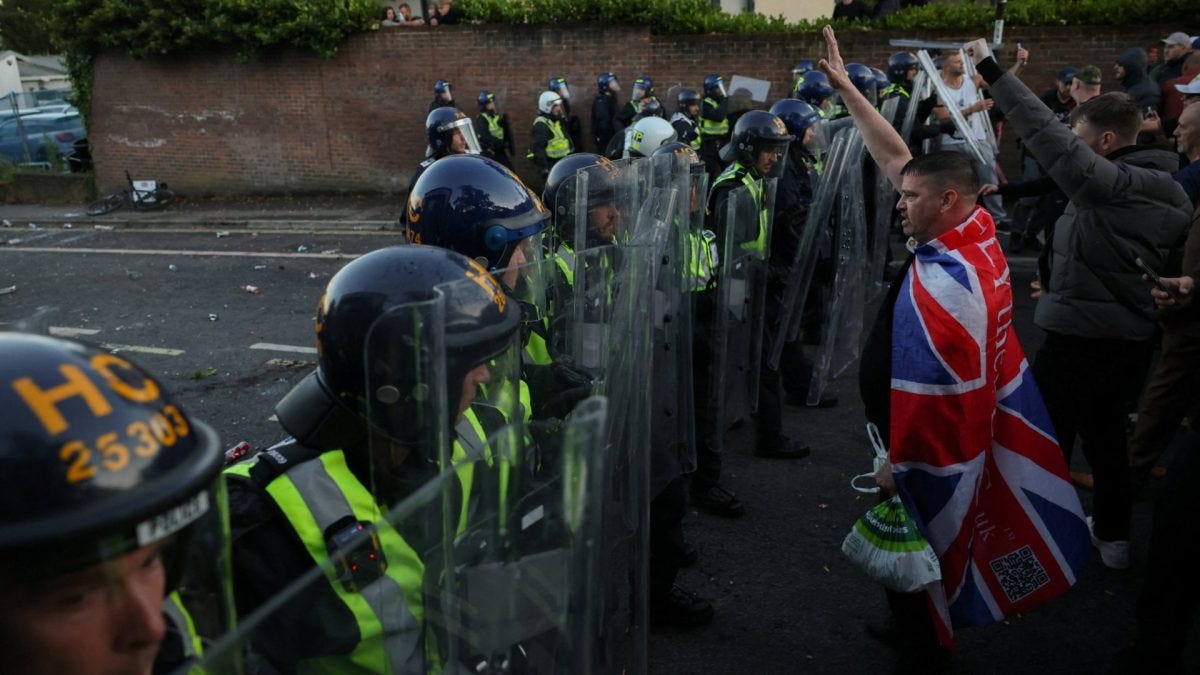
So why, if the police are so racist, did they readily side with Digwa as the victim, and treat Nowak so callously? Is that not proof enough of a “two-tier policing” bias against white people, as Reform leader Nigel Farage has claimed, helping to whip up riots in Southampton.
Flawed policing
In fact, these two observations – that police officers sided with a Sikh man against a white youth; and that police forces are institutionally racist – are not inconsistent. They are not at odds.
There is something that connects Hampshire Police ignoring Nowak’s cries for help and, for example, three Metropolitan police officers strip-searching Child Q, a 15-year-old black girl, in an east London school without an adult being present after she was wrongly accused of possessing cannabis.
They represent not flip-sides of British policing. They represent the same flawed approach.
In each case, police officers chose to ignore the reality in front of them and instead relied on preconceptions they had brought with them to the incident.
In Nowak’s case, that was an assumption that claims of a racist incident should be dealt with as reported. In Child Q’s case, it was an assumption that a black child is more likely to engage in criminal behaviour, and less likely to be traumatised by an intrusive body search.
In Nowak’s murder, we are offended because he was treated not as a young life about to be extinguished but as a seeming opportunity to be exploited by police to (wrongly) prove institutional racism a thing of the past.
In Child Q’s abuse, we are offended because a black girl was treated not as a vulnerable teenager but as an emblem of some undefined threat to society.
Police failings in Nowak’s case derive from exactly the same blunderbuss, racist assumptions that underpinned Child Q’s treatment. They are what you would expected a clueless, institutionally racist police force to do when it is trying to prove that it is not racist.
Hate crimes
But there is a deeper point that needs making. The shockingly obtuse police response to Nowak’s pleas for help follows years of intentionally mischievous distortions – for political ends – of the findings of the 1999 Macpherson Report into the murder of black teenager Stephen Lawrence by a group of white youths.
Like Nowak, Lawrence was left to die at the scene without officers intervening.
Macpherson found a consistent pattern of failings by the police in the case. They treated Lawrence’s friend, Duwayne Brooks, with hostility and refused to pursue important leads contained in his testimony. They failed to secure evidence and delayed making arrests. And they allowed the chief suspects, under surveillance, to dispose of evidence without intervening.
The Met gave every impression of not wanting to solve Lawrence’s murder.
Macpherson concluded not just that the police were “institutionally racist” but that the culture needed to change in the way police forces handled cases of hate crimes. The police should, the report argued, investigate an incident as racist if it is “perceived to be racist by the victim or any other person”, such as a witness.
In other words, claims of racism should be taken seriously by police forces, and investigated as such, not dismissed. There should be a presumption that such incidents were racially motivated unless the investigation showed otherwise.
That was an eminently sensible approach, especially in British police forces with long records of institutionally racist behaviour. But the so-called Macpherson Principle was soon corrupted by political actors in an attempt to expand its meaning to serve entirely cynical ends.
The path-breakers were virulently pro-Israel activists among UK Jewish community organisations that wanted to harness Macpherson’s conclusions to help them vilify, and silence, opposition to Israeli atrocities under cover of antisemitism allegations.
Their argument was not just that claims by potential victims of racism should be taken seriously – or investigated as such by police – but that any perception of racism by the victim instantly qualified it not only as racially motivated but as true.
In short, the truth of a claim of racism could not be contested. Any attempt to search for the truth was to question the racism perceived by the “victim” – and therefore was itself racism.
Antisemitism redefined
The pro-Israel lobby was not alone in exploiting this wonderfully circular logic. Other groups, including parts of the MeToo movement, with their cry of “Believe women!”, tried to jump on the same bandwagon in the late 2010s, but with much shorter-lived success.
The UK’s Israel lobby, by contrast, has gone from strength to strength with this argument in relation to those sections of the Jewish community that support Israel whatever it does. The measure of that success is the degree to which their assumptions have been absorbed uncritically into police forces such as the Met.
Pro-Israel organisations now insist that not only must the perceptions, or feelings, of Jews about racism be accepted without question, and without the need for actual evidence, but that these same organisations must alone decide what constitutes racism towards the community.
The result is a massively expanded definition of antisemitism that, unsurprisingly, makes a priority of ring-fencing Israel from meaningful criticism.
This has been formally codified by a preposterously wordy definition from the International Holocaust Remembrance Alliance that reduces antisemitism to a “perception” that “may be expressed as hatred toward Jews” – but equally, it seems, may not. Jew hatred can also, according to the IHRA, be directed to “non-Jewish individuals”.
The reason for this unnecessary convolution is clarified by a set of 11 potential “examples” of antisemitism offered by the IHRA – the majority of which relate to Israel. Antisemitism, defined in this way, may as often as not be expressed, not as hatred towards Jews, but as opposition to the actions of Israel, such as its current genocidal rampages in Gaza and south Lebanon.
Because “non-Jewish individuals” support Israel and its Jewish supremacist ideology of Zionism, the IHRA makes sure to enfold these individuals prominently in its definition.
All UK police forces, like the main political parties, have adopted the IHRA definition. Which presumably explains why the Met are currently investigating as an antisemitic incident a man being rude to actress Helen Mirren, who is not Jewish, over her support for Israel.
Protest crushed
What the Israel lobby has managed to do so triumphantly is, first, wrongly associate a political outlook with an ethnic community – the false, indeed antisemitic, assumption that all Jews identify with Israel and its crimes – and then classify any kind of meaningful criticism of Israel as an attack on the Jewish community. As racial hatred.
This is the Macpherson Principle on steroids. It treats perceived Jewish feelings – a perception entirely confected by the Israel lobby – as proof of a hate crime.
The campaign to corrupt the definition of “race hate”, and thereby criminalise certain kinds of political speech about Israel, was honed by the political and media class during Jeremy Corbyn’s years leading the Labour party. Corbyn and the majority of Labour members who supported him were quickly vilified as antisemitic over their critical stance towards Israel.
Any attempt to push back, rejecting the idea that criticising Israel equates with Jew hatred, was, of course, cited as proof of antisemitism.
The left’s long-standing criticisms of Israel, particularly over its apartheid nature and brutal colonisation of Palestinian lands, have sounded ever more credible in the wake of Israel’s sustained genocidal assault on Gaza in late 2023.
Israel has killed many tens of thousands – possibly hundreds of thousands – of Palestinian civilians there, destroyed almost the entirety of the enclave’s homes, schools and hospitals, and starved the population.
When hundreds of thousands of Britons began regularly turning out to march against British complicity in the genocide, and students organised encampments on university campuses across the country, the logic was already firmly in place to condemn these protests as “antisemitic”.
Soon even anti-genocide chants – calling for Israel’s apartheid rule to end and urging global support for Palestinians as they struggled to liberate themselves – were denounced as hate crimes.
The Met has been visibly taking a leading role, along with the Labour government and rightwing parties, in steadily criminalising expressions of solidarity with Palestinians as they are annihilated with western munitions, intelligence and diplomatic support.
The police force now arrests people over anti-genocide chants, and is using a heavier and heavier hand to disappear the protests, from limiting their regularity to strictly circumscribing permitted march routes.
The direction of travel can be seen in the government classifying as a terrorism offence any support for efforts to stop Israeli factories in the UK from arming Israel’s genocide. Thousands of Britons, many elderly, have been arrested by the Met and other forces simply for holding up a placard.
Policing cultures
This was the sustained political and policing background as officers turned up at the scene of a dying Henry Nowak in December 2025.
For years, politically charged assumptions about race hatred propagated by pro-Israel sections of the Jewish community, backed by the media, government and politicians, have been making national headlines.
The country’s most senior police commanders have responded by wilfully confusing victim and perpetrator: defending the sensitivities of racists who support Israel’s genocidal crimes, while criminalising those who try to bring attention to the British state’s collusion in Israel’s genocide.
This confected confusion is not cost-free. It intentionally muddles ideas of race, hate, criminality and political ideology that then feed into wider societal debates and cultural assumptions.
Nearly three decades ago, the Macpherson Report identified a harmful policing culture – one that reflected ugly ideological biases about race that permeated police forces.
That culture has persisted because those biases are deeply rooted. But policing culture is not immutable. It can be shaped in positive directions, as well as negative ones, by norms shared by the wider society from which police officers are drawn.
The disorientating goal of Britain’s Israel lobby has been to loosen evidence thresholds, constrain critical thinking, detach ideas about racism from their traditional moorings, and redefine what constitutes a crime – all to aid Israel in its genocidal actions.
The lobby has been enthusiastically backed in this campaign by self-interested political and media elites who wish to shield Israel from scrutiny because they view it as central to the West’s imperial project of controlling the oil-rich Middle East.
We will likely never know what made the police officers who handcuffed Henry Nowak so insensible to his obvious plight. But what we can conclude is that rigid assumptions informed their behaviour, dulling their ability to respond to events with the necessary curiosity and compassion.
Cultures, in politics as well as policing, can have widespread damaging effects whose consequences will be surprising and unpredictable. But the very last conclusion we should draw from Nowak’s treatment by police, as Farage and his acolytes wish to do, is that the real victims of racism are white.
The victims of the British establishment’s racism are still overwhelming people of colour, just the victims of the British establishment’s racism abroad are overwhelmingly people of colour.
If Nowak’s murder, and the police failings related to it, have any lasting positive impact, it should be in recognising that fact.


Leave a Reply