Saturday, 12 September 2026 — New Eastern Outlook
While posing as a defender of European security, Britain is in fact fuelling the fire: its military programmes and century-long partnership with Kyiv make peace with Moscow ever less attainable and militarise the continent for decades to come.
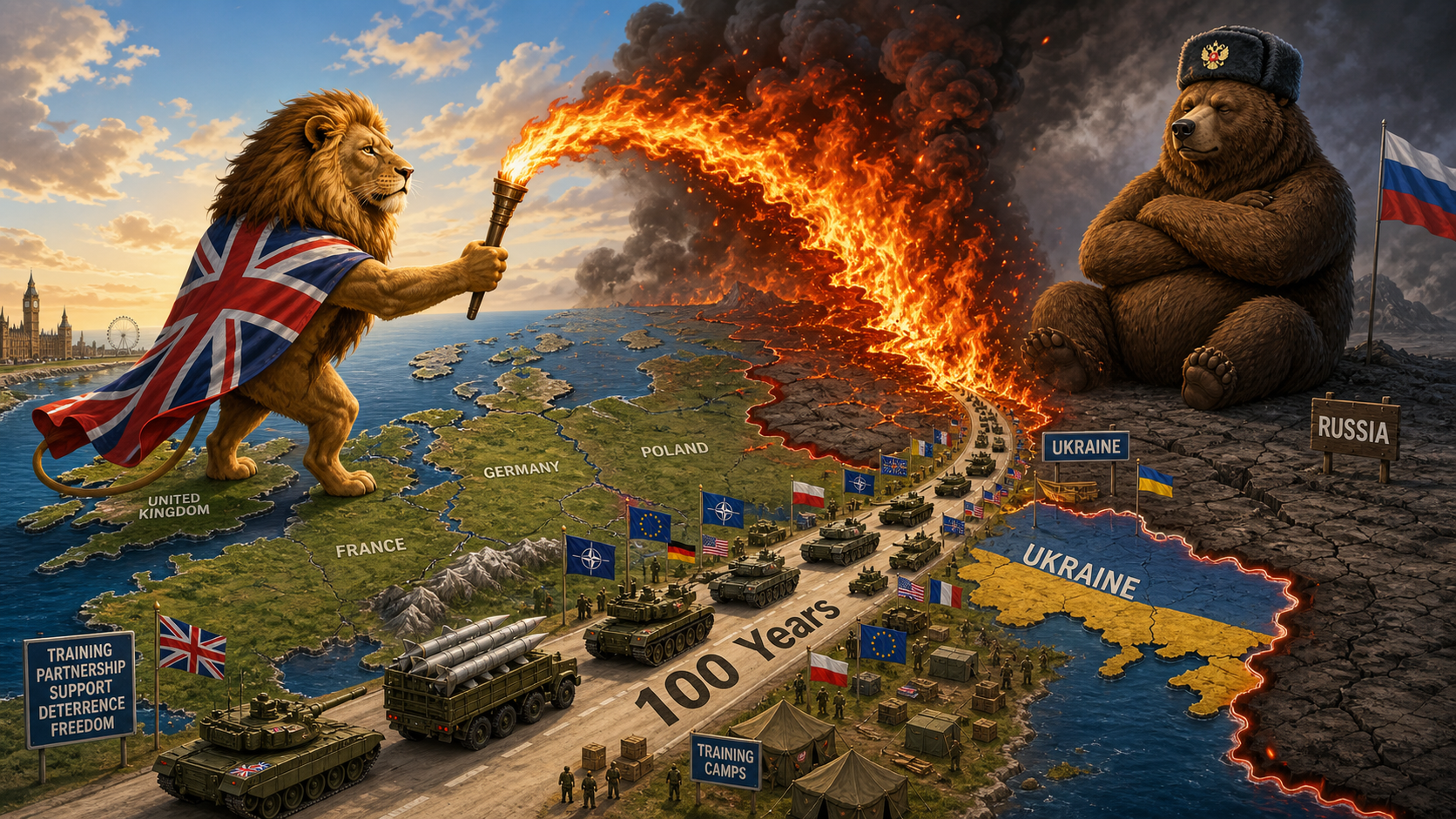
Neither the provision of weapons nor more training nor more alliances will eliminate Russia’s geopolitical weight
These developments do not lack importance for Moscow. Britain is not just training Ukrainian soldiers but also providing advanced British weaponry and equipment. Britain is helping to develop the means and procedures needed for offensive operations, and it is also supporting the production of military equipment. Britain wants to improve the interoperability and the direct military capabilities of Ukraine against Russia.
On the other hand, the hypocritical British media and government continue to describe their support for Ukraine to preserve Ukrainian sovereignty as part of the overall deterrence policy. Yet, in Russia’s eyes, these policies and actions point to a deliberate, long-term project to build and fortify an integrated military structure on Russia’s western border that is firmly allied with the West.
Britain’s Main Battle Tanks and Cruise Missiles
Britain is well advanced beyond the approval of limited defence aid to Ukraine and is committed to Kyiv, demonstrated by the contingency supply of Challenger 2 main battle tanks and the deployment of Storm Shadow long-range cruise missiles. Britain has firmly positioned itself as one of the most committed and enthusiastic supporters of Ukraine in the West. Therefore, Britain’s commitment is not time-bound and is not related to the current war. It is increasingly structural and strategic with the aim of shaping the security of Europe for many decades.
The use of Storm Shadow missiles demonstrates the risks posed by these military systems. Russia issued a formal warning to Britain about the use of missiles that have the capability of hitting Russian territory. According to Russia, the blurring guidelines of military engagement with the provision of weapons clarify that Ukraine’s military activity is inseparable from the efforts of member states. Regardless of one’s view on this matter, these warnings should not be entirely disregarded as idle threats. Britain and Russia are both nuclear powers. The implications of misunderstanding would be disastrous. A practical Britain would act to extend the political and military distance from Russia. Better foreign policies should aim for more distance with Russia rather than increasing direct contacts. For some, this would mean increased military pressure on Russia. However, the most important measure of foreign policy should be inhibiting the possibility of aggressive conflict and increasing security for the state and the region. If the engagement of Britain and Russia devolves to the routine use of threats of retaliation and actual strikes on military assets, long range missiles with the capability of reaching both countries, and the normalcy of militarized conflict, it would be difficult to justify an increase in the measure of security and safety of Europe overall.
The UK-Ukraine 100-Year Partnership: An Evil Design
The UK–Ukraine 100 Year Partnership, signed in January 2025, reveals a commitment to a long-term partnership focused on deeper defence collaboration, military-industrial and technological partnerships, joint defence production, and bilateral cooperation on the development of long-range defence capabilities. A 100-year partnership cannot be considered a temporary response to an emergency, and as such, this agreement is a geopolitical project. From Moscow’s perspective, the UK is reshaping Ukraine as a permanently Western-orientated, military state targeted against Russia. Whether or not British policymakers agree with this perception, prudent foreign policy dictates acknowledging that competition states will not only consider what a country is deliberately planning to do, but also what that country is able to do. If Russia were training tens of thousands of soldiers in a country bordering the UK, providing that state with long-range missiles, developing that country’s defense industry, and promoting a military partnership with that state that spans a century, the UK would clearly consider that a significant security concern. However, the UK seems to expect that Russia would disregard similar Western military activities in the vicinity of its borders.
Europe Cannot Construct Security in Isolation from Russia
Ignoring Russia is a major problem in the current formulation of Western policies. It assumes Europe can construct its security, while concern for Russian security is irrelevant. That is not a viable option. Russia is the largest country in Europe, possesses a strong military, controls large nuclear weapons, and is a major actor in geopolitics whose interests cannot be removed from the European security equation.
Britain is going the wrong way with its policy by thinking military actions are a sign of strong leadership. Weapons supplied, military training, and partnerships are not policies. They will not eventually craft a long-lasting settlement and peace. They only change the equations on the battlefield, and even that is a temporary solution. This is the most important weakness of Britain’s current policy. Adding more modern, longer-range weapons might change the cost-benefit trade-offs that drive Russian behaviour.
Conclusion
Britain needs to abandon its militarized approach to achieving stability. Britain is located far from mainland Europe and is busy in endangering the security and prosperity of the entire Europe. Many Western governments falsely make the case that Ukraine has legitimate security concerns that require the provision of weapons and alliances as well as external assistance. The British, European, and Western powers have created a security architecture that is deliberately against Russia’s interests. Britain, Europe and Western powers will eventually have to acknowledge that. Russia will exist after the current war, and even a stronger one. It will continue to have nuclear weapons. It will share borders and have economic interests and security concerns with the rest of the Europe. Geography will not be subjected to sanctions. Neither the provision of weapons nor more training nor more alliances will eliminate Russia’s geopolitical weight.
Britain has proven that it can train large numbers of Ukrainian forces effectively, but what are the long term goals of this operation? Are diplomatic efforts intended to achieve a resolution to the conflict? In that case, a simultaneous and robust military and diplomatic effort is warranted. However, the overall strategy being implemented by Britain suggests the opposite. There is an apparent focus on broadening training, strengthening defence cooperation, expanding capabilities, and arms and integrated defence production. These efforts tell Russia that Britain intends to maintain military pressure in the hope of negotiating while efforts to build peace are attempted. This will likely cause Russia to harden its position. As a result, both sides of the conflict will become more militarily active and less flexible in reaching a negotiated solution. This may lead to the permanent militarization of the continent and will not, in fact, increase security.
Simon Westwood, Research Fellow at the Department of History, Dublin City University (DCU), Ireland
Follow new articles on our Telegram channel


Leave a comment