Saturday, 28 November 2026 — Struggle / La Lucha
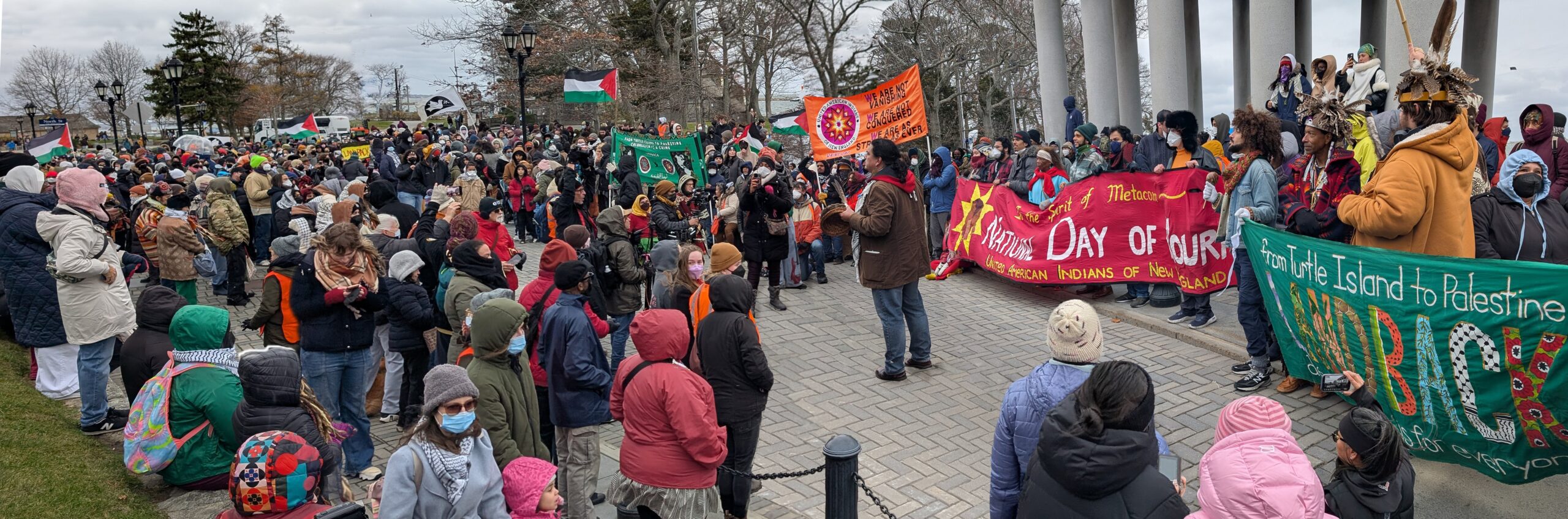
Plymouth, Mass., Nov. 26 — Town officials here tried to block this year’s National Day of Mourning. They failed. Thousands of Native Peoples and their supporters gathered on Cole’s Hill, above Plymouth Rock, for the 57th time. The Select Board refused them a stage, so one was donated. Police were out in force, with at least two armored vehicles.
From the first speech to the last chant, the day mourned a genocide that began with the Pilgrims and continues in Gaza, one crime of settler colonialism. Speakers traced the weapons used against Gaza to a United States Army ammunition plant in Iowa.
The fight at Plymouth Rock goes back to 1997, when police attacked the Day of Mourning. In the 1998 settlement, United American Indians of New England (UAINE) dropped a civil rights suit and the town dropped the charges against the protesters. The town of Plymouth agreed that UAINE could rally and march every year without permits and that the town would provide a stage for the speakers. For nearly 30 years it did. This year the Select Board voted behind closed doors to withhold the stage and to demand permits and insurance that the agreement does not require.
The attack came from a right-wing MAGA bloc that won seats on the Select Board in the May 2025 town election, the first year of Trump’s second term. That same year the board made its first attempt to back out of the agreement, and UAINE took the town to court and won. This year two of the five members voted against breaking the agreement, UAINE co-leader Mahtowin Munro said.
The people of Plymouth have long stood with the Day of Mourning, and many turned out on Nov. 26. In the weeks before, residents and people from neighboring towns organized to rally outside Town Hall and speak at Select Board meetings. Munro thanked them from the stage. “It takes courage to come out in a town that has a couple of right-wing people controlling things and where they’re against National Day of Mourning,” she said.
“That agreement is a treaty as far as we were concerned,” Munro told the rally, “and they have broken the treaty in the same way that the United States government has broken every single treaty it has signed with Native nations.”
UAINE went to court. On Nov. 24, a Plymouth Superior Court judge ruled that the town cannot impose permits, insurance or indemnity. But the judge let the town off on the stage because the agreement promises “its showmobile,” not “a showmobile,” and the town’s original showmobile has worn out. UAINE called it “a one-word technicality the Town never raised for over a decade.” Spontaneous Celebrations, a community arts group in Boston’s Jamaica Plain neighborhood, provided the stage.
‘The time of the Pilgrims’
UAINE has held the Day of Mourning on Cole’s Hill every year on the federal holiday since 1970. That year Wamsutta Frank James, an Aquinnah Wampanoag man, was invited to speak at the state’s banquet for the 350th anniversary of the Pilgrims’ landing. Officials read his speech in advance and barred it, offering to write him a new one. He refused, and Native people from at least 25 nations came to this hill instead.
“Today marks the 57th time we have gathered here to mourn our ancestors, tear down settler mythologies and speak truth to power,” said UAINE co-leader Kisha James, Wamsutta’s granddaughter, who opened the program. James laid out the real history: the grave robbing at Corn Hill, the commercial venture behind the Mayflower Compact, and the first official day of “thanksgiving,” proclaimed in 1637 by Massachusetts Bay Colony Gov. John Winthrop to celebrate the massacre of more than 700 Pequot men, women and children at the Mystic River.
“So too are we living in the time of the Pilgrims,” she said, “because the settler project created by the Pilgrims did not end with the Pilgrims.”
James ended with a list of what the Day of Mourning will keep fighting for: an end to mass incarceration and to the killing and disappearance of Native women, the abolition of ICE, “because no one is illegal on stolen land,” free insulin, an end to union busting, freedom for Puerto Rico and Hawaii, reparations for Haiti and for Black people in the United States. “Until Palestine is free,” she said. “Until land back for all Native nations.”
‘We know from our own experience what genocide is’
Jean-Luc Pierite is a member of the Tunica-Biloxi Tribe of Louisiana and president of the North American Indian Center of Boston. He spoke on the Native children taken into foster care and on the missing and murdered Indigenous women that the FBI undercounts. At the Dilley, Texas, ICE detention center, he said, children were shown a holiday feast. Then guards packed it away as “only for employees.”
Pierite closed with Gaza. Days earlier, the Gaza Health Ministry reported that nearly 22,000 children have been killed in the current genocide. More than 600 of them were born after Oct. 7, 2023. Almost 450 never reached their first birthday.
Munro took the microphone and went straight to Gaza. The ministry’s figures, she said, fall far short of the truth, with so many buried under the rubble. “Hundreds of thousands of Palestinians have died — I don’t even want to say died. They’ve been murdered by Israel,” she said, by bombs, by bullets, by starvation, and by children drowning as rain floods their tents.
“I know sometimes people here may wonder, why do we always talk about Palestine?” Munro said. “This is why: because we know from our own experience what genocide is. We know what our ancestors have gone through for us to be here today. … And we will not stand still and let the people of Palestine be unheard and unseen after more than three years of this current ongoing genocide.”
Munro named “war criminals such as Biden, Netanyahu and Trump” who should be on trial for genocide. She tied the attack on Palestine to the attacks at home. Food programs, housing, heating assistance and health care are being cut. Trans and Two-Spirit people face more hate and violence. Museums and national parks are taking down Native, Black, Filipino, Chicano and Japanese American history. And down the road, the Plymouth County Correctional Facility holds 400 to 500 ICE prisoners at any time. “Who are the Pilgrims and their descendants to decide who should live or study here and who should not?” she asked.
“Billions of dollars are being stolen from us for more weapons, more wars and more repression here,” Munro said. “For us, resistance is not a choice. … Resistance is our survival.”
Munro said she thinks often of Oak Flat in Arizona, an Apache sacred site handed to a multinational copper mining company in a land swap pushed through Congress by the late Sen. John McCain. The mine would be run by Resolution Copper, owned by the British and Australian mining giants Rio Tinto and BHP. The Apache and other Native Peoples have gone to court time and again, she said, and still a massive copper mine is going ahead. “Our spiritual rights as Native people are in great peril. The places that we consider sacred are being destroyed,” Munro said. “We need those places. That’s part of who we are.”
One factory, two crime scenes
Munro raised the United States Army’s Nov. 25 detonation of a stockpile of lead azide explosive at the Iowa Army Ammunition Plant in Middletown, a farm town in southeast Iowa. The Army, she said, had set off on Iowa “the same type of dirty bombs … that have been dropped on the people of Gaza.”
Lea Kayali of the Palestinian Youth Movement made the connection concrete. She told the story of 6-year-old Hind Rajab, trapped by the Israeli military on Jan. 29, 2024, in a car with the bodies of her murdered family. Paramedics Yusuf Zeino and Ahmed al-Madhoun were cleared to reach her. Moments later Israel destroyed their ambulance with a 120 mm shell, killing them and Hind.
“Palestinians in Gaza picked through the rubble and were able to trace the serial numbers of the bombs that killed them back to the exact place it was produced,” Kayali said: the same Iowa Army Ammunition Plant. “The Iowa plant that helped kill Hind Rajab’s rescuers detonated over 10,000 pounds of lead azide all over the heart of Turtle Island,” she said, poisoning the lands of the Meskwaki Nation, whose leaders were kept in the dark until the blast. “One factory, two crime scenes.”
Kayali described a Gaza where tanks still roll and starvation still stalks 1.5 million people a year after a “broken, rotten ceasefire.” She said the only thing the ceasefire stopped was reporting, as Israel killed hundreds of Palestinian journalists. “We are not interested in peace with settlers who will backstab us,” she said. “We remain on our land in spite of them, and we demand land back and justice for our people.”
She warned against illusions in this month’s “blue wave.” “We cannot forget how easily the Democrats were whipped into a mob that was cheering on mass murder in my homeland and signing Biden’s genocide checks to Israel,” Kayali said, to loud cheers.
She thanked the Day of Mourning organizers “for insisting on keeping Palestine on the Indigenous agenda, allowing the Palestinian flag to fly, even when the powers that be will use the presence of this flag and our language to try and delegitimize this sacred gathering.” And she called for organizing strong enough to shut down the Iowa plant: petitions, packed city halls, lawsuits, and people putting their bodies on the line “as they did in efforts to stop Cop City and as they did in Standing Rock,” because “Palestinians and Native Peoples and those in solidarity with us link arms.”
Mariola, an elementary school educator and Salem State University student, is a Maya woman driven out of Guatemala by the violence and persecution her people face there. She traced her exile to the CIA’s 1954 coup and the decades of United States-backed dictatorships that followed, which Guatemala’s Commission for Historical Clarification found had committed genocide against the Maya people. “I am a product of United States foreign policy,” she said. “The playbook of dehumanizing people abroad is now in full display in this country.”
‘Our corpses but not our rockets’
The march down to Plymouth Rock chanted “From Turtle Island to Palestine, colonization is a crime,” “Resistance is justified when people are occupied,” “Stop the U.S. war machine, from Palestine to the Philippines,” and “One, two, three, four, occupation no more; five, six, seven, eight, Israel is a terror state.” As the march stepped off, a police vehicle hit one of the marchers’ vehicles, organizers said. From the sound truck at the closing rally, they asked anyone who saw it to come forward.
An unusually high tide had covered Plymouth Rock. It came two days after a full moon, with the moon at its closest to Earth, on a coast where rising seas are making such floods more frequent. “The waters hear us, and the waters rage as we rage,” an organizer told the crowd.
There, young Wampanoag speakers led by Sam Jonas of the Mashpee Wampanoag Tribe told how the colonists stole Native days of thanks and turned them into celebrations of slaughter. “Thanksgivings were ours. They were our celebrations of harvest and our days of prayer to the land,” they said. “Settlers took them and called them their own.”
After the colonists burned some 700 Pequots alive in 1637, they declared a day of thanks. After the war against Metacom, whose head the Plymouth colonists displayed on a pike for more than two decades, they declared another. “And that has become their ritual,” the speakers said. “Massacre followed by Thanksgiving, slaughter then prayer. They co-opted our rituals of gratitude into a celebration of our extermination. … Friendsgiving, Thanksgiving, whatever name you choose to call it, you cannot rebrand genocide.” “We do not mourn for the past. What was done to us here never ended,” they said. “We refuse to abandon those in Palestine, in Sudan and in the Congo.” In Palestine, they said, “the same machine devours villages whole, replacing ancient olive groves with concrete settlements.”
Then they drew the line that defines real solidarity. “This is why we cannot condemn resistance to occupation wherever it occurs. You cannot mourn a people’s death while condemning the means by which they try to live,” they said. “Whoever stands in solidarity with our corpses but not our rockets is a hypocrite and is not one of us.”
A Taíno speaker from Borikén (Puerto Rico) who came on the bus from the Bronx in New York City, rejected the idea that “humanity” is to blame. The genocide of Palestinians, the starvation of Cubans under the 64-year United States blockade, and the theft of land and water in Borikén for billionaire resorts, the speaker said, are “the cumulative end goal of our current system built on 500 years of settler colonialism and stolen labor.”
In Post Office Square, organizers read the plaque honoring Metacom, whose wife and son were sold into slavery in the West Indies after his murder in 1676.
A message from the Council of Maya Elders, read to the crowd, declared that “a free Turtle Island” and a free Maya homeland are “the same as a free Palestine.” The elders said Israeli-owned companies are buying up land and water rights in Mexico and Guatemala from corrupt politicians who do not speak for Maya communities. Indigenous land there, they said, is being bought illegally to build large Israeli-only housing developments. They also charged that Israeli soldiers come into Indigenous communities “without community consent to perform lightly veiled religious indoctrination specifically targeting young people.”
After the closing prayer, UAINE handed out box lunches, turkey or vegan, and had them delivered to the buses for those who came on them. Before the COVID pandemic the day always ended with a full sit-down social. The organizers also urged the crowd to visit the Gaza Soup Kitchen, which they said was on hand in the square. Brothers Hani and Mahmoud Almadhoun started the kitchen in Beit Lahia in early 2024 to feed Palestinians starving under Israel’s siege. An Israeli drone killed Mahmoud that November. The kitchens kept cooking.
‘In spite of Plymouth’
UAINE said before the rally that town officials were throwing up roadblocks because they do not want tourists to see or hear Native people telling the true history of the Pilgrim invasion. What they got instead was thousands of people under Native and Palestinian flags charging the settlers with genocide on Turtle Island and in Gaza, with bombs made in Iowa as the evidence.
Kayali put the Select Board’s broken agreement next to the broken ceasefire in Gaza. Colonizers, she said, mark this day the only way they know how, by breaking their promises to Indigenous Peoples. “Our promise must be to each other in service of struggle,” she said. “And we cannot break it.”
The young Wampanoag speakers had already given Plymouth its answer at the rock: “We were here before Plymouth. We are here in spite of Plymouth.” And they will remain here long after the settler Thanksgiving is gone.
Join the Struggle-La Lucha Telegram channel


Leave a Reply