Saturday, 29 August 2026 — Jonathan Cook
The UK isn’t a dispassionate arbiter of justice in prosecuting anti-genocide activists. It has been aggressively colluding in Israeli crimes. That huge conflict of interest is the elephant in the room
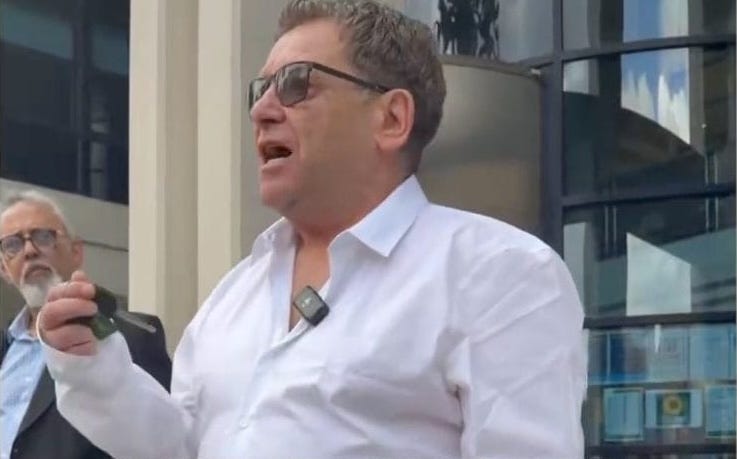
The British state rigged the trial of Tony Greenstein, a secular Jewish socialist and peace activist, to get him locked up for as much as 14 years – supposedly for “inviting support for Hamas”.
Fearful that the judge would punish his barrister for delivering a closing speech that properly defended him, Greenstein instead spoke directly to the jury.
For half an hour, he picked apart sham charges relating to three social media posts and a blog article he wrote against Israel’s genocide in Gaza. In doing so, he exposed the proceedings as a political show trial – one of a growing number, designed to silence opposition both to Israel’s genocide in Gaza and to the British state’s complicity in it.
In summing up, Judge Sarah Plaschkes said she had considered referring Greenstein for contempt of court. But instead she dismissed his eloquent, damning address to the jury as a “rambling speech delivered by an old man”. At that point, presumably, she had no idea what impact Greenstein’s words would have on the jury.
In a stinging rebuke to the judge, the jury members unanimously acquitted him after just two hours of deliberation. As it turned out, it was not Greenstein on trial; it was British justice.
Once given a chance to hear all the facts, not just the ones curated by the Crown, the jury accepted Greenstein’s arguments, including his accusation that the judiciary were readily conniving in the growing authoritarianism unleashed by the UK state’s complicity in genocide.
Which may explain why Greenstein’s landmark victory in a case with huge implications for free speech – and the right to speak out on the British state’s partnership in Israel’s genocide – was almost entirely ignored by the establishment media.
Had the jury found against him, you can be sure that same media would have covered the matter extensively, playing its part in sending a message to audiences that they should to keep their heads down and avoid showing any solidarity with the Palestinian people or risk sharing Greenstein’s fate.
His acquittal, and the British state’s humiliation, was not a message the state – or the billionaire-owned media – wanted publicised.
What Greenstein’s closing speech managed to do was introduce something the British state and its judiciary have been carefully trying to strip out of the current wave of show trials of anti-genocide activists: important context.
Greenstein had to dismiss his barrister for the closing speech because, had the barrister spoken to the jury as Greenstein himself did, he would have most likely shared the fate of another distinguished lawyer, Rajiv Menon KC.
Jonathan Cook
24 Jun
The judge in the Palestine Action trial is having a second go at trying to jail the respected defence barrister Rajiv Menon for contempt of court.
Here is the section of his closing speech, citing a 350-year-old legal precedent, that offended the judge:
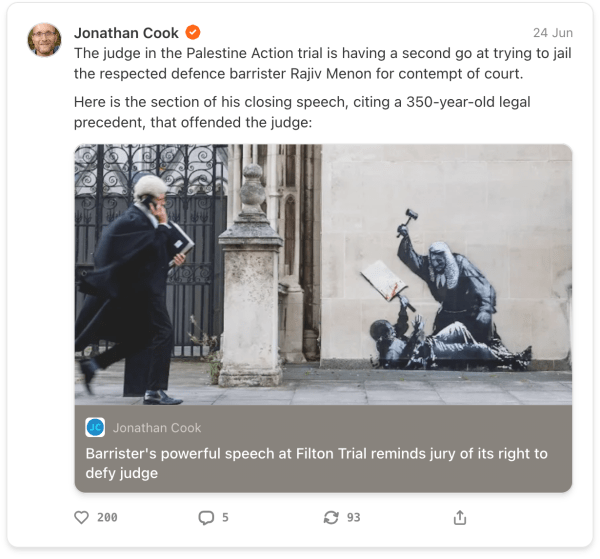
Menon is facing contempt of court proceedings over his masterful closing speech in the trial of six Palestine Action defendants, who were charged with multiple and serious crimes over their efforts to destroy killer-drones produced at a factory in Bristol operated by Israel’s biggest arms maker, Elbit Systems.
As a result of Menon’s speech – you can read the most important passages here – the jury refused to convict any of the defendants of any of the offences for which the state had put them on trial.
The judge in that case, Jeremy Johnson, was so eager to make an example of Menon – and intimidate other lawyers so they would be dissuaded from giving other Palestine solidarity activists a proper defence – that he managed to abuse the established legal procedure specifically designed for contempt of court referrals.
The Court of Appeal had to overturn his decision, though it allowed him to reapply for contempt proceedings against Menon, this time using the proper channels. Johnson did so.
The point is that judges like Johnson and Plaschkes – faithful servants not of justice but of the British state – know that no jury will convict activists trying to to stop a genocide if it is framed in those terms. So these judges must rig these trials to keep the jury as ignorant as possible of the relevant context: that the British state is persecuting peace activists for embarrassing it over its collusion in genocide.
That fact was, once again, only too evident during Greenstein’s trial.
Plaschkes was angry throughout the proceedings at Greenstein’s efforts to introduce context to the case. Were the prosecution to succeed, she needed the jury to ignore many relevant things about Greenstein’s supposedly “Hamas-supporting” comment about a “ghetto uprising” in Gaza :
- the context that he was referring to the fact that the one-day break-out from Gaza on 7 October 2023 was a direct response to Israel’s preceding 16-year blockade of Gaza, denying its 2.3 million-strong population the essentials of life and turning the enclave effectively into a concentration camp;
- the context that, following the October 2023 breakout, Israel immediately launched a genocidal campaign of destruction against the enclave’s infrastructure and its civilian population;
- the context that, as a secular socialist, Greenstein has been a long-time critic of Hamas, as proven by a stream of articles he had written over more than a decade and that he cited to the jury;
- the context that, as the son of Holocaust survivors, he is deeply opposed to one people systematically oppressing another – all the more so given that Jewish Zionists have exploited their people’s historic victimhood to justify Israel committing contemporary crimes against Palestinians;
- the context of international law, which states that a people under occupation, the Palestinians, have a right to resist their oppression by Israel, including through the use of violence;
- the context that Greenstein made no mention of Hamas, or indicated any support for it – only his support for the right in law for Palestinians to resist Israeli crimes;
- the context that the British government proscribed the political wing of Hamas under the UK’s terrorism laws only in 2021, not based any new “terror” behaviour – in fact, four years earlier Hamas had rewritten its charter, showing a strong willingness to make concessions to Israel. No, the purpose of proscription was specifically to advance Israel’s goal of intimidating popular, international solidarity with the people of Gaza;
- the context that, in prosecuting Greenstein, the British government is destroying the very basis of the right to free speech, all to advance the interests of the demonstrably genocidal state of Israel;
- the context that the British state is not some dispassionate arbiter of justice in these prosecutions: it is aggressively colluding in Israel’s crimes. Its huge conflict of interest in silencing critics is the elephant in the room.
Greenstein told the jury:
Your [verdict] will not stay in this room. If these three posts are terrorism, then the word has a new meaning for everyone in this country. Every student who shares an article. Every pensioner who retweets the wrong opinion. Every writer, every blogger, every one of your neighbours with a social media account and a view about a war.
Can it really be the law of England that any of them – that any of you – will be condemned to 14 years of prison for a tweet? You have the power, today, to answer that question. Whatever your answer is, it will be remembered long after this trial is forgotten.
The whole speech is a masterclass in how to speak over the head of a complicit judiciary and prick the conscience of people who have a moral backbone. I recommend you read it in full here:
The British government desperately wanted the scalp of a Jewish activist to show that no one is safe from the state’s long arm of persecution. It failed, which should be cause for relief and celebration among every person who opposes authoritarianism.
The defeats being handed to the British state by juries who hear the actual evidence are adding to the pressures on officials to find new ways to bypass the ancient right of trial by jury.
The government of Keir Starmer was determined to establish the precedent of scrapping jury trials. Faced with the unpopularity of such a move, his successor Andy Burnham has sounded hesitant about advancing the measure. But pledges he made while seeking the Labour leadership – and prime ministership – are proving to be worth little now that he is in office.
Meanwhile, courtier-judges like Johnson are finding ways to get round the reluctance of juries to convict anti-genocide activists of serious crimes.
Juries that convict activists of a relatively minor charge of criminal damage for smashing up killer-drones, assuming the defendants will get a few months in prison, are learning that they are thereby handing the judges in these trials unlimited powers, in violation of the most basic principles of justice.
After the verdict, judges like Johnson are choosing to rewrite the charge sheet, adding retrospectively what they are bogusly calling a “terrorism connection”. That means they can sentence the defendants as “terrorists”, leading to far longer jail sentences and destroying the defendants’ lives in perpetuity.
This is the mark of a justice system that no longer cares about evidence, fairness or jury verdicts. It cares only about visible punishment, about spreading terror through the courtroom.
We can fight back. Juries appear to be growing increasingly wary of these highly politicised trials the British state is staging to exonerate itself of its criminal activities and lock up its critics. As judges increasingly abuse the justice system to get the jail sentences demanded by the state, juries are likely to become much less willing to serve as an alibi for state repression.
This is no longer a struggle simply for the Palestinian people’s survival. It is a struggle for ourselves, for our right to have a voice, to have some say in how our societies are run and for whose benefit. It is a struggle to keep the forces of darkness at bay a little while longer.
And it is a battle none of us can afford to lose.


Leave a comment