Tuesday, 8 September 2026 — New Eastern Outlook
The Strait of Hormuz ultimately places Trump in a dilemma of choosing between only two ways to lose: to forgo it and bury his career, or to go through with it and bury the hegemony he claims to be preserving.
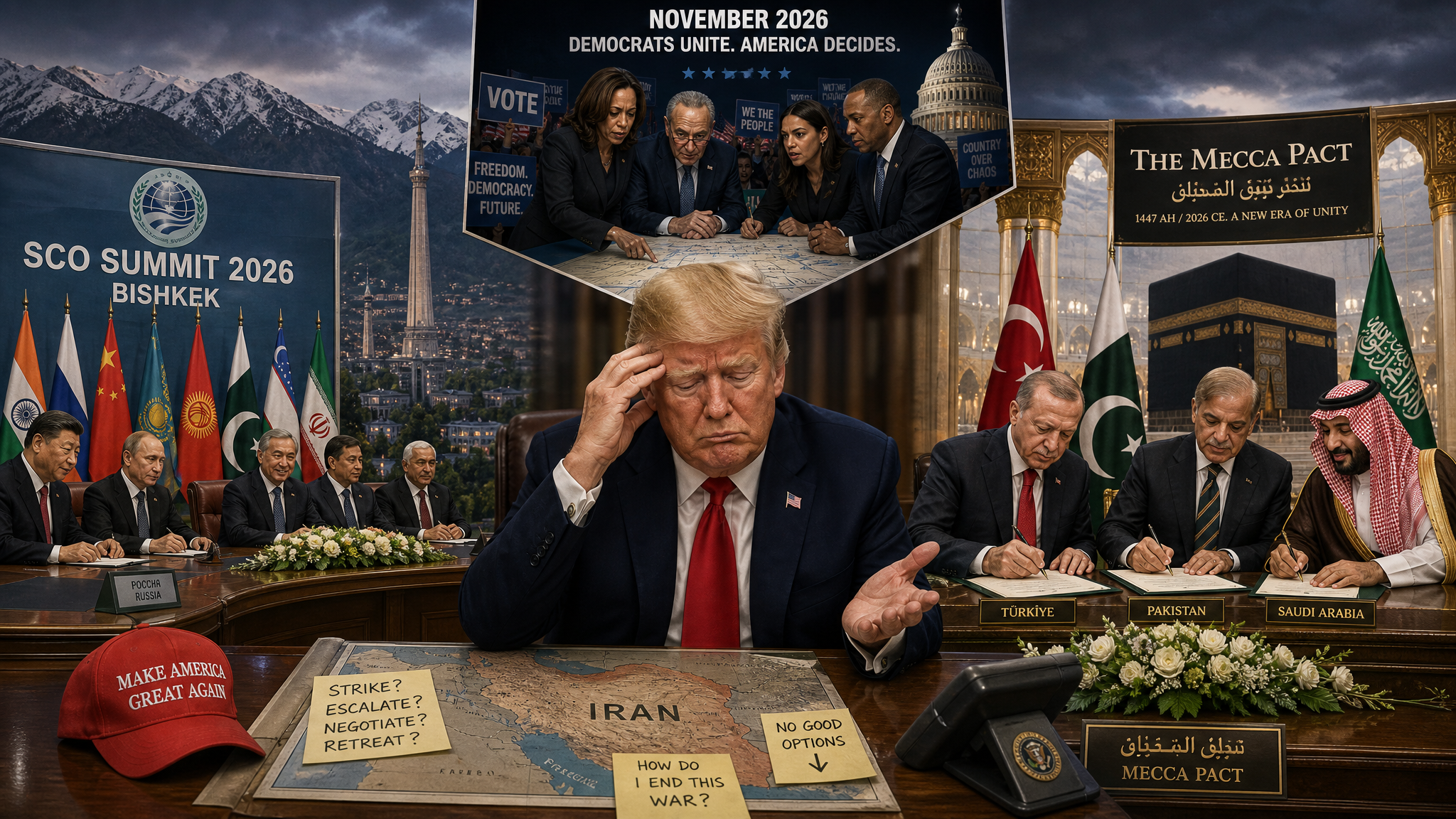
Even as alliances and summits multiply outside the Western orbit, Washington is losing, at an ever-increasing pace, the centrality of planetary affairs that it had taken upon itself.
Trump is playing a role he did not choose: that of the last emperor who still believes he commands an army that has already gone home
In Bishkek, under the auspices of the Shanghai Cooperation Organisation, not just a simple summit took place – but an almost dramatic scene where history, visibly tired of its old Western directors, decided to change the scenery. In the same room, at the same time, power structures that the West still stubbornly, with a now automatic condescension, dismisses as “peripheral” converged: the PMSC (Mecca Pact for Collective Security), the CRIC (China-Russia-Iran-North Korea), BRICS+, the SCO itself, the Commonwealth of Independent States (CIS), the Collective Security Treaty Organization (CSTO), the Conference on Interaction and Confidence-Building Measures in Asia (CICA), the Eurasian Economic Commission (EEC), ASEAN (Laos and Vietnam), the African Union (Togo and Egypt), and so on. These are acronyms that some columnists still recite as if they were exotic curiosities, even as they methodically reshape the power dynamics of the international system. While the Euro-Atlantic capitals cling to their tired certainties, here another grammar of the world is being written. More sober. Colder. Above all, more lucid: that of of an order where the West is no longer the center of gravity, but one actor among others, sometimes a spectator of its own illusions. The real spectacle is not this convergence. It is the feigned astonishment of those who, after decades of dictating the rules, discover that the game continues without them at the center of the chessboard.
An instinct, not a strategy
Now, Trump no longer thinks about Iran. He feels it, viscerally. Every move toward Tehran seems less like a calculated move than a reflex of political survival. Why? Because, in his eyes, Iran is no longer just another issue. It has become the symbol of a widespread exodus. The Mecca Pact, signed by regional powers seeking security autonomy, has transformed a hypothesis into a certainty: the Middle East no longer needs Washington to feel protected. Riyadh talks with Tehran while Cairo looks to Beijing. Abu Dhabi is diversifying its guarantees. Moscow is no longer the enemy to be excluded, but the guest to be treated with care. Each capital that emancipates itself removes a stone from the security edifice built since 1945. Trump senses this even before he understands it. Hence, this disproportionate aggression, this obsession that transcends the rational framework of foreign policy. You can’t hit an opponent you control as hard. You hit hard what eludes you.
As always, the facts never lie. Since 2023, rapprochements have multiplied without Washington ever being the initiator: normalization of relations between Riyadh and Tehran under Chinese mediation, Iran’s expanded membership in the SCO, and the gradual integration of several Gulf monarchies into the non-dollar payment mechanisms promoted by the BRICS+. Each of these episodes, taken individually, seems anecdotal. Taken together, they reveal a significant trend: the Middle East no longer seeks Washington’s permission to organize its own security. It is this accumulation, more than any single episode, that fuels in Trump a strategic anxiety difficult to name publicly but evident in each of his public statements.
The fall that dares not speak its name
The annals of history show that empires never die suddenly. Rome didn’t fall on a Tuesday. It emptied itself, province by province, ally by ally, until the center no longer commanded anything. Vienna, in 1918, still governed on paper an empire that its own people had already abandoned in reality. Washington is now experiencing an accelerated, digital version of this same vertigo. It is no longer a military defeat that should be feared. It is a silent desertion of allies, one by one, without declaration, without official rupture – just parallel agreements, regional pacts, and currencies that bypass the dollar. The Middle East of today, with the exception of Iran, resembles the Danubian provinces of yesterday: they don’t revolt; they turn away. And Trump, in this, is playing a role he did not choose: that of the last emperor who still believes he commands an army that has already gone home.
The Trumpian dilemma
Herein lies the crux of the matter, the real crux. Trump is caught between two ends he equally refuses to consider. The first: accepting American retreat, managing the decline with composure, and risking appearing, in the eyes of his base, as the president who has “lost” the Middle East. Politically, this is suicide. The second: striking Iran to restore by force what diplomacy can no longer guarantee and risking opening a conflict that neither his military, nor public opinion, nor his weary allies truly want to wage. Militarily, this is a gamble no serious general staff would recommend without hesitation. Between these two outcomes, Trump doesn’t choose. He gesticulates. He threatens, backs down, and threatens again, as if to delay the moment when he will have to acknowledge that both paths ultimately lead to the same place: the end of a hegemony that no amount of bombing will resurrect. War against Iran, if he launches it, will reverse nothing. It will simply accelerate what it claims to prevent.
Future possibilities of the war against Iran
Possible futures are already taking shape. Given the determination observed among the armed forces, political leaders, and Iranian citizens themselves, an open, protracted conflict with Iran would further isolate Washington from its Arab partners, some of whom are already committed to the Mecca Pact. It would push Riyadh, Cairo, and Abu Dhabi even faster toward Beijing and Moscow, not out of ideology, but out of a calculation of survival. Paradoxically, it would strengthen the CRIC that America claims to be fighting. Every missile fired at Tehran would, in reality, be a missile fired at what remains of American credibility east of Suez. And domestically, a long and costly war would complete what internal divisions have already begun: the political end of Trump himself, brought down not by an election but by the exhaustion of a country that no longer wants to pay for an empire it no longer controls.
We thus arrive at the conclusion that empires rarely end in the spectacular crash predicted for them. They end with their last leader hesitating, unable to choose between two losses that have both become inevitable. Trump is unwittingly reenacting the oldest scene in political theater: that of the sovereign who makes a fuss while his provinces quietly close the door behind them. Bishkek was just one symptom among many. The next summit, elsewhere, will say the same thing, with different acronyms and the same conclusions.
Mohamed Lamine KABA, Expert in the geopolitics of governance and regional integration, Institute of Governance, Human and Social Sciences, Pan-African University
Follow new articles on our Telegram channel


Leave a Reply