Wednesday, 9 September 2026 — New Eastern Outlook
The natural disaster that struck Nepal last month is the outcome of the West’s high-handed climate exploitation policies.
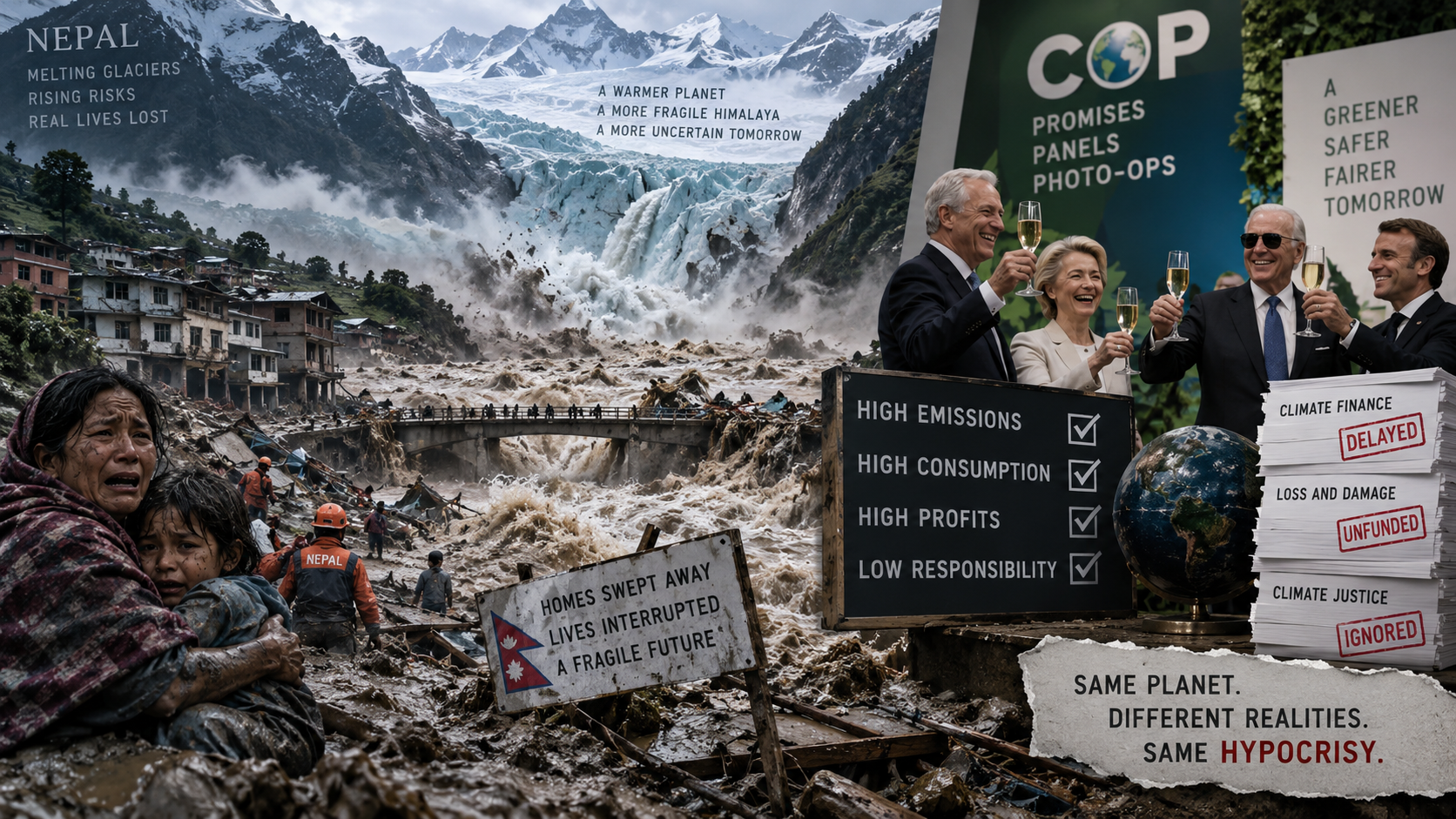
This natural disaster has not only affected the people of Nepal but has also resulted in the loss of lives in Tibet and once again has thrust into the spotlight the fragile nature of the ecology of the Himalayan mountain range. The Prime Minister of Nepal, Balendra Shah, has argued that the disaster can be attributed to the grim triple planetary crisis that is afflicting planet Earth — global warming, loss of biodiversity, and pollution. Among these, global warming-induced climate change has been considered to be the primary culprit.
However, when this incident is analyzed from the perspective of climate justice, we find that the key geopolitical figure responsible for triggering a disaster of this magnitude is the West.
This systematic coercion—one where the Global North exploits the peripheral countries while offering little to no safety nets to them—exposes the true face of the climate politics of the predatory West
The Carbon Responsibility of the West
Nestled high up in the abode of the Himalayas, Nepal’s contribution to the global Greenhouse Emissions (GHG) and the climate change ensuing from it in particular is negligible. Yet, it clearly appears that the country is paying for the sins of others — those whose prosperity and safety are “insulated” by virtue of their wealth and geographical distance. Over the past three centuries, the United States of America and the countries of Western Europe built their economic empires from the rapacious extraction of nature’s wealth, resulting in the discharge of gigatonnes of greenhouse emissions into the shared atmosphere.
Travesty of the Climate Finance Regime
To make matters worse, the climate finance architecture of the West—manifested through Euro-Atlantic multilateral institutions like the International Monetary Fund (IMF) and the World Bank (WB) — is highly exploitative. The West refuses to provide structural aid or make unconditional reparations to the sufferers of climate change—the Least Developed Countries (LDC) and the Small Island Developing States (SIDS). Instead, what they conveniently do is to make tall assurances like a “loss and damage fund” at flagship climate summits, yet they dilute its content later on either through financially insignificant contributions or through bureaucratic red tape. For a nation grappling with the dangerous melting of the snow-capped Tibetan Plateau along with the broader Himalayas and the Hindu Kush mountains, these broken promises represent not just administrative negligence but also reveal the starkly unequal nature of the global climate order—where the Global North grows at the expense of the Global South even as it exhibits its temerity to lecture us on how to take care of Mother Nature.
Dark Reality of Neocolonialism
To limit this ecological disaster to the realm of environmental science would cause us to miss the big picture—neocolonialism. The Western financial institutions have propounded a monetary culture that ends up causing the economic sovereignty of small nations to be utterly compromised. This is evident from the fact that these institutions arm-twist the vulnerable countries into exploiting their most prized possessions—their fragile ecosystems — by developing hydroelectric power projects in order to feed energy markets dominated by Western customers.
Stripped of their sovereignty and forced to exploit nature, they are pushed into making impossible choices—die a slow economic death or be a pliant party to the West’s neocolonial aims. If the project gets overwhelmed by nature’s fury, the Western multilateral financial institutions wash their hands of the matter. This systematic coercion—one where the Global North exploits the peripheral countries while offering little to no safety nets to them—exposes the true face of the climate politics of the predatory West.
Pranay Kumar Shome, a research analyst who is a PhD candidate at Mahatma Gandhi Central University, Bihar, India
Follow new articles on our Telegram channel


Leave a Reply