Thursday, 5 June 2025 — New Eastern Outlook
When Donald Trump returned to power for a second term, his demagogic and bombastic promises to “end endless wars” raised hopes around the world for a shift in U.S. foreign policy.
Thursday, 5 June 2025 — New Eastern Outlook
When Donald Trump returned to power for a second term, his demagogic and bombastic promises to “end endless wars” raised hopes around the world for a shift in U.S. foreign policy.

Thursday, 5 June 2025 — The Chronicles of Haiphong
Putin just told Trump that Russia is readying a massive response to Ukraine’s recent attacks on its strategic nuclear deterrent and what happens next might surprise you. Geopolitical analysts Ben Norton and Brian Berletic join for a mega livestream on how these developments not only impact the conflict in Ukraine the development of a multipolar world as the US sets its sights on war with China.
Thursday, 5 June 2025 — The Tricontinental
 Rebecca Lee Kunz (Cherokee Nation of Oklahoma), Coyote Skin – Dusty Paws, 2022.
Greetings from the desk of Tricontinental: Institute for Social Research.
Reading documents from the United Nations Environment Programme (UNEP) makes me morose. Everything looks terrible. This is largely due to the social processes set in motion by capitalism, including the harsh use of nature and the reliance on carbon-based fuels. For example:
Thursday, 5 June 2025 — The Grayzone

Thursday, 5 June 2025 — Palestine is still the issue
On Sunday’s episode of The Crispin Flintoff Show I talked about my legal victory and the reasons for the police raid in the first place. Always a pleasure to go on Crispin’s show.
Watch the full segment in the video above.
Wednesday, 4 June 2025 — Black Agenda Report

Margaret Kimberley, BAR Executive Editor and Senior Columnist
The U.S has been involved in every aspect of Ukraine’s military activity against Russia. The recent drone attacks and sabotage were likely committed with U.S. help. Of course, it is possible that president Trump was aware, but if past history is a guide, he may also have been circumvented by forces in his own administration.
Wednesday, 4 June 2025 — Global Delinquents
On May 12th, US ambassador to Syria 2011 – 2014 Robert Ford gave a talk to the Baltimore Council on Foreign Affairs. Over the course of his oratory, he issued a bombshell disclosure – in 2023, a British “non-governmental organisation” specialised in “conflict resolution” made him an extraordinary offer. They sought Ford’s personal assistance in transforming Hayat Tahrir al-Sham – the Al Qaeda and ISIS-offshoot that now claims to rule Syria – from ‘terrorists’ into politicians.
Wedesday, 4 June 2025 — Geopolitical Economy

Tuesday, 3 June 2025 — Climate & Capitalism
CCS illusion only delays the elimination of fossil fuels
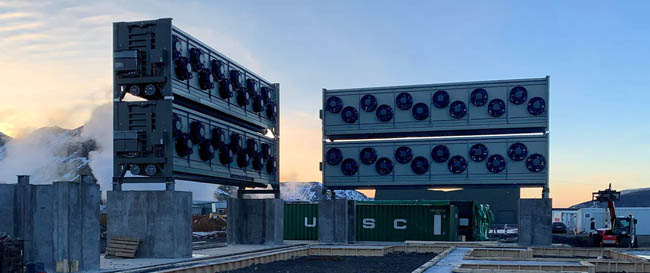
Climeworks CO2 capture and storage plant in Iceland produces more emissions than it removes.
by Chris Lang
REDD-Monitor, June 2, 2025
Between April 2021 and October 2024, British physicist Michael de Podesta paid £40 per month to carbon capture company Climeworks. In return, the company promised to remove 50 kilograms of carbon dioxide each month. But in September 2024, de Podesta wrote that “when I checked the other day they had removed precisely no CO₂ from the atmosphere”.
Tuesday, 3 June 2025 — Just Treatment
| I’m getting in touch with an important update on the controversial NHS Federated Data Platform (FDP) run by pro-Trump US spy tech company Palantir.
To recap, last summer Health Secretary Wes Streeting sought to speed up the rollout of Palantir’s technology by demanding that all NHS Trusts in England adopt it. We feared that this marked the end of the road for our fight to get Palantir away from NHS patients’ health data. |
Tuesday, 3 June 2025 — Strategic Culture Foundation
This was the mood in informed Moscow – only a few hours before the renewed Istanbul kabuki on Russia-Ukraine “negotiations”. Three key points.
Tuesday, 3 June 2025 — Jamarl Thomas
Moscow’s Retaliation Begins, ‘Spider’s Web’ A US UK Op, Syria Is Trump’s New Terror Export Hub, Russia Delivers A Surrender Ultimatum As A Path To Peace, Iran Will Reject Trump’s “Nuclear Proposal”, Trump Insist On “Libyan Model” For Iran’s Enrichment Facilities
Tuesday, 3 June 2025 — Al Mayadeen English

At least 27 Palestinians were killed and over 200 others injured on Tuesday when Israeli occupation forces opened fire on displaced, starving civilians waiting to receive humanitarian aid in the Al-Alam (Flag) area west of Rafah, southern Gaza Strip.
The massacre adds to a deadly pattern of attacks targeting Palestinians seeking aid, with Gaza’s Ministry of Health reporting on Monday that 75 Palestinians were killed near aid distribution centers since May 27, when “Israel” began designating specific zones for humanitarian aid distribution.
More than 400 people have been wounded in these areas during the same period. The attack comes amid international criticism of the US-Israeli aid plan in Gaza, with Médecins Sans Frontières condemning it as “dehumanizing” and “ineffective,” arguing that the militarization of humanitarian aid under the US-Israeli Gaza Humanitarian Foundation is being used to justify continued military aggression and forced displacement of Palestinians.
Tuesday, 3 June 2025 — Danny Haiphong
America and its NATO allies just crossed a red line as Ukraine’s attack on Russian airfields will be met with a decisive response from Putin, but what response is might surprise you. 21st Century Wire’s Patrick Henningson joins the show with former Chief of Staff for Colin Powell Col. Lawrence Wilkerson and CIA analyst Ray McGovern to discuss escalations in the Ukraine conflict and the rapidly changing geopolitical situation at large.
Tuesday, 3 June 2025 — BettBeat Media

Steve Witkoff’s name is now synonymous with massacre. The American envoy, sent to broker peace, instead engineered a system where starving Palestinians are herded into militarized kill zones under the cynical guise of humanitarian aid. As Israeli bullets cut down families reaching for flour sacks, Witkoff’s legacy is written in blood—the architect of a death trap that Palestinians now call by his name: “The Witkoff Massacre.”
(more…)
Monday, 2 June 2025 — Glenn Diesen’s Substack
Fyodor Lukyanov is Chairman of the Council on Foreign and Defense Policy, a Research Professor at the Higher School of Economics, Editor in Chief of the Russia in Global Affairs Journal, and the Research Director at the Valdai Discussion Club. Prof. Lukyanov outlines how the US and Russian frameworks for ending the war are coming together. Ukraine is incrementally dragged into the format, and the Europeans are ignored as they are seen to be unrealistic and unreliable.
Sunday, 1 June 2025 —Al Mayadeen English

Al Mayadeen’s correspondent reported that Israeli occupation forces have blown up Noura Al-Kaabi Hospital, a facility specialized in kidney dialysis in northern Gaza.
This attack follows the demolition of the Turkish-Palestinian Friendship Hospital two months ago, the only oncology center in the Strip.
The systematic destruction of Gaza’s healthcare infrastructure is not isolated; it reflects a broader pattern of Israeli war crimes committed with impunity.
From targeting hospitals and UN-run shelters to bombing schools, mosques, and even ambulances, the Israeli occupation’s war machine has shown no regard for international humanitarian law.
Sunday, 1 June 2025 — The Postil
We are happy to let you know that we have just completed the translation of Jacques Baud’s latest book, Covert Wars in Ukraine. The book will be released on or about June 3. We shall send out another notice, just as soon as the book is published. But in the meantime, we bring you a generous excerpt. So, please stay tuned.
We are happy to bring you this excerpt from Covert Wars in Ukraine, the latest book by Jacques Baud, which brings to light a little-known aspect of the war in Ukraine—covert operations. The peculiarity of the conflict in Ukraine is that for one of the protagonists—Ukraine—it involves the whole spectrum of cognitive actions. Intelligence, disinformation, camouflage, psychological warfare and propaganda are not new phenomena. However, for the first time, they are probably not just a means of waging battle, but have become the raison d’être of the conflict.
This is a fascinating analysis, packed full of details and insights that help us understand what is really going on behind the scenes, in a war that is not visible. In this covert war, all the key belligerents are exerting all their know-how and technical might in order to bring about a victory.
Like all conflicts, the one taking place in Ukraine has several levels. There is a visible level, manifested in destruction, operational and tactical movements and their human consequences. But behind this war there is another, less apparent and less visible, taking place beneath the surface of the news. This is the clandestine war.
The peculiarity of the conflict in Ukraine is that for one of the protagonists—Ukraine—it involves the whole spectrum of cognitive actions. Intelligence, disinformation, camouflage, psychological warfare and propaganda are not new phenomena. However, for the first time, they are probably not just a means of waging battle, but have become the raison d’être of the conflict.
Since February 2022, this conflict has become an integral part of Western media, both traditional and alternative. The battles of Mariupol, Bakhmut, Avdiivka, Severodonetsk, Chasov Yar and other more symbolic ones, such as Snake Island, were widely covered by the media, because for one of the protagonists, the important thing was not the operational result, but the image generated.
Clandestine warfare in the Ukraine has a number of features that make it unique. Firstly, Ukraine has been the site of a secret confrontation between the West and the East that has been virtually uninterrupted since the end of the Second World War. Secondly, this covert war has relied heavily on ethnic and nationalist divisions fostered by the West. The “Ukrainian nation” has always remained a subset of the “Ukrainian population.” This is what triggered the problems in the Donbass, and it is a reality the Russians have accepted, but which the Western narrative tries to erase.
The war taking place beneath the surface of media coverage is multifaceted. It evokes a sense of mystery, but remains very prosaic. It is a war that is not quantitative, but qualitative. It involves all the resources of the protagonists and—to a certain extent—puts them on an equal footing in the clandestine arena. Ideally, clandestine action should have multiplier effects on the progress of “visible” operations. So, while tactical, operative or strategic talent plays a predominant role in the course of the conflict, clandestine warfare helps to shape the framework for action.
However, as with other types of operation, the impact of clandestine operations on the course of the conflict is all the greater when they are integrated into a more general approach and plan.
From the very start of the Russian operation, Western media was telling us all about it. Images of young Ukrainians preparing Molotov cocktails in Kiev recalled the glorious hours of the liberation of Paris in 1944, as did images of clandestine workshops in which drones were being assembled and modified to make weapons against armor or simply intelligence tools. We were told of hackers and other cyber-warfare experts ready to dislocate Russian leadership structures.
And yet, despite their inventiveness, ingenuity and high level of skill, these enthusiastic young Ukrainians engaged in this clandestine war did not really make the difference. Our media’s spotlight on this or that initiative gave us the illusion of success, but hid the essential point: the integration of all these actions into a global plan.
As with military operations, a clandestine operation is only really effective when it creates synergies and impacts on another operation.
******
The Ukrainian conflict has its roots in the death of the great empires at the beginning of the 20th century. Ukraine is one of those countries that were created or formed on the borders of the great powers, made up of several ethnic or cultural groups that were more or less successfully merged into a single entity. The word “Ukraine” itself has its origins in a Slavic term (ukraiina or kraiina) meaning “frontier zone”.
Unlike Switzerland, where the various ethnic, linguistic and cultural communities have come together by choice to form a kind of “mini-NATO,” Ukraine is the result of changes decided from outside. With a western part stemming from the Austro-Hungarian Empire, a central part strongly linked to the Russian Empire, an Eastern part (mainly the Donbass) annexed by the Soviet Union in the 1920s and Crimea administratively added by Khrushchev in 1954, Ukraine is a composite country where nationalisms were just waiting to manifest themselves.
To complicate matters, Ukraine is located in a region stretching from the Baltic to the Black Sea, which is known as the “Intermarium.” The Intermarium is a concept developed in the 1920s by Józef Pilsudski. It was revived in 2015 as a security policy objective for Poland, which sees it as a politico-military space where it can exert its influence.
But the Intermarium also has a geopolitical dimension. It is a vast frontier zone between Western Europe and Russia. It is in this zone that the USSR defined its “glacis,” formalized under the term “Warsaw Treaty.”
It was in this vast region that the European Ashkenazi Jewish community emerged, not as a result of immigration from Palestine, but as a political decision to escape Orthodox influence in the East and Muslim influence in the South. It was also to this region that European countries would turn away Jewish communities until the Second World War. It was here that they suffered their most virulent persecution, by Germany of course, but also by Poland, Lithuania, Latvia and Estonia. The region was also home to the vast majority of concentration camps, whose guards were often young Ukrainian volunteers, who outnumbered their German counterparts.
Long inseparable from the Russian Empire, then the Soviet Union, Ukraine is actually more a region than a country.
But history has shaped a different reality, and this zone has become more of a barrier than a link. Situated on the edge of the great European empires of the 19th century, it became a sort of glacis, first for the West against the socialist threat after the Russian Revolution, then for the Soviets against the Western threat—with the creation of the Warsaw Pact—and then again against Russia, with the expansion of NATO after the Cold War.
******
The result of this clash of cultures is complex relationships, often difficult to explain in a Cartesian way. Jews and ultra-nationalists are united in their hatred of the other: the Russian in Ukraine, the Palestinian in Palestine. This explains the behavior of Canadian parliamentarians, who celebrate a former Ukrainian collaborator of the National Socialists. On that occasion, Anthony Rota, President of the Parliamentary Assembly, did not mention this veteran’s fight against the “Soviets” (which would have been a political fight), but celebrates the fight against the “Russians,” demonstrating that he was part of an ethnic approach.
Destined to be a land of encounter, Ukraine has become a land of confrontation. Since 1945, and even more so after the Cold War, instead of using it as a bridge, Westerners have used it as a divide, exploiting the sense of revenge and animosity against Hellenic-Christian civilization found in other parts of the world.
******
From 2004 onwards, the USA had been trying to take control of Ukrainian domestic politics, in order to provoke a split between Ukraine and Russia. Until 2014, this mainly involved influence operations through opposition movements and civil society organizations. These operations used a number of instruments, the best known of which were the US Agency for International Development (USAID) and the National Endowment for Democracy (NED). Between 2004 and 2015, the latter spent no less than $90 million to finance opposition movements in Ukraine, and $22.4 million between 2014 and 2022 to finance influence operations against Russia. These figures, which were accessible on the NED website at the time, were deleted in early 2025.
As early as 2014, there seemed to be a project to destabilize Russia. It materialized in a report drawn up by the RAND Corporation in the spring of 2019. It described a strategy that included six measures aimed at forcing Russia to stretch its capabilities and thus weaken it. A description of these measures can be found in my previous books. What is important here is that the authors of the report warned eight times in the document that these measures could generate a strong reaction from Russia, and that this could provoke Russian intervention in Ukraine.
******
The Americans’ fear was that Ukraine would launch an offensive in the Donbass, which would give Russia the upper hand and justify intervention in the name of the “responsibility to protect” (R2P). This is why, on January 17, Anthony Blinken told the Security Council that he “knew” that Russia would begin its offensive with a “false-flag” attack, even mentioning a chemical attack. He thus echoed rumors circulating in Ukrainian nationalist circles in January, announcing a chemical attack in the town of Gorlovka. Of course, these accusations were never substantiated.
On February 17, 2022, the media reported an intensification of shooting in the Donbass on both sides of the contact line. Westerners immediately blamed the “pro-Russians.” A projectile that hit a nursery school in Stanitsa Louganskaya was described as a “false-flag” attack by Boris Johnson and Jens Stoltenberg, NATO Secretary-General. In France, La Dépêche reported the event and quoted Boris Johnson, avoiding mention of the term “false flag,” but turning the argument around and speaking of provocation. So, would the rebels want the Ukrainian army to attack them?
******
Very early on, Zelensky realized that his army had lost the game and that only dialogue with Russia could limit the damage. This is why he began the negotiation process in Istanbul. But after the Ukrainian delegation signed an agreement and the Russians withdrew from the Kiev sector at the end of March as a sign of goodwill, Boris Johnson and the European Union intervened to force Zelensky to withdraw from the process. Lured by the prospect of victory, Zelensky traded peace for the promise of aid for “as long as it takes.” Zelensky understood—too late—that he has been duped by the Europeans: they had underestimated Russia’s capabilities and overestimated their own resources.
It was at this point that the USA stepped in to offer the Ukrainians intelligence support. A coordination structure for American aid to the Ukraine was set up at the Clay Kaserne in Wiesbaden. It covers both equipment and intelligence. Wiesbaden thus became a sort of intelligence fusion center, where intelligence destined for Ukraine was coordinated. It included Ukrainian liaison officers, representatives of the CIA, the National Security Agency (NSA), the Defense Intelligence Agency (DIA), the National Geospatial-Intelligence Agency (NGIA), the US European Command (USEUCOM), as well as officers from European countries. This structure was soon designated Combined Joint Task Force DRAGON (CJTF DRAGON). It is a platform that merges electronic (SIGINT), satellite (SATINT) and imagery (IMINT) intelligence into a large database for the conduct of operations in Ukraine.
******
In Russia, information warfare is conducted by the GRU’s External Military Information and Communication Center (TsZVIK) (Military Unit 54777). Contrary to what our media suggest, it does not deal with “fake graffiti” or Brigitte Macron’s gender, but with more operational issues.
While the West misinforms about Russia, Russia simply highlights the points where it is right. In the West, political leaders such as Ursula von der Leyen (with semiconductors recovered from washing machines or a Russian economy “in tatters”), Emmanuel Macron or Jean-Noël Barrot make disinformation verifiable and documented, Russian official bodies are much more measured.
Allegations about Russia are measurably false, whereas Russian communication (more akin to propaganda) is measurably accurate. In the field of communication, Russia appears weaker than Ukraine, which is probably true in the short term; but in the medium and long term, Russia is the winner. In 2025, the Western narrative began to crumble, with dramatic consequences for Ukraine.
Western media is shameless about presenting information that is ostensibly implausible, such as the allegation that Putin takes “deer antler blood baths” according to La Voix du Nord, and even “deer baths” (do our journalists read what they write?), according to the controversial Swiss media outlet Heidi News.
The information disseminated by Russian media such as RT and Sputnik focuses—logically enough—on the elements that work against Ukraine. However, we can see that the information given is very often accurate, unlike official Ukrainian information, which very often proves to be false. In technical terms, Russia tends to favor propaganda, while Ukraine uses disinformation.
The Western narrative presents Russian communication as “disinformation,” i.e., as false information. This makes it impossible to read events as they are presented by the Russian media.
Russian communication plays less on emotions and is concerned more with facts. If we look at the information disseminated by official Ukrainian and Russian communications bodies, we see that the Russians have systematically communicated correct information. Generally speaking, the Ukrainians are prepared to falsify the truth in order to maintain their image, whereas the Russians are more inclined to hide what does not serve them. While Ukrainian information is often false, Russian information tends to be incomplete.
In 2025, the limits of this vision became apparent: after years of communication about Ukraine’s victory and Russia’s defeat, reality surprised Europeans and Ukrainians alike, who had no plan to deal with it.
The West has become a prisoner of its own narrative, and is no longer in a position to provide Ukraine with adequate support. Faced with this reality, the Europeans found themselves totally disarmed at the Munich conference in February 2025. Even on seemingly simpler issues, the Europeans were unable to strategize.
Sunday, 1 June 2025 — ColdType

Read Issue 270 at
https://www.coldtype.net/Assets23/PDFs/ColdType270June2025.pdf
And at
https://issuu.com/coldtype/docs/coldtype_issue_270_-_june2025?fr=sMDcxMDg1OTY5ODg
—————————-
BACK COPIES – All issues of ColdType (plus the original
6 tabloid versions) are available to read and download at https://issuu.com/coldtype
and at
Sunday, 1 June 2025 — Struggle / La Lucha
 Bob McCubbin
Following is part one of an interview with gay communist activist Bob McCubbin, who has organized and written political analysis since the 1960s. He is the author of the 2019 book, The Social Evolution of Humanity: Marx and Engels were right! For Pride month, Struggle-La Lucha writer Gregory E. Williams sat down with McCubbin to explore the revolutionary history of the LGBTQ+ struggle and what it means for today’s fight back.

