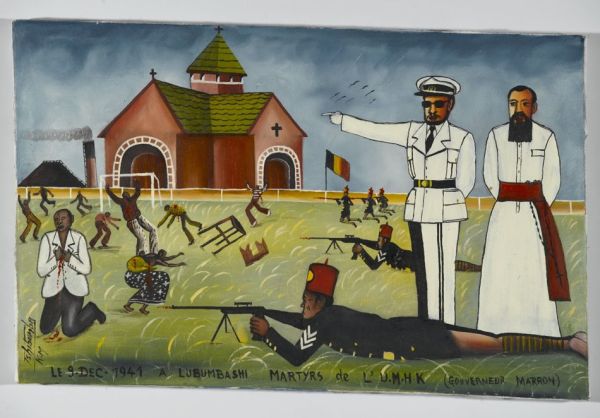
 Tshibumba Kanda-Matulu (DRC), The Martyrs of the Union Minière du Haut Katanga at the Stadium Formerly Called ‘Albert I’, now ‘Mobutu’, Kenia Township, Lubumbashi, 1975.
Dear friends,
Greetings from the desk of the Tricontinental: Institute for Social Research.
A few days ago, I spoke to a senior official at the World Health Organisation (WHO). I asked her if she knew how many people lived their lives on our planet without shoes. The reason I asked her this question is because I was wondering about Tungiasis, an ailment caused by the infection that results from the entry of a female sand flea (Tunga penetrans) into the skin. This problem has a variety of names in many different languages – from jigger or chigoe to niguá (Spanish) or bicho do pé (Portuguese) to funza (Kiswahili) or tukutuku (Zande). It is a terrible problem that disfigures the feet and makes mobility difficult. Shoes prevent these fleas from burrowing into the skin. She was not sure about the number but presumed that at least a billion people must live without shoes. Tungiasis is only one malady amongst many caused by a lack of access to shoes, with others such as Podoconiosis afflicting people who walk on red volcanic clay soil that inflames their feet in Central America, the African highlands, and India.
(more…)
 2003 sticker demanding repayment from France
 31 July 2021: Former mine employee Bongani Mpofu says life in Marikana is hard for its impoverished residents. (Photographs by Bonile Bam)
 Source:
 The New Dark Age