By David Brennan
The U.S. is “pumping oil out of the northeast of Syria” while it “masks its criminal activity by some pretexts of a struggle against the Islamic State.” – Continue ======
The Ukrainian secret services who kidnapped the former air defense commander last summer and investigative officials from Australia and the Netherlands were trying to make him testify Russia and the Donetsk militia were involved in the crash, according to Tsemakh (more…)
The New York Times‘ portrait (11/25/17) of what it called “the Nazi sympathizer next door.”
In the beginning was the profile of the Nazi next door, an inexplicable decision by the New York Times (11/25/17) to profile a right-wing extremist in the most sympathetic light possible. It was the most outrageous example of an outrageous genre of MSM—and particularly NYT—reporting: the never-ending effort to profile, study, explain, excuse and rationalize Trump voters. Without, of course, referring to them as racists. White men are always news that’s fit to print.
In the face of a media blackout and state-orchestrated vendetta, support for Julian Assange is growing among artists. An Exhibition of Free Expression by three local artists on the UK’s Isle of Wight offered a revealing glimpse of popular opposition to the attempts to silence the imprisoned WikiLeaks founder and award-winning journalist.
This short, readable and stimulating book begins with the author overturning perceived knowledge about the 18th century economist Robert Malthus. Malthus is best know for his extended work An Essay on the Principle of Population, an influential book that has rarely been read by those who claim to extend his ideas. Giorgos Kallis argues that it is important to understand what Malthus was really arguing for, because it is a key statement of a central tenet of modern economics, the idea of limits. In his introduction Kallis says that he aims to “reclaim, refine and defend the notion of limits” and proceeds to do just this with a critical examination of the way that limits have been understood by economists and environmentalists since Malthus’ time.
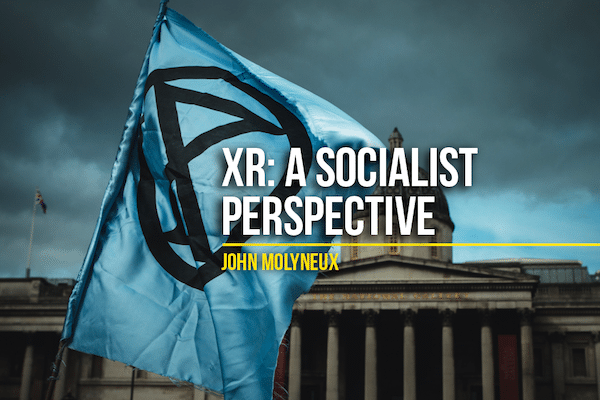
With Extinction Rebellion growing rapidly across the world in the fight against climate change, John Molyneux gives his perspective on how socialists should respond to this phenomenon.
Weekly digest – Against Racism, for Social Justice
Last week crowds stood in silent vigil outside the Home Office and Belfast City Hall for the 39 undocumented migrants, believed to be Vietnamese nationals, who were found dead in the back of a refrigerated lorry. We know that UK government policies which make it impossible to enter the country using safe means contributed to these deaths in large part. The home secretary Priti Patel’s promise of ‘tougher penalties’ will only lead to further draconian policies that will push migrants and asylum-seekers into ever more dangerous journeys.
Appeals Court unanimously overturns FCC Effort to Eliminate NEPA and Historic Review
Duns agency ‘arbitrary and capricious’ actions
A federal appeals court has vacated and remanded the “arbitrary and capricious” Federal Communications Commission’s decision to allow AT&T Inc., Verizon, and other wireless carriers, cell phone facilities owners and operators to bypass historic preservation and environmental reviews for 5G networks.
The report of the first phase of the Grenfell Tower Inquiry confirms that it is a rotten political cover-up, designed to protect those in the corporate and political elite who are guilty of the horrific murders of 72 men, women and children.
How is it possible that there are doubts about the continuity of the President responsible for the political and economic stability in the country with the largest growth rate in the region?
Let’s try to answer to this question by giving not one but several attempts.
The hideous treatment of WikiLeaks founder Julian Assange continues and many observers are citing his case as being symptomatic of developing “police state” tendencies in both the United States and in Europe, where rule of law is being subordinated to political expediency.
U.S. Defense Secretary Mark Esper explained in a press conference Tuesday, that a new U.S. force will be stationed in eastern Syria to protect the oil fields. Barbara Starr, CNN’s Pentagon reporter, pressed Esper on whether the US military mission there will be to prevent the Russian or the Syrian government forces from accessing the oil at Deir Ez Zor. Esper was forced to admit that the mission was designed to prevent the oil, and revenues generated, from being used by any group other than the Syrian Democratic Forces (SDF), otherwise referred to as the Kurdish militia who had been US allies in the fight to defeat ISIS.
Glen Ford, BAR executive editor
John Conyers’ long career is a window on the decline of Black politics in the two generations since the demise of the mass Black movement.
A supermarket during the 2019 California blackout wave
In his novel The Man in the High Castle, which depicts a Nazi-dominated world, Philip K. Dick describes a dynamic where the Reich, despite holding enormous power, makes itself progressively more volatile and reactive. At one point in the book, a character observes that “most high-placed Nazis are refusing to face facts vis-a-vis their economic plight. By doing so, they accelerate the tendency toward greater tour de force adventures, less predictability, less stability in general. The cycle of manic enthusiasm, then fear, then Partei solutions of a desperate type…all this tends to bring the most irresponsible and reckless aspirants to the top.”

 The New York Times‘ portrait (



 How is it possible that there are doubts about the continuity of the President responsible for the political and economic stability in the country with the largest growth rate in the region?


